
EUTECNIQ Sciences

See every page on one mapArrow keys move through results · Enter opens · Esc closes

Extraction & purification Peer-reviewed methods NIST, NIOSH and ICH data Educational models Proposed capability

Extraction decides what leaves the plant, and the method decides how fast, how hot and what solvent stays behind

Extraction methods, supercritical CO₂ physics, solvent recovery and solvent safety, for readers who must judge a process, not only a yield.

Status. EUTECNIQ owns no extraction equipment and has run no extractions. Laboratory extraction is planned for Phase I, pilot extraction and solvent recovery for Phase II (platform plan). Calculators are educational models.

Related: published LCAs of extraction routes · CHEM21 solvent greenness · residual-solvent limits in 21 CFR 173 · solvents across five activity-coefficient axes

629 → 910kg/m³: CO₂ density at 40 °C as pressure rises from 10 to 30 MPa
30.98 °Cand 7.38 MPa: the critical point of CO₂, above which it is a supercritical solvent
25 ppmhexane residue allowed in spice oleoresins (21 CFR 173.270)
13 °Cflash point of ethanol: its vapor can ignite at room temperature

Span and Wagner, J Phys Chem Ref Data 1996 (via CoolProp; matches NIST WebBook); eCFR, 21 CFR 173.270, October 2026; NIOSH Pocket Guide, ethanol.

Grinding, solvent and pressure set the yield, the purity and the residue

  1. Grinding sets the pace. Broken cells release their contents fast. Intact cells leak slowly, by diffusion.
  2. CO₂ is a tunable solvent. At 40 °C, raising the pressure from 10 to 30 MPa makes CO₂ 45% denser, and its dissolving power rises steeply with density.
  3. A laboratory yield is not a plant cost. Solvent-to-feed ratio, the energy to recover solvent, cycle time, downstream purification and the fire-safety class of the solvent decide the cost per kilogram.
How it works

Solvent gets in, actives dissolve, then they get out: fast from broken cells, slowly from intact ones

Milling opens the cells on each particle's surface. Their contents wash out quickly. Cells deeper inside stay closed, so their contents must cross cell walls first.

One ground particle, and the yield curve it producesIllustrative schematic and model
Broken-and-intact-cells concept: Sovová H. Chem Eng Sci. 1994;49(3):409–414. Curve: the simplified two-period form described under the extraction-curve explorer below, with invented parameters.

Finer grinding opens more cells, so more of the yield arrives in the fast first phase.

Explanation, details and sources

The five steps a solvent goes through, in order:

  1. GrindMilling breaks cells open on each particle's surface.
  2. WetSolvent soaks into the particle's pores.
  3. DissolveActives dissolve until the solvent is saturated or they run out.
  4. Wash outFree solute from broken cells leaves quickly.
  5. Diffuse outSolute in intact cells crosses cell walls slowly.

Why it mattersParticle size and grinding are cheap levers. The Science lab diffusion calculator shows the slow tail: halve the particle size and it runs four times faster.

Six methods

Six ways to get actives out of a plant, each trading time, heat and solvent

Schematics, not to scale Hover a part for detail.

Maceration and percolation

How it works, conditions, strengths and limits
How it works
In maceration, ground plant soaks in solvent. In percolation, solvent flows through a packed bed, so saturated solvent is constantly replaced by fresh solvent.
Typical conditions
Room temperature, atmospheric pressure, long contact times, large solvent volumes. Published example: soak 24 h in 70% ethanol, then percolate with 20 times the herb's amount of 70% ethanol.
Strengths
Simple equipment; no heat, so suited to heat-sensitive components.
Limits
Long extraction time and low efficiency; high solvent use.

Zhang et al. 2018 (Table 1 and text); Nayak et al. 2026 (Table 1)
Soxhlet extraction

How it works, conditions, strengths and limits
How it works
Solvent boils, condenses and drips onto the plant in a porous thimble. When the chamber fills, a siphon drains it back to the flask. The plant always meets freshly distilled solvent.
Typical conditions
Organic solvents boiled in the flask, atmospheric pressure, long runs, moderate solvent volume.
Strengths
Automatic and continuous; less time and solvent than maceration or percolation.
Limits
Heat and long runs raise the risk of degradation. With tea, Soxhlet at 70 °C recovered less total polyphenol and alkaloid than maceration at 40 °C.

Zhang et al. 2018 (Table 1 and text)

Ultrasound-assisted extraction

How it works, conditions, strengths and limits
How it works
Ultrasound (above 20 kHz) makes tiny bubbles form and collapse in the solvent. The collapse breaks and erodes plant tissue, which speeds up dissolving and diffusion.
Typical conditions
20–120 kHz and 20–700 W in published fruit and vegetable studies. Published example: 50% ethanol, 1:30 solid-to-solvent, 0.3 mm particles, 15 min.
Strengths
Short times at lower temperature; less solvent and energy; suits heat-sensitive compounds.
Limits
Too much intensity can degrade actives. Cavitation becomes uneven at large scale.

Kumar et al. 2021; Zhang et al. 2018; Nayak et al. 2026 (Table 1)

Microwave-assisted extraction

How it works, conditions, strengths and limits
How it works
Microwaves heat polar molecules such as water and ethanol (ionic conduction and dipole rotation). Moisture inside the plant heats up, so heat and mass move outward together.
Typical conditions
2.45 GHz microwaves; the solvent must absorb them (polar, such as water, ethanol or methanol). Published example: 80% ethanol, 25:1 liquid-to-solid, 1.5 kW, 7 min.
Strengths
Fast; less organic solvent; heats the plant material selectively.
Limits
Uneven heating creates hot spots that can degrade actives. Limited penetration at 2.45 GHz makes large volumes heat unevenly.

Zhang et al. 2018; Nayak et al. 2026 (Table 1 and text)

Pressurized liquid extraction

How it works, conditions, strengths and limits
How it works
Pressure keeps the solvent liquid above its normal boiling point. Hot liquid solvent dissolves more, diffuses faster and penetrates the plant better.
Typical conditions
The U.S. EPA method (written for soils, sediments, sludges and waste solids) runs 100–180 °C at 1,500–2,000 psi (10.3–13.8 MPa) with 5-minute static steps.
Strengths
Much less time and solvent than older methods; better repeatability.
Limits
High temperature can harm heat-sensitive actives: Maillard reactions appeared at 200 °C with grape pomace. Specialized, costly equipment.

Zhang et al. 2018; U.S. EPA Method 3545A (2007); Nayak et al. 2026 (Table 1)

Supercritical CO₂ extraction

How it works, conditions, strengths and limits
How it works
Above 31 °C and 7.38 MPa, CO₂ diffuses like a gas but is dense like a liquid. Pressure tunes what it dissolves. Lowering the pressure drops the extract out, and the CO₂ can be recycled.
Typical conditions
Published example: CO₂ with 2% ethanol at 30 MPa (300 bar) and 40 °C, to extract vinblastine from Catharanthus roseus.
Strengths
Low critical temperature suits heat-sensitive compounds; CO₂ is non-toxic, inert and low-cost; little or no organic solvent; CO₂ leaves the extract as a gas.
Limits
CO₂ is non-polar, so polar actives need a co-solvent such as ethanol. High equipment cost, mainly from the high pressure.

Zhang et al. 2018; Tzima et al. 2023; Nayak et al. 2026 (Table 1); critical point: Span and Wagner 1996

Faster methods use energy (ultrasound, microwaves, heat, pressure) to speed up the same two steps: dissolving and diffusing.

Compare

No method wins on every axis: the molecule, the residue the product can tolerate and the scale decide

The matrix follows a published relative comparison. The table below it adds what sets selectivity, what drives cost and what limits scale.

Seven methods on four criteria: the fast, low-solvent methods pay in pressure or in heatPublished relative ratings
Seven extraction methods rated on time, organic solvent use, operating pressure and treatment of heat-sensitive actives, with each method's main reported limitationRelative ratings (Zhang et al.)Review textShort extractiontimeLow organicsolvent useOperatingpressureGentle onheat-sensitiveactivesMain reported limitationMacerationMaceration: time longMaceration: organic solvent use largeMaceration: atmospheric pressureAtmosphericMaceration: heat-sensitive actives suitedLong time, low efficiencyPercolationPercolation: time longPercolation: organic solvent use largePercolation: atmospheric pressureAtmosphericPercolation: heat-sensitive actives suitedSlow; high solvent useSoxhletSoxhlet: time longSoxhlet: organic solvent use moderateSoxhlet: atmospheric pressureAtmosphericSoxhlet: heat-sensitive actives degradation risk statedHeat and long runs can degrade activesPressurized liquidPressurized liquid: time shortPressurized liquid: organic solvent use small or nonePressurized liquid: high pressureHighPressurized liquid: heat-sensitive actives degradation risk statedHigh temperature; specialized equipmentSupercritical CO2​Supercritical CO_{2}: time shortSupercritical CO_{2}: organic solvent use small or noneSupercritical CO_{2}: high pressureHighSupercritical CO_{2}: heat-sensitive actives suitedPolar actives need a co-solvent; high equipment costUltrasound-assistedUltrasound-assisted: time shortUltrasound-assisted: organic solvent use moderateUltrasound-assisted: atmospheric pressureAtmosphericUltrasound-assisted: heat-sensitive actives suited, with a stated riskHigh intensity can degrade actives; uneven cavitation atscaleMicrowave-assistedMicrowave-assisted: time shortMicrowave-assisted: organic solvent use moderateMicrowave-assisted: atmospheric pressureAtmosphericMicrowave-assisted: heat-sensitive actives degradation risk statedHot spots; uneven heating in large volumesFavorable: short, small or none, suitedModerate, or suited with a stated riskUnfavorable: long, large, degradation riskHigh operating pressure calls for pressure-rated equipment; for supercritical CO2​ it is the main source of the high equipment cost (Nayak et al.).
Time, organic solvent use and pressure: relative ratings in Zhang Q-W, Lin L-G, Ye W-C. Chin Med. 2018;13:20, Table 1. Heat-sensitive actives and limitations: the review text of Zhang et al. 2018 and Nayak A, et al. Ultrason Sonochem. 2026;124:107712, Table 1; Tzima S, et al. Molecules. 2023;28(3):1410.
Text version: the published relative comparison
Relative comparison of seven extraction methods
MethodPressureTimeOrganic solvent useCompounds reachedReported limitation
MacerationAtmosphericLongLargeDepends on the solventLong time, low efficiency (Zhang)
PercolationAtmosphericLongLargeDepends on the solventSlow; high solvent use (Zhang; Nayak)
SoxhletAtmosphericLongModerateDepends on the solventHeat and long runs can degrade actives (Zhang)
Pressurized liquidHighShortSmallDepends on the solventHigh temperature can degrade heat-sensitive actives; specialized equipment (Nayak)
Supercritical CO₂HighShortNone or smallNon-polar to moderately polarPoor for polar actives without a co-solvent; high equipment cost (Nayak; Tzima)
Ultrasound-assistedAtmosphericShortModerateDepends on the solventHigh intensity can degrade actives; uneven cavitation at scale (Nayak)
Microwave-assistedAtmosphericShortNone or moderateDepends on the solventHot spots; uneven heating in large volumes (Nayak)

Zhang Q-W, Lin L-G, Ye W-C. Chin Med. 2018;13:20, Table 1 and text. Nayak A, et al. Ultrason Sonochem. 2026;124:107712, Table 1. Tzima S, et al. Molecules. 2023;28(3):1410. Pills: relative ratings as given by Zhang et al.

[1] Zhang et al. 2018, Table 1 and text. [2] Kumar K, et al. Ultrason Sonochem. 2021;70:105325. [3] Nayak et al. 2026. [4] U.S. EPA SW-846 Method 3545A (2007). [5] Tzima et al. 2023. [6] Cheng Y, Xue F, Yu S, Du S, Yang Y. Subcritical water extraction of natural products. Molecules. 2021;26(13):4004; water's critical point: IAPWS-95 via CoolProp 8.0.0. [7] Puri M, Sharma D, Barrow CJ. Trends Biotechnol. 2012;30(1):37–44. [8] Cassano A, et al. Int J Mol Sci. 2018;19(2):351; Zhang et al. 2018. [9] McCabe WL, Smith JC, Harriott P. Unit Operations of Chemical Engineering. 7th ed. McGraw-Hill; 2005 (leaching). Unbracketed cells are general engineering judgments, not data.

A method that wins in a published laboratory comparison can lose in a plant, where solvent recovery, pressure rating, cycle time and fire-safety class set the cost.

Explanation, details and sources
Engineering comparison of ten extraction approaches: principle, operating window, selectivity levers, scale-up, cost drivers and limits
ApproachPrincipleOperating window (published)Selectivity leversScale-upMain cost driversMain limits and hazards
Maceration, percolationSoaking, or solvent flowing through a packed bed; diffusion-limitedRoom temperature, atmospheric pressure [1]Solvent and its water content, particle size, contact timeSimple vessels; straightforward to enlargeSolvent volume to recover; long cycle times tie up vesselsSlow; large flammable-solvent inventory when ethanol is used
SoxhletRepeated reflux of freshly distilled solventSolvent boiling point, atmospheric [1]Solvent choiceMainly a laboratory and analytical reference methodEnergy for continuous boilingProlonged heating degrades heat-sensitive actives [1]
Ultrasound-assisted (UAE)Cavitation disrupts tissue and speeds mass transfer20–120 kHz, 20–700 W in reviewed studies [2]Solvent, power, time, temperatureCavitation becomes uneven in large volumes [3]Transducer power and probe or flow-cell designExcess intensity can degrade actives [3]
Microwave-assisted (MAE)Dielectric heating of the solvent and plant moisture2.45 GHz; solvent must absorb microwaves [3]Solvent polarity, power, timeLimited penetration depth heats large volumes unevenly [3]Microwave equipment and powerHot spots; closed vessels build pressure
Pressurized liquid (PLE, ASE)Liquid solvent held above its boiling point by pressure100–180 °C, 10.3–13.8 MPa in EPA Method 3545A (written for soils and wastes) [4]Temperature, solventStandard in analytical laboratoriesPressure-rated cells and pumpsThermal degradation; Maillard products at 200 °C in grape pomace [3]
Supercritical CO₂ (SFE)Dense CO₂ above 30.98 °C and 7.38 MPa; density sets dissolving powerExample: 30 MPa, 40 °C, 2% ethanol [1]Pressure, temperature, co-solvent, staged separators [5]Vessel volume and pressure rating set the cost of each step upCapital for high-pressure equipment [3]; compression energy; CO₂ make-upPolar actives need a co-solvent [3]; high-pressure and CO₂ asphyxiation hazards (see process safety)
Subcritical water (pressurized hot water)Liquid water heated below its critical point (373.95 °C, 22.06 MPa); its polarity falls as it heatsWater at 200, 250 and 300 °C has a dielectric constant similar to acetonitrile, methanol and ethanol [6]Temperature, timePressure vessel and heat recovery needed; mostly laboratory and pilot reports [6]Heating water; drying an aqueous extract (water's latent heat is the highest of common solvents)Hydrolysis of glycosides and esters; Maillard and caramelization products; line plugging [6]
Enzyme-assisted (EAE)Enzymes hydrolyze cell-wall polysaccharides to release contentsCellulase, α-amylase and pectinase; room temperature or heated after treatment [1]Enzyme choice and dose, pH, timeFits existing aqueous vessels [7]Enzyme cost; incubation time; enzyme inactivation stepCan change composition versus solvent-only extracts; the enzyme preparation needs a lawful basis for the product category
Membrane-assisted processingPressure-driven filtration separates by molecular size (MF, UF, NF)Selection by molecular-weight cut-off, pressure, temperature and feed flow [8]Membrane material and cut-off [8]Modular; area scales with throughputMembrane area and replacement; cleaning; pumpingFouling; similar-sized molecules are not cleanly separated [8]
Continuous countercurrent extractionSolids and solvent move in opposite directions, so the leanest solvent meets the most-depleted solidsSet by the solvent and the equipment designNumber of stages, solvent-to-feed ratioIndustrial leaching equipment; needs steady feed [9]Capital for continuous equipment; lower solvent per kilogram for a given recoveryMore complex control; staging is modeled on Process engineering
Supercritical CO₂

Pressure turns CO₂ from a thin gas into a dense, liquid-like solvent

CO₂ density over temperature and pressure: steep near the critical point, flatter at extraction pressuresReference equation of state
Span R, Wagner W. J Phys Chem Ref Data. 1996;25(6):1509–1596, evaluated with CoolProp (computed October 24, 2026). Marked conditions: Zhang et al. 2018 (30 MPa, 40 °C, with 2% ethanol; density shown for pure CO₂) and Prado et al. 2012 (35 MPa, 313 K). Drag to rotate.
Data table: CO₂ density, kg/m³
Pressure32 °C40 °C60 °C80 °C
7.5 MPa366232173147
10 MPa750629290222
15 MPa835780604427
20 MPa881840724594
30 MPa940910830746
40 MPa982956890823
30.98 °Ccritical temperature of CO₂
7.38 MPacritical pressure (about 73 atmospheres)
629 → 910kg/m³ at 40 °C, from 10 to 30 MPa (NIST)
−10%Peng–Robinson density error at 40 °C and 10 MPa
CO₂ density versus pressure at four temperaturesReference equation of state
Span R, Wagner W. A new equation of state for carbon dioxide. J Phys Chem Ref Data. 1996;25(6):1509–1596, evaluated with CoolProp 8.0.0 (Bell IH, et al. Ind Eng Chem Res. 2014;53(6):2498–2508). Values match the NIST Chemistry WebBook at 40 °C (5–30 MPa), retrieved October 22, 2026.
Show data
CO2 density in kilograms per cubic meter by pressure and temperature
Pressure (MPa)32 °C40 °C50 °C60 °C
5121.5113.1104.898.3
7.5365.9231.5193.9172.8
10750.0628.6384.3290.0
15834.5780.2699.8604.1
20880.7839.8784.3723.7
25914.0879.5834.2786.6
30940.5909.9870.4829.7
40981.9956.1923.3890.1

Density in kg/m³ from the Span–Wagner equation of state (CoolProp 8.0.0).

Near the critical point, a small pressure change moves density a lot. That is the control knob for what CO₂ dissolves.

Peng–Robinson equation of stateP = RTV − b − a(T)V(V + b) + b(V − b)
Reference density (NIST)
Peng–Robinson density
Peng–Robinson error

Assumptions
  • Pure CO₂; Tc = 304.13 K, Pc = 7.3773 MPa, ω = 0.22394 (Span–Wagner values in CoolProp)
  • Standard Peng–Robinson (1976) with no volume translation
  • Across 32–80 °C and 1–40 MPa, its error ranges from −15% (32 °C, 7.6 MPa) to +4%
Simple model versus reference data at the chosen temperatureModel comparison
Peng D-Y, Robinson DB. A new two-constant equation of state. Ind Eng Chem Fundam. 1976;15(1):59–64. Reference: Span & Wagner (1996) via CoolProp.
Method, assumptions and limits: Peng–Robinson versus reference density
What it calculates
The density of pure CO₂ at the chosen temperature and pressure from the Peng–Robinson cubic equation, and its error against the Span–Wagner reference equation of state.
Equations
a = 0.45724 R²Tc²/Pc · α(T); b = 0.07780 RTc/Pc; α = [1 + κ(1 − √(T/Tc))]², κ = 0.37464 + 1.54226ω − 0.26992ω². The cubic in the compressibility factor Z is solved analytically; where three roots exist, the root with the lowest fugacity coefficient is kept. Density ρ = PM/(ZRT).
Variables and units
T in K (slider in °C), P in Pa (slider in MPa), R = 8.314462618 J/(mol·K), M = 0.0440098 kg/mol, ρ in kg/m³. Reference densities come from a CoolProp grid (0.1 MPa steps from 6 to 12 MPa, 0.5 MPa elsewhere, every 1 °C) with linear interpolation in pressure.
Valid range
32–80 °C and 1–40 MPa; inputs are clamped to that range. Every state shown is above the critical temperature, so no phase boundary is crossed.
What it does not establish
It does not predict solubility, extraction yield or the behavior of CO₂ with a co-solvent or dissolved extract. It shows only why process design uses a reference equation of state near the critical point.
Verification
Independent Python cases (CoolProp 8.0.0 Span–Wagner and CoolProp's own Peng–Robinson backend) in tests/numerics/ref/technologies-extraction.py; at 40 °C and 10 MPa the reference is 628.61 kg/m³ (NIST WebBook) and Peng–Robinson gives 563.5 kg/m³ (−10.4%).

A one-line equation of state misses CO₂ density by up to 15% near the critical point; the error shrinks far from it.

Chrastil (1982) density relationln S = k ln ρ + aT + b
Density gain, 10 → 30 MPa
Solubility gain, same step
Assumptions
  • Fixed temperature (40 °C), so the a/T term cancels in the ratio
  • k is fitted from solubility data for each compound; the slider value is illustrative
  • Real solubility also depends on the solute's vapor pressure
Relative solubility in CO₂ at 40 °C (1 = solubility at 10 MPa)Illustrative exponent
Chrastil J. Solubility of solids and liquids in supercritical gases. J Phys Chem. 1982;86(15):3016–3021; association-number interpretation as described in Bawazeer S. Sci Rep. 2025;15:42267. Densities: Span & Wagner (1996) via CoolProp.
Method, assumptions and limits: Chrastil solubility ratio
What it calculates
How many times more of a solute CO₂ can dissolve at 30 MPa than at 10 MPa, both at 40 °C, for an assumed exponent k.
Equation
At fixed temperature, S₂/S₁ = (ρ₂/ρ₁)k, because the a/T + b terms cancel. ρ from the Span–Wagner reference grid.
Variables and units
S in g/L of CO₂ (only the ratio is shown, so units cancel); ρ in kg/m³; k dimensionless, 2–12 (clamped).
Assumptions
The Chrastil form holds for the solute over this density range; k is a fitted constant for each solute and is illustrative here.
What it does not establish
It does not give the solubility of any named botanical compound. Fitted Chrastil parameters from measured solubility data are needed for that.
Verification
Python reference cases at k = 2, 6 and 12 using CoolProp densities (628.61 and 909.89 kg/m³).

Because solubility scales with a power of density, a 45% density gain can mean several times more dissolving power.

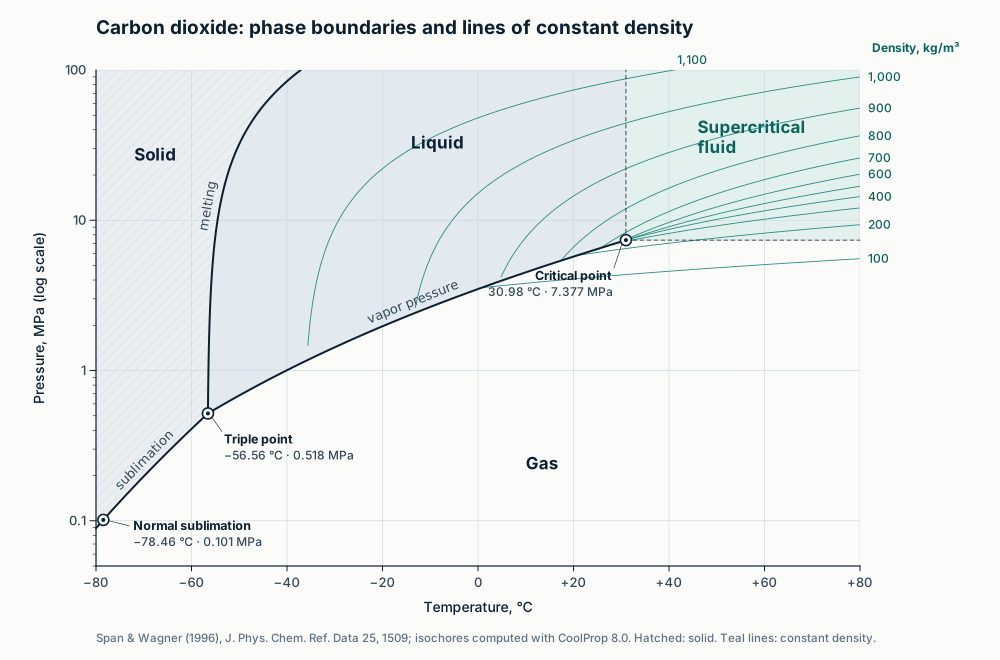
Above 31 °C and 7.4 MPa carbon dioxide is supercritical, and its density can be tuned continuously with pressure and temperatureReference equation of state
Pressure against temperature for carbon dioxide: solid, liquid, gas and supercritical regions, the triple point at −56.56 °C and 0.518 MPa, the critical point at 30.98 °C and 7.377 MPa, and lines of constant density from 100 to 1,100 kg per cubic meter. Above the critical point a small change in pressure or temperature changes the density of the fluid strongly. Computed from the Span and Wagner (1996) reference equation of state.
Span R, Wagner W. J Phys Chem Ref Data 1996;25:1509 (vapor, melting and sublimation pressure equations); isochores from the same equation of state in CoolProp 8.0. Generated illustration, EUTECNIQ. Full-size SVG
Extraction curve

A supercritical extraction curve has a fast straight start and a slow tail

Two-period broken-and-intact-cells curve (simplified from Sovová, type A)e = ys q  for q ≤ q1 = r xu/ys
e = xu[1 − (1 − r) e−C2(q − q1)]  for q > q1
End of fast period, q1
Yield after 50 kg CO₂/kg
CO₂ for 90% of the oil

Assumptions
  • Extractable oil xu = 0.20 kg per kg of oil-free plant solids; q and e use the same basis. All parameter values are illustrative
  • Type A curve: one straight section, then an exponential tail. Some materials show a second straight section (type B)
  • Real parameters are fitted from pilot runs at fixed pressure, temperature and flow
Share of the oil recovered versus CO₂ passedModel output
Simplified from Sovová H. J Supercrit Fluids. 2005;33(1):35–52 (type A); published equations as given by Mouahid A, Claeys-Bruno M, Clercq S. Processes. 2024;12(9):1865, Eqs. 1–4. Model origin: Sovová H. Chem Eng Sci. 1994;49(3):409–414.
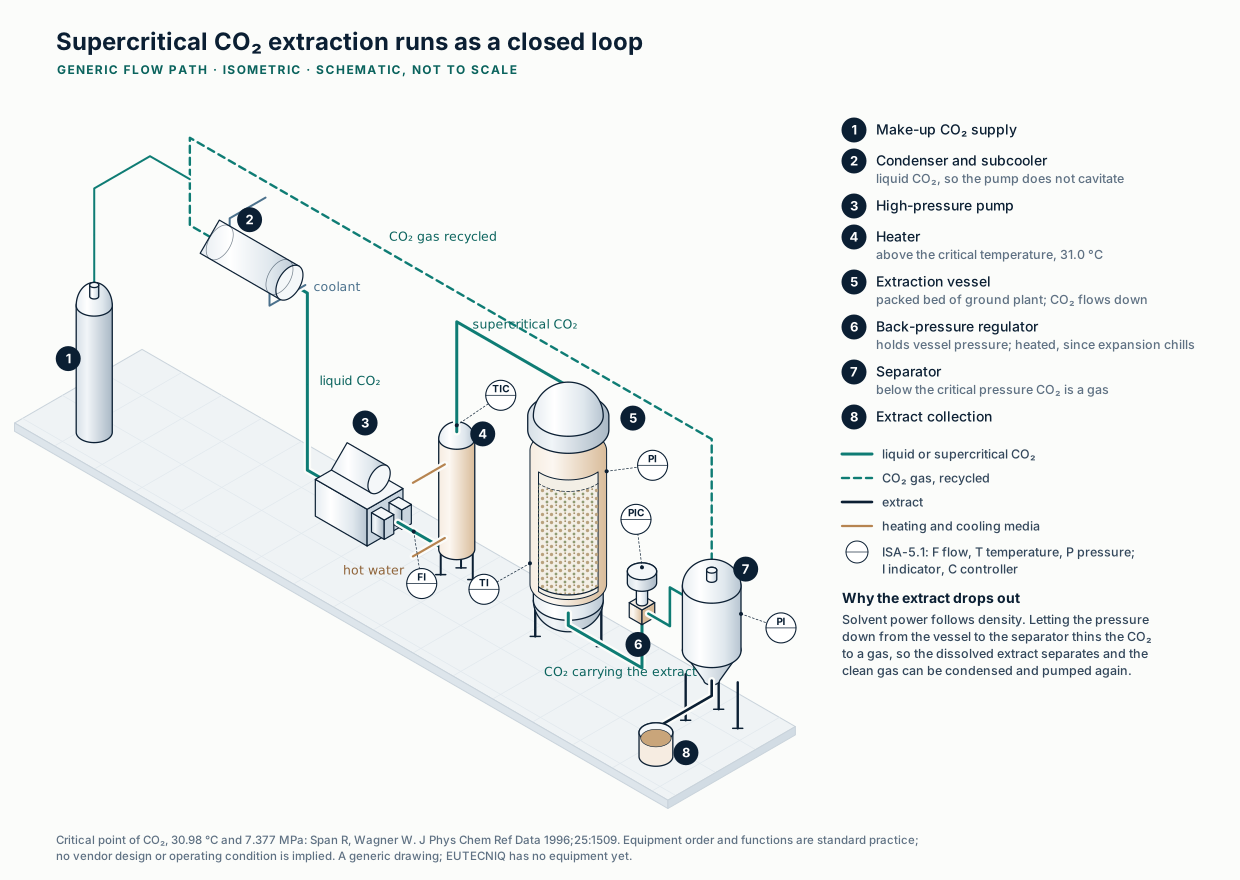
The extraction curve is read at the separator: CO₂ passes the packed bed, drops its extract when the pressure is let down, and returns through the condenserSchematic · reference critical point
Isometric drawing of a generic supercritical carbon dioxide extraction loop: make-up CO2 from a supply cylinder; a condenser that liquefies and subcools the CO2; a high-pressure pump; a heater that takes it above 31 degrees C; an extraction vessel holding a packed bed of ground plant; a heated back-pressure regulator that lets the pressure down; a separator where the CO2 turns to gas and the extract drops out to a collection vessel; and the CO2 gas returning to the condenser. Instrument bubbles use ISA-5.1 tags.
Critical point: Span R, Wagner W. J Phys Chem Ref Data 1996;25:1509. Equipment order and functions are standard practice; no operating condition or vendor design implied. Generated illustration, EUTECNIQ. Full-size SVG
Method, assumptions and limits: extraction curve
What it calculates
The share of the extractable oil recovered after a given mass of CO₂ per kilogram of oil-free plant solids has passed through a packed bed.
Equations
First period: e = ysq until the broken-cell oil r xu is exhausted at q1 = r xu/ys. Second period: first-order release from intact cells, e = xu[1 − (1 − r)exp(−C2(q − q1))]. CO₂ for a fraction f > r: q = q1 + ln[(1 − r)/(1 − f)]/C2.
Variables and units
q: kg CO₂ per kg oil-free solids; e: kg oil per kg oil-free solids; ys: kg oil per kg CO₂ (slider in g/kg); r: fraction of oil in broken cells; C2: per (kg CO₂/kg solids); xu = 0.20.
Simplification
This form is continuous at q1 and ignores release from intact cells during the first period. Sovová's published type A approximation (Mouahid et al. 2024, Eqs. 1–3) writes the tail as xu[1 − C1exp(−C2q)] with r = 1 − C1exp(−C2qc/2), which counts that release. The simplified curve therefore shows a sharper transition than a fitted curve.
Valid range
r 10–90%, ys 1–15 g/kg, C2 0.005–0.08 (clamped). Plug flow, constant solubility, no co-solvent.
What it does not establish
It does not predict the yield of any real material. Pilot runs at fixed pressure, temperature and flow would be needed to fit ys, r and C2.
Verification
Independent Python cases (closed-form and numerical root-finding) for the three readouts at the default, low and high settings.

Better grinding stretches the fast straight start; higher solubility (more pressure) makes it steeper; neither speeds up the slow tail much.

Explanation, details and sources

The straight start is free oil from broken cells, limited by how much CO₂ can carry. The tail is oil diffusing out of intact cells. Move the sliders to see which lever changes what.

Why it mattersThe CO₂ needed per kilogram of extract sets run time and energy; pilot runs would fit this model to price each lever. Staging is on Process engineering.

Yield, purity, recovery

Yield, purity and recovery are three different numbers, tied together by one mass balance

Mass balance on the target constituentY · P = R · xf  so  P = R xf / Y

DER and the "higher ratio is better" misconception: Monagas M, et al. Understanding plant to extract ratios in botanical extracts. Front Pharmacol. 2022;13:981978.

One kilogram of plant through extraction and solvent recovery, at the calculator's default settingsEducational model
Mass balance of one kilogram of dry plant extracted with ethanol at the calculator's default settings, with numbered streams, a stream table and where each cost driver arisesEthanolDry plantMExtractorSolid–liquidseparationSpent plantEvaporatorCondenserDry extract214365Recovered solventHeatStream table, per kg of dry plant#StreamMassTarget1Dry plant1.000 kg20 g2Ethanol, 10 L7.85 kg–3Extract solution7.85 + 0.125 kg16 g4Spent plant0.875 kg4 g5Recovered ethanol7.85 kg–6Dry extract0.125 kg16 gTarget content of the extractP = R·xf​/Y = 0.80 × 0.02 / 0.125 = 12.8%Native drug-to-extract ratio1/Y = 8 : 1Latent heat to evaporate stream 56.67 MJ per kg plant = 53.4 MJ per kg extractABCDEFWhere the cost per kilogram is set at scaleASolvent-to-feed ratioBCycle time, vessel occupancy, pressure ratingCSolvent retained in the spent plantDEvaporation energyEPurification to the specificationFFire-code class of the solvent; exposure limits
Calculator defaults: ethanol, 10 L per kg of dry plant, Y = 12.5%, xf = 2%, R = 80%; ethanol density 0.785 kg/L and latent heat 0.850 MJ/kg (CoolProp 8.0.0; the measured 38.56 kJ/mol in the NIST WebBook gives 0.837 MJ/kg, the value used on the process-engineering page, 1.5% lower). Same assumptions as the calculator: single pass, all solvent evaporated once and none retained in the spent plant, latent heat only. Letters A–F mark where the cost per kilogram is set; the schematic is not to scale and implies no equipment design.
Target content of the extract, P
Enrichment over the plant
Native DER (plant : extract)
Solvent per kg of extract
Latent heat per kg of extract
Same, in kilowatt-hours

Heat to evaporate the solvent, per kg of dry extract, at the chosen ratio and yieldEducational model with reference data
Show data
Solvent mass and latent heat per kilogram of dry extract at the chosen settings
SolventSolvent per kg extract (kg)Latent heat per kg extract (MJ)
Solvent property data used by the model
SolventDensity at 25 °C (kg/L)Normal boiling point (°C)Latent heat at boiling point (MJ/kg)Flash point (°C)
Water0.997100.02.257not flammable
Ethanol0.78578.40.85013
Methanol0.78664.51.10111
Acetone0.78556.10.501−18
Hexane0.65568.70.335−22
Heptane0.68098.40.317−4

Density, boiling point and latent heat: CoolProp 8.0.0 reference equations of state. Flash points: NIOSH Pocket Guide, converted from °F.

Thermophysical properties: Bell IH, et al. Ind Eng Chem Res. 2014;53(6):2498–2508 (CoolProp 8.0.0). Flash points: NIOSH Pocket Guide to Chemical Hazards, retrieved October 22, 2026.
Method, assumptions and limits: mass balance and solvent load
What it calculates
From the yield, the plant's target content and the recovery, the target content of the extract; and from the solvent-to-feed ratio and yield, the mass of solvent and the latent heat needed to evaporate it, per kilogram of dry extract.
Equations
P = R xf/Y; enrichment = P/xf; native DER = 1/Y; solvent per kg extract m = (S/F)·ρ/Y; heat Q = m·Δhvap(Tb); 1 kWh = 3.6 MJ.
Variables and units
S/F in L of solvent per kg of dry plant; ρ in kg/L at 25 °C; Y, xf, R as fractions (sliders in %); Δhvap in MJ/kg at the normal boiling point.
Assumptions
Single pass: all solvent fed is evaporated once and none is retained in the spent plant. Pure solvents (ethanol–water blends, which are common, would fall between the two pure values). Latent heat only: no sensible heat, no losses, no plant moisture.
Valid range and guards
Inputs are clamped to the slider ranges. If R xf > Y, the purity would exceed 100%, which is impossible; the tool says so instead of showing a number as valid.
What it does not establish
It is not an energy or cost estimate for any plant. Multiple-effect evaporation and vapor recompression supply far less steam per kilogram evaporated than a single-effect evaporator, solvent retained in the spent plant must also be recovered, and solvent losses, waste treatment and labor are not included.
Verification
Independent Python cases that evaluate the properties directly in CoolProp 8.0.0 for each solvent, including an inconsistent-input case.
Text version of the cost drivers

The cost per kilogram at scale depends on the solvent-to-feed ratio and how much of that solvent must be recovered, the energy for evaporation, cycle time and vessel occupancy, the purification needed to reach the specification, the pressure rating of the equipment, the fire-code class of the solvent and the operators' exposure limits.

Explanation, details and sources

A quoted "15% yield" says how much extract came out, not how much active it contains or how much of the plant's active was captured. A buyer needs all three, and the solvent each kilogram cost.

Extraction yield, Y

Dry extract per dry plant. Its inverse is the native drug-to-extract ratio (DER); a higher ratio is not a stronger or better extract.

Purity (content), P

Target constituent per mass of extract, by a validated assay. Purification raises it, usually at some cost in recovery.

Recovery, R

Share of the plant's target that ends up in the extract; it needs an assay of the plant too.

At the same ratio and yield, water needs about ten times the evaporation heat of hexane and over three times that of ethanol, while hexane's flash point is −22 °C. Energy and fire risk pull in opposite directions.

A better laboratory yield does not guarantee better industrial economics. EUTECNIQ would compare candidate processes on modeled cost of goods and safety class at pilot scale before committing capital (proposal).

Fractionation & purification

Purification trades recovery for purity, so each step must earn its place in the specification

Six purification families, each separating on a different propertySchematic, not to scale
Six purification families for botanical extracts, each drawn as its working unit with the property it separates on and its main strength or limitLiquid–liquid partitionUpperLowerTwo immiscible liquidsSeparates byPartition coefficientbetween two immiscibleliquidsStrength or limitChanging the solvent pairor the ratio within a solventfamily moves the cutCountercurrent and centrifugal partitionchromatographyLiquid held in a coilor rotorSeparates byPartition; the stationaryphase is a liquid held bygravity or centrifugal forceStrength or limitNo solid support to adsorbthe sample irreversiblyMacroporous adsorbent resinsLoadWashEluteSeparates byAdsorption on a non-ionicpolymer; release withaqueous ethanolStrength or limitHigh capacity, low cost,easy regeneration andscale-up (reviewers)Preparative chromatographyFractionsSeparates byAdsorption on silica orreversed-phase mediaStrength or limitResolves close relatives;solvent and media make itcostly per kgMembranesFeedRetentatePermeateSeparates byMolecular size, bymolecular-weight cut-offStrength or limitWorks at low temperature;fouling limits throughputFractional separation of CO2​ extractsExtractorFractions atfalling pressureSeparates byDissolving power, whichfalls with density aspressure dropsStrength or limitTwo or more separators atfalling pressure
Zhang et al. 2018; Ito Y. J Chromatogr A. 2005;1065(2):145–168; Friesen JB, Pauli GF. J Liq Chromatogr Relat Technol. 2005;28(17):2777–2806; Soto ML, et al. J Food Eng. 2011;105(1):1–27; Cassano A, et al. Int J Mol Sci. 2018;19(2):351; Tzima et al. 2023. Simulated moving bed chromatography (continuous, less solvent) is described in the text version.
Text version of the six purification families
Partition

Liquid–liquid partition and solvent-system optimization

The extract is split between two immiscible liquids; each compound distributes according to its partition coefficient. Changing the solvent pair or the ratio within a solvent family moves the cut.

Ito 2005; Friesen & Pauli 2005

Support-free chromatography

Countercurrent and centrifugal partition chromatography (CCC, CPC)

Partition chromatography in which the stationary phase is itself a liquid held by gravity or centrifugal force, so there is no solid support to adsorb the sample irreversibly. The two-phase solvent system is chosen so the target's partition coefficient falls in a workable range.

Zhang et al. 2018; Ito 2005; Friesen & Pauli 2005

Adsorption

Macroporous adsorbent resins

Non-ionic polymer adsorbents take up compounds from an aqueous extract and release them when eluted with a stronger solvent, typically aqueous ethanol. Reviewers cite high capacity, relatively low cost, easy regeneration and easy scale-up; surface area, pore diameter and polarity set capacity.

Zhang et al. 2018; Soto et al. 2011

Adsorption

Preparative chromatography

Flash and preparative HPLC on silica or reversed-phase media resolve closely related compounds, but solvent and media consumption make them costly per kilogram. Simulated moving bed chromatography runs continuously and uses less solvent.

Zhang et al. 2018

Size

Membranes

Microfiltration clarifies; tight ultrafiltration and nanofiltration concentrate and fractionate by molecular-weight cut-off at low temperature. Separation depends on membrane material, cut-off, pressure, temperature and flow, and fouling limits throughput.

Cassano et al. 2018; Zhang et al. 2018

Pressure

Fractional separation of supercritical extracts

Two or more separators at falling pressure drop out different fractions of a CO₂ extract, because dissolving power falls with density.

Tzima et al. 2023

Explanation, details and sources

A crude extract holds hundreds of compounds. Enrichment uses differences in partition, adsorption, molecular size or, for CO₂ extracts, density. Equations, a purity–recovery calculator and lot blending are on Purification and standardization.

Every purification step also changes what a "standardized" extract means: an enriched fraction is a different material from the native extract, and comparability, labeling and, for supplements, whether a new dietary ingredient notification is needed must be assessed for the new material (see NDIN).

Solvents

Solvent choice is a safety and quality decision, not only a yield decision

Residual-solvent limits in medicines (ppm)ICH Q3C
U.S. FDA. Q3C—Tables and List: Guidance for Industry, Revision 3 (June 2017). Class 2 values are the concentration limits listed in the guidance; for Class 3 solvents, 50 mg/day or less (5,000 ppm, 0.5%) is acceptable without justification. Water and CO₂ do not appear in the Q3C tables. Food limits for solvent residues in spice oleoresins (21 CFR 173) are charted in the CFR atlas.
Show data
ICH Q3C class, permitted daily exposure and concentration limit by solvent
SolventClassPDE (mg/day)Limit (ppm)
Benzene1not set (avoid)2
Chloroform20.660
Hexane22.9290
Acetonitrile24.1410
Dichloromethane26.0600
Toluene28.9890
Methanol230.03,000
Ethanol350 or less without justification5,000 (default)
Acetone350 or less without justification5,000 (default)
Ethyl acetate350 or less without justification5,000 (default)
Heptane350 or less without justification5,000 (default)
2-Propanol350 or less without justification5,000 (default)
Hansen solubility parameters: polar versus hydrogen-bonding (MPa½)Published values
Blend δP (MPa½)
Blend δH (MPa½)
Distance to soybean oil, Ra (hexane: 4.6)
Show data
Hansen solubility parameters by liquid
LiquidδDδPδHSource
Hexane14.900Carré et al. 2024
Heptane15.300Hansen 2007
Ethyl acetate15.85.37.2Carré et al. 2024
Acetone15.510.47.0Carré et al. 2024
2-Propanol15.86.116.4Carré et al. 2024
Ethanol15.88.819.4Carré et al. 2024
Methanol15.112.322.3Carré et al. 2024
Water15.616.042.3Hansen 2007
Soybean oil16.52.02.7Hansen 2004, via Carré et al. 2024

All values in MPa½.

Carré P, et al. OCL. 2024;31:31, Table 2 (hexane, alcohols, acetone, ethyl acetate; soybean oil from Hansen 2004). Hansen CM. Hansen Solubility Parameters: A User's Handbook, 2nd ed. CRC Press; 2007, as tabulated by Accu Dyne Test (water, heptane; accessed October 22, 2026). Blend rule and distance Ra² = 4ΔδD² + ΔδP² + ΔδH²: hansen-solubility.com, HSP Basics. Hansen parameters split a liquid's cohesion into dispersion (δD), polar (δP) and hydrogen-bonding (δH) parts; the closer two sets are, the more alike the liquids. δD varies little across these solvents (14.9–15.8 MPa½; soybean oil 16.5), so the chart shows the two that separate them; Ra uses all three.
Screening seven solvents on safety, residue limit and oil solvency at once: brush an axis to keep only what passesValues cited on this page
Residual-solvent limits from FDA, Q3C—Tables and List, Revision 3 (June 2017; Class 3 shown at the 5,000 ppm default; food limits for spice oleoresins: 21 CFR 173 in the CFR atlas); NIOSH Pocket Guide flash points and lower flammable limits; Hansen parameters from OCL 2024 Table 2 and Hansen 2007; distance to soybean oil Ra² = 4ΔδD² + ΔδP² + ΔδH², lower for a better oil solvent. Boiling points and δP, δH are in the table.
Data table
SolventICH limit, ppmFlash point, °CLEL, %Boiling point, °CδPδHRa to soybean oil
Hexane290-221.169004.6
Heptane5,000-41.0598004.1
Ethyl acetate5,000-42775.37.25.8
Acetone5,000-182.55610.479.6
2-Propanol5,000122836.116.414.4
Ethanol5,000133.3788.819.418.1
Methanol3,0001166412.322.322.3
Method, assumptions and limits: Hansen blend and distance
What it calculates
The Hansen parameters of an ethanol–water blend and its Hansen distance to soybean oil, as a guide to how alike the two liquids are.
Equations
Blend: δi = φEδi,E + (1 − φE)δi,W for i = D, P, H, with φE the ethanol volume fraction. Distance: Ra = [4(ΔδD)² + (ΔδP)² + (ΔδH)²]½.
Assumptions
Ideal volume-fraction mixing (no volume change on mixing); 25 °C parameter values.
What it does not establish
A smaller distance indicates likely miscibility; it does not give the solubility of any botanical compound or the selectivity of an extraction. Strongly hydrogen-bonding mixtures such as ethanol–water deviate from ideal blending.
Verification
Independent Python cases at 0%, 70% and 100% ethanol.
Deep eutectic solvents and ionic liquids are extraction research until four questions are answered for a useProposed screening sequence
Four questions a research solvent such as a deep eutectic solvent or ionic liquid would have to pass before its residue could be acceptable in a product; a no at any gate leaves it a research toolDES, NADES, ionicliquidsExtraction research1Listed for this use?21 CFR 173 Subpart Cnames specificextraction solvents,uses and residues; DESand ionic liquids do notappear as a class2Mixture judged atthe residue?A component used infoods on its own doesnot establish that themixture, at the residueleft in the product, isacceptable3Residuemeasurable?The residue needs itsown analytical method4Safety andregulatory basis?A safety assessment,and a regulatory basisfor the productcategoryYesYesYesNo at any gate: a research tool only, which is how EUTECNIQ would treat these solvents until the questions are answeredfor a specific useNoNoNoNoBefore a solvent residue could be acceptable in a productFour questions a research solvent such as a deep eutectic solvent or ionic liquid would have to pass before its residue could be acceptable in a product; a no at any gate leaves it a research toolDES, NADES, ionic liquidsExtraction research1Listed for this use?21 CFR 173 Subpart C names specific extractionsolvents, uses and residues; DES and ionic liquidsdo not appear as a class2Mixture judged at the residue?A component used in foods on its own does notestablish that the mixture, at the residue left in theproduct, is acceptableYes3Residue measurable?The residue needs its own analytical methodYes4Safety and regulatory basis?A safety assessment, and a regulatory basis for theproduct categoryYesNo at any gate: a research tool only, until thequestions are answered for a specific use
eCFR, 21 CFR Part 173 Subpart C, up to date as of October 15, 2026. Dai Y, et al. Anal Chim Acta. 2013;766:61–68 (more than 100 natural deep eutectic mixtures). Passos H, Freire MG, Coutinho JAP. Green Chem. 2014;16:4786–4815 (limits of toxicity, cost and melting point). The sequence is an EUTECNIQ proposal.
Text version: research solvents and what they mean for a product
Research solvents

Deep eutectic solvents (DES, NADES) and ionic liquids are extraction research, not ready formulation components

Natural deep eutectic solvents are liquids formed when certain plant primary metabolites, solid on their own, are mixed in the right ratio; one group reported more than 100 such mixtures and found many biomolecules far more soluble in them than in water. Ionic liquids are salts that are liquid at low temperature. The same authors note that ionic liquids and deep eutectic solvents still face limits of toxicity, cost and, for many DES, being solid at room temperature.

Dai Y, et al. Anal Chim Acta. 2013;766:61–68. Passos H, Freire MG, Coutinho JAP. Green Chem. 2014;16:4786–4815.

What that means for a product

A good extraction solvent is not automatically an acceptable residue, excipient or food component

  • U.S. food regulations list specific extraction solvents and their permitted uses and residues (21 CFR Part 173, Subpart C); neither DES nor ionic liquids appear there as a class.
  • A component that is used in foods on its own does not establish that the mixture, at the residue left in the product, is acceptable.
  • Any residue would need its own analytical method, safety assessment and regulatory basis for the product category; see Regulatory & safety.
  • EUTECNIQ would treat these solvents as research tools until those questions are answered for a specific use (proposal).

eCFR, 21 CFR Part 173 Subpart C, up to date as of October 15, 2026.

Explanation, details and sources

The residual-solvent limits below come from the ICH Q3C guideline for medicines. EUTECNIQ would use them as its internal benchmark for all products (proposal). U.S. food regulations name specific extraction solvents for specific uses: for example, 21 CFR 173.270 permits hexane residue in spice oleoresins up to 25 ppm.

Hexane sits closest to soybean oil, yet its limit is 17 times tighter than ethanol's default. Ethanol–water blends slide along a straight line, so the blend ratio is a continuous design knob.

Process safety

The common extraction solvents can ignite at room temperature, so the plant is designed around their vapors

All seven organic solvents fall in OSHA Category 2, and each burns over its own range of vapor in airNIOSH data; OSHA definitions
Seven extraction solvents plotted by flash point and boiling point inside OSHA's flammable-liquid categories, all in Category 2, and their flammable ranges in airFlash point and boiling point against OSHA's categoriesCategory 2: flash point below 23 °C and boiling point above 35 °CCategory 1: flash point below 23 °C and boiling point at or below 35 °CCategory 3: flash point 23 to 60 °CCategory 4: flash point above 60 °C and at or below 93 °C−2002040608010020406080100Flash point, °CBoiling point, °CCategory 2Cat. 1Category 3Category 423 °CHexane: flash point -22 °C, boiling point 69 °CHexaneAcetone: flash point -18 °C, boiling point 56 °CAcetoneEthyl acetate: flash point -4 °C, boiling point 77 °CEthyl acetateHeptane: flash point -4 °C, boiling point 98 °CHeptaneMethanol: flash point 11 °C, boiling point 64 °CMethanol2-Propanol: flash point 12 °C, boiling point 83 °C2-PropanolEthanol: flash point 13 °C, boiling point 78 °CEthanolFlammable range in air, % by volume010203040HeptaneHeptane: 1.05–6.7% in air1.05–6.7HexaneHexane: 1.1–7.5% in air1.1–7.5Ethyl acetateEthyl acetate: 2.0–11.5% in air2–11.52-Propanol2-Propanol: 2.0–12.7% in air2–12.7AcetoneAcetone: 2.5–12.8% in air2.5–12.8EthanolEthanol: 3.3–19% in air3.3–19MethanolMethanol: 6.0–36% in air6–36Lower to upper flammable limit
NIOSH Pocket Guide to Chemical Hazards (n-hexane, acetone, ethyl acetate, n-heptane, methyl alcohol, isopropyl alcohol, ethyl alcohol), retrieved October 22, 2026; °F converted to °C and rounded. Categories: 29 CFR 1910.106(a)(19), up to date as of October 21, 2026 (Category 1: flash point below 23 °C, boiling point at or below 35 °C; Category 2: flash point below 23 °C, boiling point above 35 °C; Category 3: flash point 23–60 °C; Category 4: above 60 and at or below 93 °C). Carbon dioxide is not flammable.
Text version: flammability data by solvent
Flammability data for common extraction solvents and CO2
SolventFlash point (°C)Flammable range in air (% by volume)Boiling point (°C)OSHA 1910.106 category
Hexane−221.1–7.569Category 2
Acetone−182.5–12.856Category 2
Ethyl acetate−42.0–11.577Category 2
Heptane−41.05–6.798Category 2
Methanol116.0–3664Category 2
2-Propanol122.0–12.783Category 2
Ethanol133.3–1978Category 2
Carbon dioxidenot flammablenot flammablesublimesnot a flammable liquid; OSHA exposure limit 5,000 ppm (8-hour average); 1.53 times as dense as air
How a proposed ethanol extraction room would be zoned and controlledSchematic, not to scale
Illustrative zoning of a proposed ethanol extraction room under OSHA's Class I definitions: a Division 1 area around open transfer and extraction equipment, Division 2 elsewhere in the room, an adjacent unclassified room under positive pressure, and seven numbered controlsClass I, Division 2 (illustrative extent)Class I, Division 1 (illustrative extent)Unclassified, kept so by positive-pressure ventilationClass I, Division 2Liquids stay in closed systems; or ventilation normallyprevents ignitable mixturesClass I, Division 1Open transfer; extraction equipment using volatileflammable solventsUnclassifiedControl room+Positive pressureMExtractorEvaporatorCondenserSolventDrumExhaust to outsideATShutdowninterlockClean-air supply1234567Controls (numbers on the drawing)1Small solvent inventory at the point of use;solvent recovered in closed equipment2Open transfer: bonding and groundingagainst static3Extraction equipment listed to UL 1389, orapproved by technical report andreviewed by the fire code official beforeinstallation4Electrical equipment approved,intrinsically safe or safe for the classifiedlocation5Exhaust ventilation and flammable-vapordetection, interlocked with shutdownwhere the fire code calls for it6Hot-work permits for flames and sparks7Adjacent room kept unclassified only bypositive-pressure clean air, withsafeguards against its failureZone extents are illustrative, not to scale: each room is classified individually and the result documented (29 CFR 1910.307(a)–(b)). No site or equipment has been selected.
Class I, Division 1 and 2 definitions and the note that Division 1 usually includes locations with fat and oil extraction equipment using volatile flammable solvents: 29 CFR 1910.399. Equipment in classified locations must be intrinsically safe, approved for the location, or safe for it; classified areas must be documented: 29 CFR 1910.307(b)–(c). UL 1389 listing or technical report: 2025 California Fire Code § 3904.2. eCFR up to date as of October 21, 2026. Controls 3, 4 and 7 restate the fire code and OSHA; 1, 2, 5 and 6 are EUTECNIQ design intentions, and a process hazard analysis would precede each first run and each scale-up.
Text version of the rules and the proposed design
Rules that apply Regulatory requirement

Codes set thresholds and design reviews before any extraction runs

  • Process safety management. OSHA's PSM standard covers a process with 10,000 pounds (4,536 kg) or more on site in one location of a flammable liquid with a flash point below 37.8 °C, with exceptions that include atmospheric storage kept below the normal boiling point (29 CFR 1910.119(a)(1)(ii)).
  • Fire code. Chapter 39 of the 2025 California Fire Code, Processing and Extraction Facilities, requires plant-oil extraction equipment to be listed to UL 1389 or approved through a technical report by a registered design professional, reviewed by the fire code official before installation (§ 3904.2).
  • Exposure. OSHA's 8-hour limit for CO₂ is 5,000 ppm. CO₂ is heavier than air and collects in pits and low rooms, so CO₂ systems need monitoring and ventilation.

eCFR, 29 CFR 1910.106 and 1910.119, up to date as of October 21, 2026. 2025 California Fire Code (Title 24, Part 9), Chapter 39, § 3904, as published by GoCodeBook; confirm with the authority having jurisdiction. NIOSH Pocket Guide, carbon dioxide.

How EUTECNIQ would design for it Proposal

Small inventories, closed transfers and engineered controls

  • Keep flammable-solvent inventory at the point of use small, and recover solvent in closed equipment.
  • Remove ignition sources: electrical equipment rated for the classified area, bonding and grounding against static, and hot-work permits.
  • Ventilation and gas or CO₂ detection interlocked with shutdown where the fire code calls for it.
  • Pressure equipment (supercritical CO₂, pressurized hot water) designed with relief devices, interlocks and documented inspection.
  • A process hazard analysis for each new process before first run, and again before scale-up.
Explanation, details and sources

Every organic solvent below has a flash point under 23 °C and boils above 35 °C, which places it in OSHA's Category 2 flammable liquids. Its vapor can form an ignitable mixture with air at ordinary room temperature.

  • Process safety management. OSHA's PSM standard covers a process with 10,000 pounds (4,536 kg) or more on site in one location of a flammable liquid with a flash point below 37.8 °C, with exceptions that include atmospheric storage kept below the normal boiling point (29 CFR 1910.119(a)(1)(ii)). Regulation
  • Carbon dioxide. OSHA's 8-hour limit is 5,000 ppm. CO₂ is 1.53 times as dense as air and collects in pits and low rooms, so CO₂ systems need monitoring and ventilation. Regulation

No site, building or equipment has been selected; these are design intentions to be reviewed by qualified fire-protection and process-safety engineers.

EUTECNIQ's role

What EUTECNIQ proposes to do in extraction, and what it would place with partners

Screening and purification in Phase I, a pilot process in Phase II, and partners for commercial scale and fire-protection engineeringProposed division of work
Proposed extraction work: EUTECNIQ would screen methods and purify in Phase I and run a pilot process in Phase II; partners would cover methods outside the equipment list, commercial toll extraction until Phase III, preparative chromatography at scale and fire-protection engineeringPlanned in houseQualified external partnerMethod screeningPhase ILaboratory percolation, ultrasound-assisted and supercriticalCO₂ extraction; yield, purity and recovery measured against awritten specificationPartnerMethods outside the planned equipment listPilot processPhase IIPilot extraction, evaporation and solvent recovery; fittedkinetic models and a cost-of-goods modelPartnerToll extraction at commercial scale until Phase IIIPurificationPhase ILaboratory resin, partition and membrane trialsPartnerPreparative chromatography at scaleSafety and compliancePlannedProcess hazard analysis and solvent-residue testingPartnerFire-protection engineering and code reviewEUTECNIQ owns no extraction equipment and has run no extractions; every row is a proposal.Proposed extraction work: EUTECNIQ would screen methods and purify in Phase I and run a pilot process in Phase II; partners would cover methods outside the equipment list, commercial toll extraction until Phase III, preparative chromatography at scale and fire-protection engineeringMethod screeningPlanned in house · Phase ILaboratory percolation, ultrasound-assisted andsupercritical CO₂ extraction; yield, purity and recoverymeasured against a written specificationQualified external partner · PartnerMethods outside the planned equipment listPilot processPlanned in house · Phase IIPilot extraction, evaporation and solvent recovery;fitted kinetic models and a cost-of-goods modelQualified external partner · PartnerToll extraction at commercial scale until Phase IIIPurificationPlanned in house · Phase ILaboratory resin, partition and membrane trialsQualified external partner · PartnerPreparative chromatography at scaleSafety and compliancePlanned in house · PlannedProcess hazard analysis and solvent-residue testingQualified external partner · PartnerFire-protection engineering and code reviewEUTECNIQ owns no extraction equipment and has run noextractions; every row is a proposal.
Facility plan, October 2026. The same four rows are in the table below. EUTECNIQ owns no extraction equipment.
Show the table (4 rows): Proposed in-house extraction work by phase and work placed with partners
Proposed in-house extraction work by phase and work placed with partners
WorkPlanned in houseQualified external partner
Method screeningPhase I Laboratory percolation, ultrasound-assisted and supercritical CO₂ extraction; yield, purity and recovery measured against a written specificationPartner Methods outside the planned equipment list
Pilot processPhase II Pilot extraction, evaporation and solvent recovery; fitted kinetic models and a cost-of-goods modelPartner Toll extraction at commercial scale until Phase III
PurificationPhase I Laboratory resin, partition and membrane trialsPartner Preparative chromatography at scale
Safety and compliancePlanned Process hazard analysis and solvent-residue testingPartner Fire-protection engineering and code review
Explanation, details and sources

Founder-reported prior experience The founder reports four years (2007–2011) as a senior process engineer in industrial extraction and separation, including process design, debottlenecking and energy optimization, at a prior employer. These are not EUTECNIQ results; see Founder.

Have a botanical that needs a process, not only a yield?

Describe the material, the target constituents and the product category. EUTECNIQ is in formation and would respond with a proposed development plan, not a quotation for work it cannot yet perform.