

Public botanical data are too small to train a model, so the proposal adapts open ones
“Large Botanical Model” names a proposed architecture: open models adapted to EUTECNIQ's own paired lot records. EUTECNIQ has no model, no training data and no compute contract.
Status. A proposal: no laboratory, LIMS records or trained model exist. Public counts and constants were checked on October 22–24, 2026.
Academy fundamentals: Course 11, Multi-objective ingredient design
Nine data types would meet in one shared embedding, trained so that records of the same lot sit together
Scroll sideways inside the diagram to see all four columns.
Select a component in the diagram (click, or Tab and press Enter) to read what it would do, where it starts from and its status. The same information is in the text table below the diagram.
All 23 components as text: role, starting point and status
| Component | What it would do | Starting point or source (verified) | Status |
|---|---|---|---|
| Literature text | Supplies evidence passages for answers and the links between species, constituents and studies. | PubMed lists more than 40 million citations and abstracts (NLM). Full texts only where the license permits; PMC states that license terms vary by article and that bulk retrieval is allowed only through its four automated services. | Public source |
| Monographs | Supplies identity tests, acceptance criteria and botanical descriptions for retrieval. | Compendial texts are published under copyright by their publishers; use in an index or for training would be licensed first. Terms have not been assessed. | License needed |
| Regulatory documents | Supplies the regulation and guidance text that answers are checked against. | Works of the U.S. Government are not protected by copyright under 17 U.S.C. §105, which covers the Code of Federal Regulations and FDA guidance documents. | Public source |
| Chemical structures | Supplies natural-product chemical space and the species in which each structure was reported. | COCONUT, October 2026 release: 738,794 molecules, CC0. LOTUS: 750,000+ referenced structure–organism pairs on Wikidata, CC0. | Public source |
| MS/MS spectra | Supplies fragment spectra for structure retrieval and for comparing lots. | MassBank: 119,845 spectra of 18,529 compounds; each record carries a mandatory Creative Commons license field (CC0, CC BY, CC BY-SA, CC BY-NC or CC BY-NC-SA). GNPS/MassIVE public datasets: terms not reviewed here. | Public source |
| NMR spectra | Confirms structures and profiles whole extracts. | Mostly EUTECNIQ's own spectra of authenticated reference lots; no public NMR collection was assessed for this page. | To be generated |
| Chromatograms | Fingerprints of lots for identity and consistency. | EUTECNIQ's own HPLC and HPTLC runs under recorded methods; public chromatogram collections were not assessed. | To be generated |
| DNA barcodes | Species-level identity of the source plant, where intact DNA survives processing. | rbcL + matK is the recommended core plant barcode (CBOL Plant Working Group 2009); ITS2 was validated for medicinal plant species (Chen et al. 2010). | Public method |
| EUTECNIQ LIMS records | Supplies the pairs that make alignment possible: spectra, chromatograms, barcodes and assay results of the same authenticated lot. | None. EUTECNIQ has no laboratory or LIMS yet; these records would be created from the first sample, with provenance. | Does not exist yet |
| Language model and retrieval index | Drafts answers from retrieved passages; adapted to botanical vocabulary with low-rank adapters rather than pretrained from scratch. | OLMo 2 7B: Apache 2.0, trained on 4 trillion tokens, with weights, training data and code released (model card). LoRA (Hu et al. 2021); retrieval-augmented generation (Lewis et al. 2020). | Candidate |
| Chemical language encoder | Turns a SMILES string or a molecular graph into a vector. | MoLFormer was pretrained on SMILES of 1.1 billion molecules from PubChem and ZINC (Ross et al. 2022). ChemBERTa released a curated set of 77 million PubChem SMILES (Chithrananda et al. 2020). | Candidate |
| Spectrum transformer | Turns an MS/MS spectrum into a vector that can be compared with structures. | DreaMS was pretrained without labels on millions of tandem mass spectra (the GeMS dataset, mined from MassIVE GNPS) by predicting masked peaks and retention orders; the authors released the dataset and model (Bushuiev et al. 2025). | Candidate |
| NMR encoder | Places ¹³C NMR spectra and structures in one space for cross-modal retrieval. | CReSS used deep contrastive learning to retrieve structures from ¹³C NMR spectra (Yang et al. 2021, Anal Chem). | Method published |
| 1-D signal encoder | Encodes aligned chromatographic traces. | No pretrained starting point is assumed; it would be trained on EUTECNIQ's own runs. | To be built |
| Sequence encoder | Encodes barcode sequences for species-level matching. | k-mer frequency profiles are a simple first representation; reference sequences from public libraries, after their terms are confirmed. | To be built |
| Lot-record encoder | Encodes assay, impurity, stability and process results of a lot. | EUTECNIQ data only, under 21 CFR Part 11 controls where the record is required. | To be built |
| Retriever and citation verifier | Selects passages, conditions the language model on them, and removes any sentence its cited passage does not support. | Retrieval-augmented generation (Lewis et al. 2020); citation-quality metrics of the ALCE benchmark (Gao et al. 2023). | Candidate |
| Shared embedding | One vector space in which paired records of the same lot are close; an applicability check refuses inputs far from training data. | Symmetric contrastive loss (InfoNCE, van den Oord et al. 2018; the paired form used by CLIP, Radford et al. 2021). | Proposed |
| Cited literature answers | Drafts dossier sections and answers scientific questions with a source for every sentence, for expert editing. | Measured by citation precision and recall (Gao et al. 2023). Never filed or published without human review. | Proposed |
| Identity verification | Ranks how consistent a lot's spectra, fingerprint and barcode are with authenticated references of the labeled species. | A screen only. Part 111 requires at least one appropriate test or examination to verify the identity of each dietary ingredient (21 CFR 111.75(a)(1)), using scientifically valid methods (111.75(h)(1)). | Proposed |
| Adulterant flagging | Flags lots that resemble known adulterated or substituted material. | A flag triggers a confirmatory test by a validated method; it never releases or rejects a lot. | Proposed |
| Property prediction | Predicts physicochemical properties with a prediction interval, or abstains outside the applicability domain. | Baselines and calibration rules are on Computational science and AI. | Proposed |
| Wet-lab validation | Tests every consequential output with a validated method and returns the result to LIMS as a new paired record. | Proposed EUTECNIQ laboratory or a qualified external partner; none is in operation. | Does not exist yet |
Explanation, details and sources
Status. A proposal from a company in formation with no laboratory, LIMS records or trained model. Public counts, published constants and hardware figures were checked against primary sources on October 22–24, 2026. The COCONUT token count is our own computation; other calculator numbers illustrate published equations.
- A proposed architecture≠an existing model
- A scaling-law projection≠a measured result on botanical data
- Lower training loss≠better identity, safety or quality decisions
- A model flag≠a validated test result
Governance, data rights and funding gates: Computational science and AI. The first narrow model, for extraction yield: Botanical Intelligence.
An encoder turns one kind of record, such as a mass spectrum, into a vector. Text feeds a language model through a retrieval index, so answers come from documents, not memory; measurements feed a shared embedding for three screening tasks.
sij = ui · vj‖ui‖ ‖vj‖
ui is one record's vector (the MS/MS spectrum of lot i) and vi its partner's (the same lot's chromatogram or structure). The loss is small when each record is most similar to its own partner among B candidates; temperature τ sets how sharply.
InfoNCE: van den Oord, Li, Vinyals 2018, arXiv:1807.03748. Symmetric paired form: Radford et al. 2021, arXiv:2103.00020 (CLIP, 400 million image–text pairs). For botanicals the pairs exist only where one authenticated lot is measured several ways, which is why EUTECNIQ's own records come first.
Each task would answer one question for a named decision owner, and none of them would release, reject or classify a product
Show the table (4 rows)
The model narrows where scientists look. Quality decisions remain with the quality unit and validated methods.
| Task | Input | Output | Decision owner | What happens next |
|---|---|---|---|---|
| Identity verification | MS/MS, NMR, chromatogram and barcode records of an incoming lot | Similarity to authenticated references of the labeled species, with a calibrated score or an abstention | Qualified analyst | The validated identity test is run as required; a low score adds an orthogonal test |
| Adulterant flagging | The same records, plus reference records of known adulterants | A flag with the nearest matching adulterant class | Quality unit | Confirmatory test by a validated method; the outcome becomes a labeled training record |
| Property prediction | Structure, or the measured profile of a lot | Predicted value with an interval, or no prediction outside the applicability domain | Formulation scientist | Candidates are ranked for measurement; predictions never replace data |
| Cited literature answers | A scientific or regulatory question | A draft in which every sentence links to the passage that supports it | Responsible scientist or regulatory specialist | Expert review and editing; unsupported sentences are removed and logged |
Screening on several property limits at once shows which botanical markers fall outside drug-derived heuristics
Data table: all 59 compounds
| Compound | PubChem CID | MW (g/mol) | XLogP3 | TPSA (Ų) | H-bond donors | H-bond acceptors | Rotatable bonds | Rule of five and Veber met |
|---|---|---|---|---|---|---|---|---|
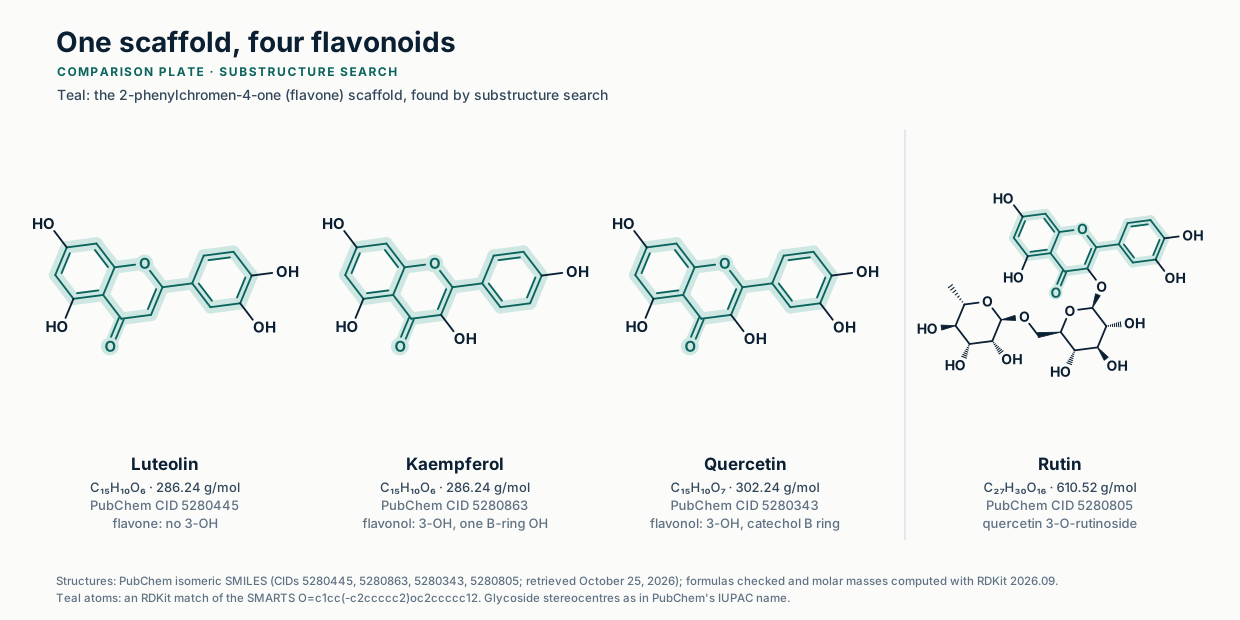
| Quercetin | 5280343 | 302.23 | 1.5 | 127 | 5 | 7 | 1 | yes |
| Curcumin | 969516 | 368.4 | 3.2 | 93.1 | 2 | 6 | 8 | yes |
| Berberine | 2353 | 336.4 | 3.6 | 40.8 | 0 | 4 | 2 | yes |
| Resveratrol | 445154 | 228.24 | 3.1 | 60.7 | 3 | 3 | 2 | yes |
| Caffeine | 2519 | 194.19 | -0.1 | 58.4 | 0 | 3 | 0 | yes |
| Capsaicin | 1548943 | 305.4 | 3.6 | 58.6 | 2 | 3 | 9 | yes |
| Piperine | 638024 | 285.34 | 3.5 | 38.8 | 0 | 3 | 3 | yes |
| Epigallocatechin gallate | 65064 | 458.4 | 1.2 | 197 | 8 | 11 | 4 | no |
| Rosmarinic acid | 5281792 | 360.3 | 2.4 | 145 | 5 | 8 | 7 | no |
| Chlorogenic acid | 1794427 | 354.31 | -0.4 | 165 | 6 | 9 | 5 | no |
| Glycyrrhizin | 14982 | 822.9 | 3.7 | 267 | 8 | 16 | 7 | no |
| Artemisinin | 68827 | 282.33 | 2.8 | 54 | 0 | 5 | 0 | yes |
| Andrographolide | 5318517 | 350.4 | 2.2 | 87 | 3 | 5 | 3 | yes |
| Silibinin (silybin) | 31553 | 482.4 | 2.4 | 155 | 5 | 10 | 4 | no |
| Hypericin | 3663 | 504.4 | 5.7 | 156 | 6 | 8 | 0 | no |
| Hyperforin | 441298 | 536.8 | 9.6 | 71.4 | 1 | 4 | 11 | no |
| Withaferin A | 265237 | 470.6 | 3.8 | 96.4 | 2 | 6 | 3 | yes |
| Ginsenoside Rb1 | 9898279 | 1109.3 | 0.3 | 377 | 15 | 23 | 16 | no |
| Baicalin | 64982 | 446.4 | 1.1 | 183 | 6 | 11 | 4 | no |
| Ursolic acid | 64945 | 456.7 | 7.3 | 57.5 | 2 | 3 | 1 | yes |
| Kavain | 5281565 | 230.26 | 2.5 | 35.5 | 0 | 3 | 3 | yes |
| Valerenic acid | 6440940 | 234.33 | 3.2 | 37.3 | 1 | 2 | 2 | yes |
| Harpagoside | 5281542 | 494.5 | -0.6 | 175 | 6 | 11 | 7 | no |
| Salidroside | 159278 | 300.3 | -0.6 | 120 | 5 | 7 | 5 | yes |
| Rosavin | 9823887 | 428.4 | -2 | 158 | 6 | 10 | 7 | no |
| 6-Gingerol | 442793 | 294.4 | 2.5 | 66.8 | 2 | 4 | 10 | yes |
| Apigenin | 5280443 | 270.24 | 1.7 | 87 | 3 | 5 | 1 | yes |
| Luteolin | 5280445 | 286.24 | 1.4 | 107 | 4 | 6 | 1 | yes |
| Kaempferol | 5280863 | 286.24 | 1.9 | 107 | 4 | 6 | 1 | yes |
| Naringenin | 439246 | 272.25 | 2.4 | 87 | 3 | 5 | 1 | yes |
| Hesperidin | 10621 | 610.6 | -1.1 | 234 | 8 | 15 | 7 | no |
| Rutin | 5280805 | 610.5 | -1.3 | 266 | 10 | 16 | 6 | no |
| Ellagic acid | 5281855 | 302.19 | 1.1 | 134 | 4 | 8 | 0 | yes |
| Gallic acid | 370 | 170.12 | 0.7 | 98 | 4 | 5 | 1 | yes |
| Oleuropein | 5281544 | 540.5 | -0.4 | 202 | 6 | 13 | 11 | no |
| Hydroxytyrosol | 82755 | 154.16 | -0.7 | 60.7 | 3 | 3 | 2 | yes |
| Thymol | 6989 | 150.22 | 3.3 | 20.2 | 1 | 1 | 1 | yes |
| Menthol | 1254 | 156.26 | 3 | 20.2 | 1 | 1 | 1 | yes |
| Eugenol | 3314 | 164.2 | 2 | 29.5 | 1 | 2 | 3 | yes |
| Lutein | 5281243 | 568.9 | 11 | 40.5 | 2 | 2 | 10 | no |
| β-Carotene | 5280489 | 536.9 | 13.5 | 0 | 0 | 0 | 10 | no |
| Forskolin | 47936 | 410.5 | 1 | 113 | 3 | 7 | 3 | yes |
| Huperzine A | 854026 | 242.32 | 0 | 55.1 | 2 | 2 | 0 | yes |
| Tanshinone IIA | 164676 | 294.3 | 4.3 | 47.3 | 0 | 3 | 0 | yes |
| Emodin | 3220 | 270.24 | 2.7 | 94.8 | 3 | 5 | 0 | yes |
| Salicin | 439503 | 286.28 | -1.2 | 120 | 5 | 7 | 4 | yes |
| Parthenolide | 6473881 | 248.32 | 2.3 | 38.8 | 0 | 3 | 0 | yes |
| Ginkgolide B | 11973122 | 424.4 | -0.4 | 149 | 3 | 10 | 1 | no |
| Bilobalide | 73581 | 326.3 | -0.3 | 119 | 2 | 8 | 1 | yes |
| Honokiol | 72303 | 266.3 | 5 | 40.5 | 2 | 2 | 5 | yes |
| Icariin | 5318997 | 676.7 | 1.7 | 234 | 8 | 15 | 9 | no |
| Puerarin | 5281807 | 416.4 | 0 | 157 | 6 | 9 | 3 | no |
| Genistein | 5280961 | 270.24 | 2.7 | 87 | 3 | 5 | 1 | yes |
| Matrine | 91466 | 248.36 | 1.6 | 23.6 | 0 | 2 | 0 | yes |
| β-Boswellic acid | 168928 | 456.7 | 8.3 | 57.5 | 2 | 3 | 1 | yes |
| Aloin | 9866696 | 418.4 | -0.1 | 168 | 7 | 9 | 3 | no |
| Withanolide A | 11294368 | 470.6 | 3.3 | 96.4 | 2 | 6 | 2 | yes |
| Crocin | 5281233 | 977 | -2.5 | 391 | 14 | 24 | 20 | no |
| Allicin | 65036 | 162.3 | 1.3 | 61.6 | 0 | 3 | 5 | yes |
Data table: markers meeting each limit
| Limit | Markers meeting it |
|---|---|
| Molecular weight ≤ 500 | 48 |
| XLogP3 ≤ 5 | 53 |
| H-bond donors ≤ 5 | 44 |
| H-bond acceptors ≤ 10 | 49 |
| Rule of five, ≤ 1 violation | 45 |
| Rotatable bonds ≤ 10 | 55 |
| TPSA ≤ 140 Ų | 41 |
| Veber, both limits | 40 |
| Rule of five and Veber | 38 |
Of the 21 markers outside one or both heuristics, 18 exceed 140 Ų polar surface area: candidates for delivery work, not proof of poor bioavailability.
Explanation, details and sources
Multi-objective selection keeps only candidates that satisfy several limits at once; parallel coordinates show every candidate as one line across all axes, and brushing an axis applies a limit. A property model would supply such values, with intervals, for compounds that lack them. Here the values are PubChem's computed descriptors, themselves model estimates, for 59 well-known marker compounds chosen by this page as examples; PubChem's acceptor and donor counts are not the same calculation as the original papers'.
Lipinski's rule of five states that poor absorption or permeation is more likely above 5 hydrogen-bond donors, 10 acceptors, a molecular weight of 500 or a calculated log P of 5. Veber et al. found, in rat data for over 1,100 drug candidates, that 10 or fewer rotatable bonds and a polar surface area of 140 Ų or less predicted a high probability of good oral bioavailability. Both are heuristics from drug-discovery data sets; they do not measure a botanical's absorption. See Course 11 for selection methods.
A molecule becomes a sequence of chemically meaningful tokens before a language model can read it
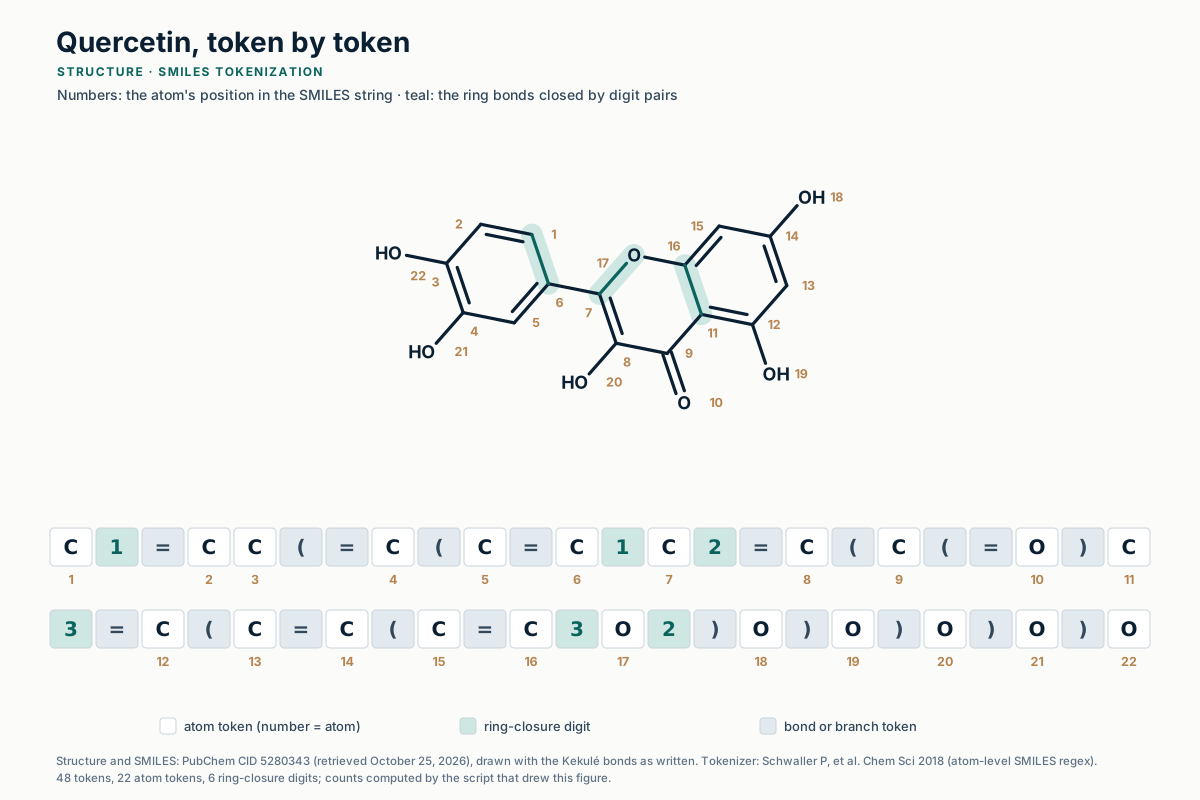
(\[[^\]]+]|Br?|Cl?|N|O|S|P|F|I|b|c|n|o|s|p|\(|\)|\.|=|#|-|\+|\\|\/|:|~|@|\?|>|\*|\$|\%[0-9]{2}|[0-9])The two quercetin examples describe the same molecule (identical InChIKey REFJWTPEDVJJIY-UHFFFAOYSA-N) yet give 48 and 42 tokens. A model sees different sequences unless strings are canonicalized or deliberately enumerated.
Method, assumptions and limits: SMILES tokenizer
- What it calculates
- The list of tokens produced by the published regular expression, and counts of characters, tokens, distinct tokens, atom tokens, bracketed atoms and ring-closure digits.
- Equation
- Tokens are the successive matches of the expression shown above, applied left to right with global matching. A string is reproduced exactly when the tokens joined together equal the input, the check the authors' code asserts.
- Variables and units
- Counts only. Atom tokens are bracketed atoms plus the organic-subset symbols B, C, N, O, P, S, F, Cl, Br, I and their aromatic lower-case forms.
- Assumptions
- The input is a SMILES string. The tokenizer does not check chemical validity; RDKit or another parser would do that before training.
- Valid range
- Any text up to 2,000 characters. Characters the expression does not cover are listed in a warning, and the string is then not reproduced exactly.
- Does not establish
- That a token sequence is the best input for a model; graph representations and other tokenizers exist. Token counts depend on how the SMILES was written, as the two quercetin forms show.
- References
- Schwaller et al. 2018 (Chem Sci); Schwaller et al. 2019, ACS Cent Sci 5(9):1572–1583 (Molecular Transformer, which reuses the same expression); PubChem.
- Verification
- An independent Python reference (re module, the same published expression, RDKit for InChIKeys) in tests/numerics/ref/insights-large-botanical-model.py reproduces every count for all seven examples.
The whole COCONUT collection is about 48 million SMILES tokens, a small corpus by language-model standards
All 738,794 COCONUT structures (October 2026): median 58 tokens, 381 distinct tokens.
Histogram data
| Tokens per molecule | Molecules | Share (%) |
|---|---|---|
| 0–9 | 1,236 | 0.2 |
| 10–19 | 13,302 | 1.8 |
| 20–29 | 38,114 | 5.2 |
| 30–39 | 77,881 | 10.5 |
| 40–49 | 121,068 | 16.4 |
| 50–59 | 134,121 | 18.2 |
| 60–69 | 107,801 | 14.6 |
| 70–79 | 73,512 | 10.0 |
| 80–89 | 52,402 | 7.1 |
| 90–99 | 31,882 | 4.3 |
| 100–119 | 38,966 | 5.3 |
| 120–149 | 28,266 | 3.8 |
| 150–199 | 15,352 | 2.1 |
| 200–299 | 4,104 | 0.6 |
| 300–499 | 693 | 0.1 |
| 500 or more | 94 | 0.0 |
Chart data
| Corpus | Tokens | Multiple of COCONUT | Source |
|---|---|---|---|
| COCONUT, all SMILES (our count) | 4.82 × 10⁷ | 1 | EUTECNIQ computation on the COCONUT Oct 2026 release |
| Compute-optimal data for a 1B model | 2.02 × 10¹⁰ | 419 | Hoffmann et al. 2022, Table 3 (Approach 1) |
| Chinchilla 70B training data | 1.40 × 10¹² | 29,028 | Hoffmann et al. 2022, Table 1 |
| OLMo 2 7B pretraining data | 4.00 × 10¹² | 82,938 | OLMo 2 7B model card |
| Llama 3 405B pretraining data | 1.56 × 10¹³ | 323,460 | Llama 3 Herd of Models, Section 1 |
Explanation, details and sources
SMILES writes a structure as a line of text; a tokenizer cuts it into one token per atom, bond, branch or ring-closure digit, keeping bracketed atoms such as [C@@H] whole. The regular expression in the tokenizer above is Schwaller et al.'s (2018), copied exactly from the authors' code.
Published scaling laws show loss falling with both parameters and data, so a small corpus caps what a larger model can learn
E = 1.69, A = 406.4, B = 410.7, α = 0.34, β = 0.28
G = (αA/βB)1/(α+β), a = βα+β, b = αα+β
The optimum needs 1,894 times more unique tokens than are available, so this budget is limited by data.
- Constants were fitted to one text corpus (MassiveText) with one tokenizer; the loss values do not transfer to SMILES or botanical text
- One pass over the data; repeating data is discussed below
- C ≈ 6ND counts training FLOPs only
Drag to rotate, or use the buttons. Amber: models trainable within the budget and the available unique tokens.
Method, assumptions and limits: scaling-law explorer
- What it calculates
- The compute-optimal model size and token count for a compute budget, the fitted loss there, the best loss reachable when unique tokens are capped, and the loss floor set by the data term alone.
- Equations
- L(N, D) = E + A/Nα + B/Dβ; Nopt = G(C/6)a, Dopt = G−1(C/6)b with G, a and b as above (Hoffmann et al. 2022, Eq. 4). With a cap Davail < Dopt, the one-epoch model uses D = Davail and N = C/(6Davail), because loss falls monotonically with N. Floor = E + B/Davailβ.
- Variables and units
- N in parameters; D in tokens; C in floating-point operations; L in nats per token on the fitting corpus.
- Assumptions
- The fits describe dense transformer language models trained on one English-dominant corpus. The two constant sets disagree. Besiroglu et al. refitted the model to data reconstructed from the paper's figures, found the published estimates inconsistent with Hoffmann's own Approaches 1 and 2, and report constants that imply about 20 tokens per parameter, against about 70 for the published Eq. 10. Both are shown so the uncertainty stays visible.
- Valid range
- The original runs spanned 70 million to over 16 billion parameters and 5 to 500 billion tokens; values far outside are extrapolations. Budgets 1017–1026 FLOPs; caps 106–1014 tokens.
- Does not establish
- Any loss, accuracy or benefit for a botanical model. Repeated data change the picture: Muennighoff et al. (2023) found up to 4 epochs of repetition gave negligible loss changes compared with unique data, while further repetition gave diminishing returns, so a small corpus can be reused only a few times.
- References
- Hoffmann et al. 2022; Besiroglu et al. 2024; Kaplan et al. 2020 (C ≈ 6N per training token); Muennighoff et al. 2023, arXiv:2305.16264.
- Verification
- The Python reference finds the optimum by bounded numerical minimization of L(N, C/6N) (scipy) instead of the closed form, and checks readouts and the static table below.
Compute-optimal frontier table for both constant sets
| Budget C (FLOPs) | Hoffmann N | Hoffmann D | Hoffmann D/N | Hoffmann loss | Replication N | Replication D | Replication D/N | Replication loss |
|---|---|---|---|---|---|---|---|---|
| 1.00 × 10¹⁸ | 8.06 × 10⁷ | 2.07 × 10⁹ | 26 | 3.535 | 8.05 × 10⁷ | 2.07 × 10⁹ | 26 | 3.490 |
| 1.00 × 10¹⁹ | 2.28 × 10⁸ | 7.31 × 10⁹ | 32 | 2.986 | 2.62 × 10⁸ | 6.36 × 10⁹ | 24 | 2.927 |
| 1.00 × 10²⁰ | 6.45 × 10⁸ | 2.58 × 10¹⁰ | 40 | 2.600 | 8.53 × 10⁸ | 1.95 × 10¹⁰ | 23 | 2.553 |
| 1.00 × 10²¹ | 1.82 × 10⁹ | 9.14 × 10¹⁰ | 50 | 2.329 | 2.78 × 10⁹ | 6.00 × 10¹⁰ | 22 | 2.306 |
| 1.00 × 10²² | 5.16 × 10⁹ | 3.23 × 10¹¹ | 63 | 2.139 | 9.05 × 10⁹ | 1.84 × 10¹¹ | 20 | 2.141 |
| 1.00 × 10²³ | 1.46 × 10¹⁰ | 1.14 × 10¹² | 78 | 2.005 | 2.94 × 10¹⁰ | 5.66 × 10¹¹ | 19 | 2.032 |
| 5.76 × 10²³ | 3.22 × 10¹⁰ | 2.98 × 10¹² | 93 | 1.931 | 7.22 × 10¹⁰ | 1.33 × 10¹² | 18 | 1.974 |
| 1.00 × 10²⁴ | 4.13 × 10¹⁰ | 4.04 × 10¹² | 98 | 1.911 | 9.59 × 10¹⁰ | 1.74 × 10¹² | 18 | 1.960 |
| 1.00 × 10²⁵ | 1.17 × 10¹¹ | 1.43 × 10¹³ | 122 | 1.845 | 3.12 × 10¹¹ | 5.34 × 10¹² | 17 | 1.912 |
Gopher's budget is 5.76 × 10²³ FLOPs (Hoffmann et al. 2022, Figure 2 caption). At that budget the replication constants give 72 billion parameters and 1.3 trillion tokens, close to Chinchilla itself; the published Eq. 10 gives 32 billion and 3.0 trillion.
Explanation, details and sources
Hoffmann et al. (2022) fitted the final loss of over 400 language models as a function of parameters N and tokens D; Chinchilla (70 billion parameters, 1.4 trillion tokens) balanced the two. When unique data are capped, extra compute buys little because the data term cannot fall.
Adapting an open model takes a few to a few hundred GPU-hours; pretraining from scratch needs thousands of times COCONUT's data
GPU-hours = CPpeak × u × 3600 s
days = GPU-hoursnGPU × 24
D is 3,027 times the whole COCONUT SMILES corpus; no botanical corpus of this size has been identified.
- Dense peak for H100 SXM is half the 1,979 TFLOPS that NVIDIA lists with sparsity
- Utilization is set by the user; it is not a measured EUTECNIQ value
- 6ND is an upper bound for LoRA, which skips weight gradients of frozen layers
- The 1 billion and 50 million token corpus sizes are assumptions for illustration
Method, assumptions and limits: training-compute calculator
- What it calculates
- Training FLOPs, GPU-hours and wall-clock days for a model of N parameters trained on D tokens, at a chosen GPU peak and utilization; and how D compares with COCONUT's 48.2 million SMILES tokens.
- Equations
- C = 6ND (2N per token forward, about twice that backward; Kaplan et al. 2020). GPU-hours = C/(Ppeak u · 3600 s). Days = GPU-hours/(nGPU · 24).
- Variables and units
- N parameters (106–1012); D tokens (106–1014); Ppeak in FLOP/s, BF16 dense: H100 SXM 989.5 × 10¹², A100 80GB 312 × 1012, L40S 362.05 × 10¹²; u 10–60%; 1–16,384 GPUs.
- Assumptions
- Perfect scaling across GPUs; no restarts, evaluation or data-processing overhead. The published check shows the size of that gap: 6ND for Llama 3 405B gives 3.79 × 10²⁵ FLOPs (reported 3.8 × 10²⁵) and, at 41% utilization, 26.0 million GPU-hours against 30.84 million reported in the model card, which counts the whole run.
- Valid range
- Dense transformers. Mixture-of-experts models use the active parameters per token instead of N.
- Does not establish
- A cost, schedule or budget. No prices are used, and EUTECNIQ has no compute contract.
- References
- Kaplan et al. 2020; Hoffmann et al. 2022; NVIDIA product pages; Grattafiori et al. 2024; Meta Llama 3.1 model card.
- Verification
- Independent Python cases for all four scenarios and three GPUs in tests/numerics/ref/insights-large-botanical-model.py.
At rank 16, low-rank adapters train about 0.5% of an open 7-billion-parameter model and cut model-state memory about eightfold
How LoRA works
LoRA freezes W0 and learns a low-rank update, h = W0x + BAx (B is d × r, A is r × k, r ≪ d, k), adding r(d + k) trainable parameters per matrix. Hu et al. (2021) report 10,000-fold fewer trainable parameters and threefold less GPU memory than full fine-tuning of GPT-3 175B; QLoRA (Dettmers et al. 2023) fine-tuned a 65-billion-parameter model on one 48 GB GPU.
Mfull = 16 P bytes
MLoRA = 2 P + 16 PLoRA bytes
- Model: OLMo 2 7B (32 layers, hidden size 4,096, MLP size 11,008, 7,298,617,344 parameters)
- 16 bytes per trained parameter for mixed-precision Adam (ZeRO, Section 3.1); 2 bytes per frozen BF16 parameter
- Activations and buffers are excluded
Method, assumptions and limits: LoRA calculator
- What it calculates
- The number of trainable parameters LoRA adds to OLMo 2 7B for a rank and a set of adapted matrices, its share of the full model, and the memory for weights, gradients and optimizer states.
- Equations
- Each adapted matrix W ∈ ℝd×k gains B ∈ ℝd×r and A ∈ ℝr×k, so r(d + k) parameters. Per layer: query, key, value and output projections are 4,096 × 4,096; gate and up projections 4,096 × 11,008; down projection 11,008 × 4,096. Full fine-tuning with mixed-precision Adam needs 2 + 2 + 12 = 16 bytes per parameter (ZeRO); LoRA keeps frozen weights at 2 bytes and spends 16 bytes per trainable parameter.
- Variables and units
- r = 1–256 (powers of two); parameters; gigabytes = 109 bytes.
- Assumptions
- Embeddings, norms and the output head stay frozen. Hu et al. adapted only the query and value projections in most experiments and found adapting both gave the best result among the options they compared.
- Valid range
- OLMo 2 7B only; other models need their own shapes.
- Does not establish
- That adapters reach full fine-tuning quality on any botanical task, or the memory for activations, which depends on sequence length and batch size.
- References
- Hu et al. 2021; Dettmers et al. 2023 (QLoRA); Rajbhandari et al. 2019 (ZeRO); OLMo 2 model card and config.
- Verification
- The Python reference recomputes the counts from the published config, and the total from the safetensors index.
Explanation, details and sources
Training takes about six floating-point operations per parameter per token; dividing by a GPU's peak rate and utilization gives GPU-hours. Llama 3 405B pretraining ran at 38–43% of peak on up to 16,384 H100 GPUs.
Open structure and spectra collections exist, but none listed here pairs several kinds of measurement on the same authenticated botanical lot
Sources, counts, terms and roles
Counts and terms come from each provider's own page or latest database paper (October 22, 2026). A license to download is not automatically a license to train.
| Source | Contents and count | Terms (as stated by the provider) | Role in the model |
|---|---|---|---|
| COCONUT | Natural-product structures with organisms and references. 738,794 molecules in the October 2026 CSV release (statistics page: 738,795 unique molecules, 73,137 organisms); 695,133 in version 2.0 as published. 48.2 million SMILES tokens (our count). | "COCONUT data is released under the Creative Commons CC0 license" | Structure pretraining and chemical space |
| LOTUS | 750,000+ referenced structure–organism pairs, hosted on Wikidata | CC0, per the LOTUS paper | Species–constituent links |
| Dr. Duke's Phytochemical and Ethnobotanical Databases | Plant, chemical, bioactivity and ethnobotany records (USDA Agricultural Research Service); the provider page does not state record counts | "Creative Commons CCZero" (data.gov catalog entry; data last modified November 30, 2023) | Traditional-use and constituent context, labeled as such |
| IMPPAT | Version 3.0: 4,154 Indian medicinal plants, 18,314 phytochemicals, 1,544 therapeutic uses, 1,576 formulations | Not stated on the home page; confirm before use | Regional constituent data, after terms are confirmed |
| MassBank | 119,845 spectra of 18,529 compounds from 53 contributors | Mandatory per-record license: CC0, CC BY, CC BY-SA, CC BY-NC or CC BY-NC-SA | Reference spectra, filtered by record license |
| GeMS (DreaMS) | Millions of unannotated MS/MS spectra mined from MassIVE GNPS; the DreaMS Atlas covers 201 million spectra | Dataset card on Hugging Face declares MIT; upstream MassIVE dataset terms not reviewed | Starting point for the spectrum encoder |
| PubMed | More than 40 million citations and abstracts | NLM data terms require acknowledging NLM and no implied endorsement; NLM states it cannot guarantee the copyright status of any item | Retrieval index with links to sources |
| PMC Open Access Subset | Articles under Creative Commons or similar licenses; count not stated on the page | License terms vary by article; bulk retrieval only through PMC's four automated services | Full texts where the article license permits |
| Code of Federal Regulations, FDA guidance | Regulation and guidance text | U.S. Government works: no copyright protection under 17 U.S.C. §105 | Retrieval index for regulatory answers |
| EUTECNIQ LIMS | None yet | EUTECNIQ-owned; customer data only under written agreement | The paired lot records that make alignment possible |
COCONUT download and statistics pages (accessed October 22, 2026); Chandrasekhar et al. 2025, Nucleic Acids Res 53(D1):D634–D643; Rutz et al. 2022, eLife 11:e70780; USDA ARS, data.gov catalog; IMPPAT home page; Neumann et al. 2026, Nucleic Acids Res 54(D1):D601–D606 and the MassBank record format; Bushuiev et al. 2025, Nat Biotechnol 44(4):630–640 and the GeMS dataset card; NLM About PubMed and data terms; PMC Open Access Subset page; 17 U.S.C. §105. Summary, not legal advice.
Every output that could change a decision would be tested in the laboratory, and each result would become a training record
Text version of the loop
Paired, authenticated data are the scarce input. The loop creates them as a by-product of quality work, recording reference lot, method version and analyst for every result; the same records are the LIMS data described on Digital lab and traceability.
- AuthenticateVoucher specimen and identity by validated methods for each reference lot
- MeasureMS/MS, NMR, chromatographic fingerprint and barcode of the same lot, recorded in LIMS
- PredictThe model screens a new lot and states its confidence or abstains
- ConfirmA validated test decides; disagreement with the model is logged
- RetrainConfirmed results enter the next model version under change control
Each task would have a metric, a baseline it must beat and a threshold set before any data are seen
Show the table (5 rows)
| Task | Primary metric | Definition | Baseline to beat |
|---|---|---|---|
| Identity verification | Top-k retrieval accuracy; sensitivity at fixed specificity | Share of query lots whose correct species is among the k highest-ranked references; true-positive rate when the false-positive rate is held at a preset level | Spectral library search; PLS discriminant analysis |
| Adulterant flagging | Area under the ROC and precision–recall curves | Ranking quality of flags against confirmed adulterated and authentic lots, with the precision–recall curve reported because adulterated lots are rare | Marker-ratio rules from pharmacopeial methods |
| Property prediction | Mean absolute error; interval coverage | Average absolute difference from measured values; share of measurements inside the stated prediction interval, against its nominal level | Gradient boosting or Gaussian processes on descriptors |
| Cited literature answers | Citation recall and precision; answer correctness | Share of statements fully supported by their citations, and share of citations that support their statement (ALCE, Gao et al. 2023), with expert grading of correctness | Keyword and citation search by a trained scientist |
| All tasks | Expected calibration error; abstention rate | Gap between stated confidence and observed accuracy across confidence bins (Guo et al. 2017); share of inputs refused as outside the domain | The same metrics for each narrow model |
The model would grow in four stages, from cited retrieval to a multimodal model, each gated by beating its baseline
Text version of the stages
- Stage 1: retrievalCited answers over public regulatory and literature text with an open model; no training
- Stage 2: adaptersLoRA adapters on botanical text and SMILES; compared with retrieval alone
- Stage 3: paired encodersSpectrum, fingerprint and barcode encoders aligned on EUTECNIQ's authenticated lots
- Stage 4: shared modelOne embedding for all data types, if stage 3 shows transfer between them
The largest risks are fabricated citations, too few paired records and data used without the right to train
Show the table (6 rows)
| Risk | Evidence or mechanism | Proposed control |
|---|---|---|
| Fabricated or wrong citations | In 84 short literature reviews, 55% of GPT-3.5 citations and 18% of GPT-4 citations were fabricated (Walters and Wilder 2023, Sci Rep) | Answers only from retrieved passages; automatic citation check; human review before any use |
| Too few paired records | Alignment needs several measurements of the same lot; public collections do not contain them | Build pairs through the wet-lab loop; keep narrow models until pairs suffice |
| Data without training rights | Licenses differ by source and, for MassBank and PMC, by record | License recorded per record; non-commercial records excluded from commercial models; counsel review |
| Scaling assumptions that do not transfer | Two fits of the same published runs disagree on the optimal tokens per parameter (about 70 against about 20) | Small pilot runs on botanical data before any larger commitment |
| Leakage and optimistic tests | Replicates of one lot or one species in both training and test sets inflate scores | Splits by botanical, lot and time; blind partner test sets |
| Use for marketing or regulatory claims | A model output is not substantiation for a health claim or a safety conclusion | Outputs excluded from claims and safety files; see Legal status |
Hold authenticated botanical data or a defined screening problem?
Describe paired measurements, an independent test set or a narrow question; EUTECNIQ would reply with an evaluation plan.