

Oral bioavailability is the product of release, absorption and survival, so a formulation should target the limiting step
How bioaccessibility, absorption and transformation combine into bioavailability, what the maximum absorbable dose says, and what tracer and curcumin studies measured.
Status. EUTECNIQ has no formulation, dissolution, permeability or pharmacokinetic data. Human results are those of the cited studies; a bioavailability gain is not evidence of efficacy.
Academy fundamentals: Course 8, Solubility, pH and the body
Czank et al., Am J Clin Nutr 2013; Jamwal, J Integr Med 2018, with COT TOX/2025/09 Table 5; Jäger et al., Nutr J 2014, Table 1; Schiller et al., Aliment Pharmacol Ther 2005.
Of a ¹³C-labeled anthocyanin dose, 12.38% left in urine and breath, 31.6% in feces, and 56.1% was not recovered in 48 hours
Data table
| Fate of the ¹³C label within 48 h | % of dose | Basis |
|---|---|---|
| Urine | 5.37 ± 0.67 | Reported, mean ± SE |
| Exhaled breath (¹³CO₂) | 6.91 ± 1.59 | Reported, mean ± SE |
| Relative bioavailability (urine + breath) | 12.38 ± 1.38 | Reported; the two components above add to 12.28 |
| Total recovered (urine, breath, feces) | 43.9 ± 25.9 | Reported; range 15.1–99.3 across participants |
| Feces | 31.6 | Derived here: 43.9 − 5.37 − 6.91 |
| Not recovered in 48 h | 56.1 | Derived here: 100 − 43.9 |
Other reported values: labeled metabolites peaked at 5.97 ± 2.14 µmol/L in serum at 10.25 ± 4.14 h; their half-lives ranged from 12.44 ± 4.22 to 51.62 ± 22.55 h; metabolites were degradation products and phenolic, hippuric, phenylacetic and phenylpropenoic acids.
The 12.38% "relative bioavailability" counts labeled metabolites in urine and breath; the authors concluded that anthocyanins are more bioavailable than previously perceived.
Explanation, details and sources
A stable-isotope label lets a study follow the carbon of a compound wherever it goes, including into metabolites that a parent-compound assay would miss. What counts as "bioavailable" therefore depends on the analyte: the parent compound, its conjugates, or every labeled product. Recovery varied widely between participants (15.1–99.3%), and more than half of the label was not accounted for within 48 hours on average.
Getting into solution, crossing the gut wall and reaching the blood unchanged are separate steps, and the smallest one sets the outcome
Text version of the three fractions
- FB, bioaccessibility
- The fraction released from the food or product matrix and solubilized in gastrointestinal fluids. Limited by liberation (L), solubility (S) and interactions that make it insoluble (I).
- FA, absorption
- The fraction of what is bioaccessible that crosses the mucus layer (ML) and the epithelium, through tight junctions (TJ), the membrane (MP) or active transporters (AT), and is not pumped back by efflux transporters (ET).
- FT, transformation
- The fraction that reaches circulation without chemical (C) or metabolic (M) transformation into a less active or inactive form.
Salvia-Trujillo L, Martín-Belloso O, McClements DJ. Nanomaterials. 2016;6(1):17, eq 1 (written BA = B* × A* × T*) and Table 2; nutraceutical bioavailability classification scheme (NuBACS): McClements DJ, Li F, Xiao H. Annu Rev Food Sci Technol. 2015;6:299–327.
Explanation, details and sources
McClements and colleagues split oral bioavailability into three fractions that multiply. A formulation that triples one of them helps only if that one is the bottleneck. Evidence for each step comes from different experiments, described on Evidence and pharmacokinetics.
"Bioavailability is the rate and extent to which the active ingredient or active moiety is absorbed from a drug product and becomes available at the site of drug action." For products not meant to reach the bloodstream, it is assessed by measurements that reflect availability at the site of action.
21 CFR 314.3(b), which 21 CFR 320.1 applies to bioavailability and bioequivalence requirements.
- Bioaccessibility≠systemic bioavailability
- Dispersibility≠solubility
- A stable nanoemulsion≠demonstrated bioavailability
- A bioavailability gain≠efficacy
- Higher exposure≠a wider safety margin
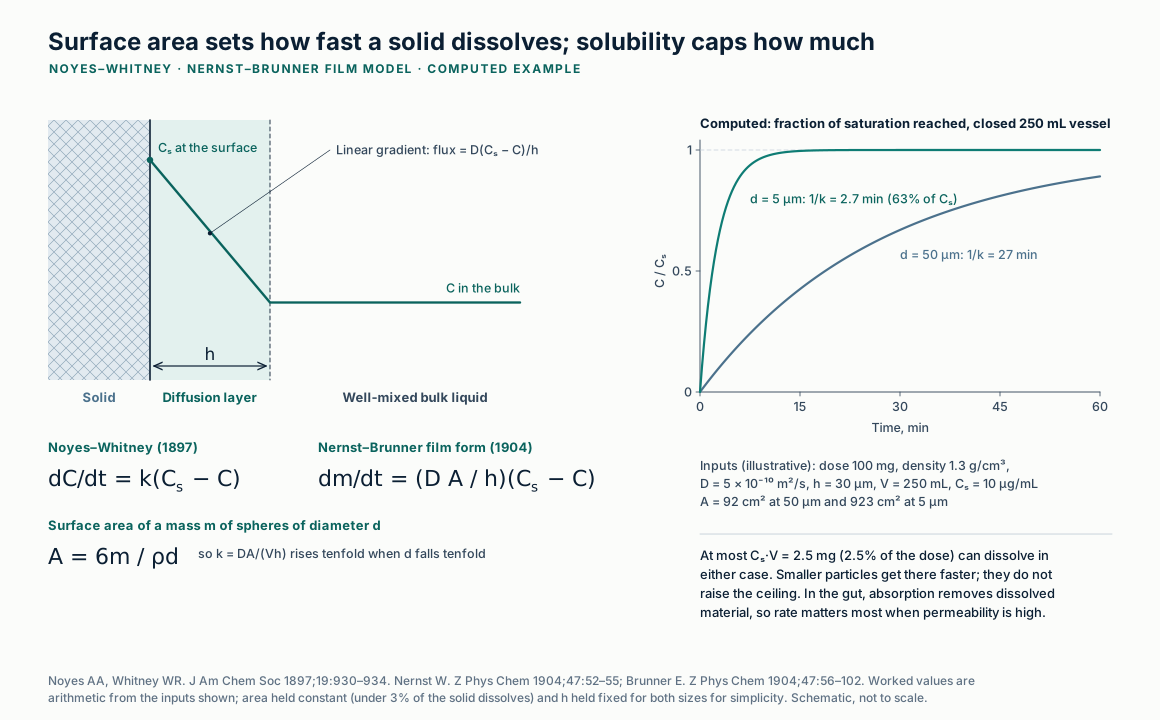
When solubility limits absorption, the absorbed amount stops rising with dose, and the maximum absorbable dose estimates where that ceiling is
Drag to rotate, or use the buttons. On log axes the MAD is a plane, because it is a product; amber marks where it exceeds the dose.
At the defaults (10 µg/mL, 1 × 10⁻⁴ cm/s, 250 mL, 199 min) the MAD is about 4.8 mg, so at most about 1% of a 500 mg dose could be absorbed if solubility were the only limit.
Method, assumptions and limits
- What it calculates
- The maximum absorbable dose, the resulting ceiling on the fraction of a dose absorbed when solubility is limiting, the absorption rate constant, and the dose, absorption and dissolution numbers.
- Equations
- MAD = S·Ka·SIWV·SITT; Ka = 2Peff/R; ceiling = min(1, MAD/dose); Do = dose/(250 mL × S); An = Peff·Tsi/R; Dn = 3D S Tsi/(r²ρ), with Tsi = SITT.
- Variables and units
- S in µg/mL (mg/mL inside MAD); Peff in cm/s; Ka in min⁻¹; SIWV in mL; SITT in min; R = 1.25 cm; D = 5 × 10⁻⁶ cm²/s; ρ = 1.2 g/cm³; r in µm. Sliders for dose, S, Peff and r are logarithmic.
- Assumptions
- Saturated luminal concentration throughout transit; passive permeation with a sink on the blood side; one well-mixed tube; no degradation or metabolism; no supersaturation, micellar solubilization or lipid digestion.
- Valid range
- A screening estimate only. Fasted small-intestinal water measured by MRI averaged 105 ± 72 mL in 12 volunteers and 54 ± 41 mL after a meal (Schiller et al. 2005), well below the 250 mL convention. Ding et al. (2012) found the equation gave conservative estimates of the absorbable dose compared with phase I dose-escalation results.
- What it does not establish
- Absorption of any real ingredient, the effect of food or formulation, first-pass metabolism (FT), or efficacy. ICH M9 criteria apply to drug biowaivers, not to supplements.
- Verification
- An independent Python reference recomputes MAD, the ceiling, Ka, Do, An and Dn from the slider values with explicit unit conversions (
tests/numerics/ref/technologies-bioavailability-design.py).
Explanation, details and sources
Amidon and colleagues showed that "the key parameters controlling drug absorption are three dimensionless numbers": an absorption number, a dissolution number and a dose number. If the gut fluid stays saturated, the most that can be absorbed during transit is solubility × absorption rate constant × fluid volume × transit time. Above that dose, more material mostly passes through.
An = PeffTsiR Dn = 3D S Tsir²ρ
M0: dose; S: solubility; Peff: effective intestinal permeability; Tsi: small-intestinal transit time (3.32 h); R: intestinal radius (1.25 cm); D: diffusion coefficient (typically 5 × 10⁻⁶ cm²/s); r: particle radius; ρ: particle density (typically 1.2 g/cm³).
Amidon GL, et al. Pharm Res. 1995;12(3):413–420; values and forms as given by Abuhassan Q, et al. Eur J Pharm Biopharm. 2022;170:160–169 (open access), eq 6 and Table 3 notes. ICH M9 (2019): a drug substance is highly soluble if the highest single therapeutic dose dissolves in 250 mL or less over pH 1.2–6.8 at 37 ± 1 °C. The dose-number calculator is on Delivery.
Ka = 2 PeffR
SIWV: small-intestinal water volume; SITT: small-intestinal transit time. The Ka relation follows from Amidon's absorption-rate integral, dm/dt = ∬PwCwdA: with the wall concentration held at saturation, absorption rate = PeffS A, and a tube has A/V = 2/R. With V = SIWV the MAD equals 2·An·S·SIWV.
MAD equation: Curatolo W. Pharm Sci Technol Today. 1998;1(9):387–393, as given by Abuhassan et al. 2022, eq 2. Absorption-rate integral: Amidon et al. 1995, eq 2. The Ka step is our derivation derived.
Curcumin formulations report 6.9- to 185-fold higher exposure than plain curcumin, and the fold-change depends on the analyte, dose and comparator
Show the data as a table
| Formulation (product studied) | Study | Jamwal 2018, dose-normalized (as reproduced by COT 2025) | Study's own headline |
|---|---|---|---|
| Liquid micelles (NovaSol) | Schiborr et al. 2014 | 185 | 185-fold (curcuminoid AUC, all subjects; 277 in women, 114 in men) |
| Water-dispersible complex, polyvinylpyrrolidone and cellulose based (CurcuWin) | Jäger et al. 2014 | 136.3 | 45.9-fold (total curcuminoids) |
| Solid lipid curcumin particles (LongVida) | Gota et al. 2010 | 100 | Not a ratio: unformulated curcumin was not detected at the same dose (formulation Cmax 22.43 ng/mL) |
| γ-Cyclodextrin formulation (CW8) | Purpura et al. 2018 | 85 | 39-fold (total curcuminoids, AUC0–12 h) |
| Phytosome: curcumin, soy lecithin, microcrystalline cellulose (Meriva) | Cuomo et al. 2011 | 48 | About 29-fold (total curcuminoids) |
| Colloidal nanoparticles (Theracurmin) | Sasaki et al. 2011 | 15.9 | 27-fold (AUC, 30 mg of each) |
| Fenugreek soluble-fiber delivery system | Im et al. 2012 | 15.8 | Not checked against the primary paper |
| Dispersed micronized curcuminoids, sustained release (MicroActive Curcumin) | Madhavi & Kagan 2014 | 9.7 | Abstract states no fold-change |
| Micronized curcumin powder | Schiborr et al. 2014 | 9 | 9-fold (all subjects; 14 in women, 5 in men) |
| Turmeric essential-oil formulation (BCM-95CG) | Antony et al. 2008 | 6.9 (corrected value) | About 6.93-fold |
Data table (Jäger et al. 2014, Table 1)
| Analyte | CS AUC (1,800 mg) | CTR AUC | CTR F | CP AUC | CP F | CHC AUC | CHC F |
|---|---|---|---|---|---|---|---|
| Curcumin | 10.8 | 5.8 | 2.6 | 28.7 | 12.7 | 307.6 | 136.3 |
| Demethoxycurcumin (DMC) | 18.4 | 2.2 | 0.6 | 28.0 | 7.3 | 54.5 | 14.2 |
| Bisdemethoxycurcumin (BDMC) | 9.3 | 2.6 | 1.3 | 6.7 | 3.5 | 10.2 | 5.3 |
| Tetrahydrocurcumin (THC) | 1.1 | 0.3 | 1.3 | 1.9 | 8.3 | 7.7 | 33.5 |
| Total curcuminoids | 39.6 | 10.9 | 1.3 | 65.3 | 7.9 | 380.0 | 45.9 |
CTR, CP and CHC were each given at 376 mg of curcuminoids. Check: total curcuminoids, CHC: (380.0 ÷ 39.6) × (1,800 ÷ 376) = 45.9.
Text version: why the numbers differ
Five methodological choices move a fold-change more than most formulation differences do
- Dose normalization. Relative bioavailability = (AUCformulation × dosecontrol)/(AUCcontrol × doseformulation); most studies gave different doses, so values had to be dose-normalized (COT 2025), which assumes exposure is proportional to dose. Gota et al. observed nonlinear dose dependency.
- An undetectable comparator. When plain curcumin is below the assay's detection limit (Gota et al. 2010; Shoba et al. 1998, "undetectable or very low"), any ratio depends on how the missing value is handled. Course 8 sets Shoba 1998 beside a 30-person crossover.
- What is measured. Free curcumin, total curcuminoids and conjugated metabolites are different analytes. After Meriva only phase-2 metabolites were detected (Cuomo et al. 2011), and Stohs et al. (2020) call hydrolyzing plasma samples before quantifying curcumin "widely used but inappropriate".
- Who is studied. Micellar curcumin was 277-fold better absorbed in women and 114-fold in men (Schiborr et al. 2014).
- How many. Crossover studies of 12 to 23 healthy volunteers (Purpura et al. 2018; Schiborr et al. 2014) estimate averages with wide individual variation.
COT TOX/2025/09, paragraphs 95 and 98; Gota VS, et al. J Agric Food Chem. 2010;58:2095–2099; Shoba G, et al. Planta Med. 1998;64(4):353–356; Cuomo J, et al. J Nat Prod. 2011;74:664–669; Stohs SJ, et al. Molecules. 2020;25(6):1397; Schiborr C, et al. Mol Nutr Food Res. 2014;58:516–527; Purpura M, et al. Eur J Nutr. 2018;57:929–938.
Higher plasma curcuminoids are not clinical benefit, and higher exposure is also a safety question: 3 of 7 tested products in a turmeric liver-injury series contained piperine.
Explanation, details and sources
Jamwal's 2018 review collected human pharmacokinetic studies of eleven formulations. The UK Committee on Toxicity reproduced its dose-normalized values in 2025. The same products' own papers often report a different headline number, because they measured total curcuminoids rather than curcumin, did not normalize dose, or could not detect the comparator.
Higher plasma curcuminoids are not clinical benefit, and evidence reviews rarely separate formulations
Cuomo and colleagues noted that even after the phytosome formulation, plasma concentrations "were still significantly lower than those required for the inhibition of most anti-inflammatory targets of curcumin".
Of 171 systematic reviews of oral curcumin published from 2003 to 2022, subgroup or sensitivity analyses addressing formulation bioavailability appeared in the methods of only 3.5% and the results of only 6.4%, although 57% mentioned bioavailability in their discussion. The authors conclude that most such reviews "should be taken with caution".
Exposure is also a safety question. Among ten turmeric-associated liver-injury cases in the U.S. Drug-Induced Liver Injury Network, 3 of the 7 products tested also contained piperine, and 7 patients carried HLA-B*35:01 (Halegoua-DeMarzio et al. 2023). Documented safety concern More on Evidence and pharmacokinetics.
Cuomo J, et al. 2011; Bučević Popović V, et al. Pharmaceuticals. 2024;17(2):164 (PMC10891944); Halegoua-DeMarzio D, et al. Am J Med. 2023;136(2):200–206.
Each limiting factor has its own tools, test and risk, and a metabolism inhibitor adds drug-interaction risk
Text version with examples and evidence levels
| Limiting factor | Signs | Formulation options | Evidence that it worked | Risks and limits |
|---|---|---|---|---|
| Bioaccessibility: solubility and dissolution | High dose number, low dissolution number, MAD below the dose | Particle-size reduction; amorphous dispersions; micelles and lipid systems; cyclodextrin complexes. Human examples: micronized and micellar curcumin (Schiborr 2014), γ-cyclodextrin curcumin (Purpura 2018) Human PK/absorption | Solubility in biorelevant media; static in vitro digestion (INFOGEST 2.0, "not suitable for simulating digestion kinetics"); then human PK | Recrystallization and precipitation; excipient legal status for supplements; dispersibility mistaken for solubility |
| Absorption: permeability and efflux | Low absorption number despite dissolved drug; efflux in cell models | Lipid systems that use lipid absorption pathways; efflux inhibition. Piperine inhibited P-glycoprotein transport of digoxin (IC50 15.5 µM) and CYP3A4 (Ki 36–77 µM) in vitro (Bhardwaj 2002) In vitro | Caco-2 and similar models, then human PK | The same inhibition can raise exposure to co-administered drugs that are P-glycoprotein or CYP3A4 substrates |
| Transformation: first-pass metabolism | Mostly conjugated metabolites in plasma; low parent compound despite good absorption | Metabolism inhibitors such as piperine: 20 mg with 2 g curcumin raised curcumin bioavailability by 2000% in volunteers (Shoba 1998) Human PK/absorption; structural modification creates a different ingredient | PK measuring parent compound and metabolites with a validated, non-hydrolyzing assay | Drug interactions; piperine-containing turmeric products in liver-injury cases Documented safety concern; a modified molecule may need an NDI notification (NDIN) |
| Stability in the product or the gut | Loss on storage or in simulated gastric or intestinal fluid | Encapsulation, antioxidants, pH and oxygen control (see Emulsions and Drying) | Stability-indicating assays (ICH Q2(R2) section 2.4); stability studies under defined conditions | Stability testing is not a validated shelf life until real-time data support it |
Schiborr C, et al. 2014; Purpura M, et al. 2018; Brodkorb A, et al. Nat Protoc. 2019;14:991–1014; Bhardwaj RK, et al. J Pharmacol Exp Ther. 2002;302(2):645–650; Shoba G, et al. 1998; Halegoua-DeMarzio D, et al. 2023; ICH Q2(R2) (2023).
Explanation, details and sources
The table pairs the step that limits F with formulation families (described on Delivery), the experiment that would show the step was fixed, and what can go wrong. Examples cite human pharmacokinetic studies where they exist.
EUTECNIQ would diagnose the limiting step before choosing a technology, and would test exposure and interaction risk together
None of the following exists yet. Human studies would be run by qualified clinical partners under ethics approval.
Text version of the six steps
- Characterize the moleculeSolubility, log P, stability, metabolism pathways from the literature
- Locate the bottleneckDo, An, Dn and MAD screening; bioaccessibility in vitro
- Match the technologyOnly families that act on that step (Delivery)
- Develop the assayParent and metabolites, validated (Method development)
- Check interactions and safetyCYP and transporter liabilities; exposure versus safety margin
- Partner a human PK studyDose-matched comparator, defined analyte, adequate sample size
Planning a bioavailability claim or a formulation?
Share the ingredient and the target. EUTECNIQ would identify the likely limiting step and the evidence a credible claim would need.