

EUTECNIQ Sciences

See every page on one mapArrow keys move through results · Enter opens · Esc closes

Academy · Course 3 Regulatory requirement Calculators

A botanical is identified by its name, its plant part and its chemistry, and each needs its own test

This course follows the identity question from the label to the laboratory: whether a lot is the plant, and the part, that its specification names. It covers accepted names, microscopy, HPTLC fingerprints and DNA barcodes, and shows what each method can and cannot see.

Level
Introductory to intermediate
Reading time
About 30 minutes
Builds on
The untapped botanicals
Tools
2 calculators, 1 heat map

Related: targeted and non-targeted chemical analysis · analytical characterization

66FDA observations in fiscal 2025 for a missing identity test, 21 CFR 111.75(a)(1)(i)
3species once sold as “ginseng”, before U.S. law limited the name to Panax
72%of species told apart by the core DNA barcode rbcL + matK (CBOL 2009)
38%of 37 St. John’s wort samples flagged by HPTLC, 8 with synthetic dyes
At a glance

No identity method answers every question, so an identity file combines anatomy, chemistry and DNA

What each identity method can and cannot detect, from plant part to dilutionQualitative summary
Matrix of seven identity methods against seven questions: macroscopy and microscopy see the plant part, chemistry sees dyes, spiking and strength, DNA metabarcoding sees other plants; qualitative summaryPlant partSpecies within agenusSynthetic dyeaddedMarkercompoundspikedOther plants in aproductDilution(strength)Identity of anextractMacroscopyMacroscopy · Plant partMacroscopy · Species within a genusMicroscopyMicroscopy · Plant partMicroscopy · Species within a genusMicroscopy · Other plants in a productHPTLC fingerprintHPTLC fingerprint · Plant partHPTLC fingerprint · Species within a genusHPTLC fingerprint · Synthetic dye addedHPTLC fingerprint · Marker compound spikedHPTLC fingerprint · Dilution (strength)HPTLC fingerprint · Identity of an extractHPLC or UHPLC profileHPLC or UHPLC profile · Plant partHPLC or UHPLC profile · Species within a genusHPLC or UHPLC profile · Synthetic dye addedHPLC or UHPLC profile · Marker compound spikedHPLC or UHPLC profile · Dilution (strength)HPLC or UHPLC profile · Identity of an extractLC-MSLC-MS · Plant partLC-MS · Species within a genusLC-MS · Synthetic dye addedLC-MS · Marker compound spikedLC-MS · Dilution (strength)LC-MS · Identity of an extractDNA barcode (specific primers)DNA barcode (specific primers) · Species within a genusDNA barcode (specific primers) · Other plants in a productDNA barcode (specific primers) · Identity of an extractDNA metabarcodingDNA metabarcoding · Species within a genusDNA metabarcoding · Other plants in a productDNA metabarcoding · Identity of an extractanswers itpartly, or for some casesrarelycannot
Summary of the sources in this course; ratings are judgments, explained in the text version.
Text version: basis for each column
  • Plant part: read from morphology and tissues; organ chemistry differs (Acorus leaf versus rhizome oil); DNA is the same in every organ.
  • Species within a genus: the core barcode left 28% of CBOL species matched only to a group of congeners; metabarcoding could not resolve Echinacea species; related species can mimic parts of a chemical pattern.
  • Synthetic dye: HPTLC with white-light detection found dyes in 8 of 37 St. John's wort samples; HPTLC-MS and densitometry confirmed them.
  • Marker spiking: ginkgo extracts spiked with flavonol aglycones pass a post-hydrolysis assay; an assay before and after hydrolysis exposes them.
  • Other plants: TLC and HPLC-MS "do not yield any information on other plant ingredients" (Raclariu 2017), and HPTLC "does not offer information on the other species within the product" (Raclariu 2018); metabarcoding does.
  • Dilution: needs a quantitative assay; similarity coefficients cannot see it (section 6).
  • Extracts: chemistry applies; DNA is degraded or absent in many extracts.

You will learn

  1. What 21 CFR 111.75(a)(1)(i) requires, and how often FDA cites firms for skipping it.
  2. Why an accepted Latin name with its author, and the plant part, belong in every identity specification.
  3. Which microscopic features (crystals, starch, stomata, hairs) identify a powdered herb.
  4. How an HPTLC plate is run and read: RF, resolution, system suitability and fingerprint comparison.
  5. What DNA barcodes resolve, and why they fail on many extracts.
  6. Which method detects which kind of adulteration.
1 · The requirement

Every dietary-ingredient lot needs an identity test before use, and FDA keeps citing firms that skip it

Observations for a missing identity test peaked at 75 in FY2013 and rose again to 66 in FY2025FDA data
FDA Form 483 observations for skipping the identity test of a dietary ingredient, fiscal years 2010 to 2025, from 11 to 75 a year; 66 in fiscal year 2025020406080Observations citing § 111.75(a)(1)(i): no identity test of a dietary ingredient before useFY2010: 11 observations under § 111.75(a)(1)(i)112010FY2011: 27 observations under § 111.75(a)(1)(i)272011FY2012: 67 observations under § 111.75(a)(1)(i)672012FY2013: 75 observations under § 111.75(a)(1)(i)752013FY2014: 56 observations under § 111.75(a)(1)(i)562014FY2015: 46 observations under § 111.75(a)(1)(i)462015FY2016: 50 observations under § 111.75(a)(1)(i)502016FY2017: 45 observations under § 111.75(a)(1)(i)452017FY2018: 54 observations under § 111.75(a)(1)(i)542018FY2019: 36 observations under § 111.75(a)(1)(i)362019FY2020: 24 observations under § 111.75(a)(1)(i)242020FY2021: 15 observations under § 111.75(a)(1)(i)152021FY2022: 22 observations under § 111.75(a)(1)(i)222022FY2023: 15 observations under § 111.75(a)(1)(i)152023FY2024: 39 observations under § 111.75(a)(1)(i)392024FY2025: 66 observations under § 111.75(a)(1)(i)662025All Part 111 observations recorded in the same files01,0002,000FY2010: 631 Part 111 observations631FY2011: 1,328 Part 111 observations1,328FY2012: 1,964 Part 111 observations1,964FY2013: 2,211 Part 111 observations2,211FY2014: 1,549 Part 111 observations1,549FY2015: 1,294 Part 111 observations1,294FY2016: 1,625 Part 111 observations1,625FY2017: 1,842 Part 111 observations1,842FY2018: 1,640 Part 111 observations1,640FY2019: 1,444 Part 111 observations1,444FY2020: 871 Part 111 observations871FY2021: 704 Part 111 observations704FY2022: 1,218 Part 111 observations1,218FY2023: 1,173 Part 111 observations1,173FY2024: 1,583 Part 111 observations1,583FY2025: 1,938 Part 111 observations1,938Fiscal year (October to September). Compliance dates: June 25, 2008, 2009 and 2010 by firm size; FY2010 is the first fiscal year in the files after all three.
FDA, Inspection Observations, Foods sheets of the FY2010–FY2025 Excel files (downloaded October 23, 2026); FDA notes the files omit some manually prepared Forms 483. Compliance dates: 72 FR 34752 (June 25, 2007). Counts reproduced by src/modules/acidn/compute/fda_483_identity.py.
Specification and finished-batch citations grew to about 9% of Part 111 observations each, while identity-test citations stayed between 1.3% and 3.6%FDA data
Heat map: share of all Part 111 observations citing seven identity and specification paragraphs, fiscal years 2010 to 2025’10’11’12’13’14’15’16’17’18’19’20’21’22’23’24’25Identity test of each dietary ingredient (§ 111.75(a)(1)(i)), FY2010: 11 of 631 Part 111 observations (1.7%)1.7Identity test of each dietary ingredient (§ 111.75(a)(1)(i)), FY2011: 27 of 1,328 Part 111 observations (2.0%)2.0Identity test of each dietary ingredient (§ 111.75(a)(1)(i)), FY2012: 67 of 1,964 Part 111 observations (3.4%)3.4Identity test of each dietary ingredient (§ 111.75(a)(1)(i)), FY2013: 75 of 2,211 Part 111 observations (3.4%)3.4Identity test of each dietary ingredient (§ 111.75(a)(1)(i)), FY2014: 56 of 1,549 Part 111 observations (3.6%)3.6Identity test of each dietary ingredient (§ 111.75(a)(1)(i)), FY2015: 46 of 1,294 Part 111 observations (3.6%)3.6Identity test of each dietary ingredient (§ 111.75(a)(1)(i)), FY2016: 50 of 1,625 Part 111 observations (3.1%)3.1Identity test of each dietary ingredient (§ 111.75(a)(1)(i)), FY2017: 45 of 1,842 Part 111 observations (2.4%)2.4Identity test of each dietary ingredient (§ 111.75(a)(1)(i)), FY2018: 54 of 1,640 Part 111 observations (3.3%)3.3Identity test of each dietary ingredient (§ 111.75(a)(1)(i)), FY2019: 36 of 1,444 Part 111 observations (2.5%)2.5Identity test of each dietary ingredient (§ 111.75(a)(1)(i)), FY2020: 24 of 871 Part 111 observations (2.8%)2.8Identity test of each dietary ingredient (§ 111.75(a)(1)(i)), FY2021: 15 of 704 Part 111 observations (2.1%)2.1Identity test of each dietary ingredient (§ 111.75(a)(1)(i)), FY2022: 22 of 1,218 Part 111 observations (1.8%)1.8Identity test of each dietary ingredient (§ 111.75(a)(1)(i)), FY2023: 15 of 1,173 Part 111 observations (1.3%)1.3Identity test of each dietary ingredient (§ 111.75(a)(1)(i)), FY2024: 39 of 1,583 Part 111 observations (2.5%)2.5Identity test of each dietary ingredient (§ 111.75(a)(1)(i)), FY2025: 66 of 1,938 Part 111 observations (3.4%)3.4Component specifications (§ 111.70(b)), FY2010: 9 of 631 Part 111 observations (1.4%)1.4Component specifications (§ 111.70(b)), FY2011: 30 of 1,328 Part 111 observations (2.3%)2.3Component specifications (§ 111.70(b)), FY2012: 64 of 1,964 Part 111 observations (3.3%)3.3Component specifications (§ 111.70(b)), FY2013: 90 of 2,211 Part 111 observations (4.1%)4.1Component specifications (§ 111.70(b)), FY2014: 88 of 1,549 Part 111 observations (5.7%)5.7Component specifications (§ 111.70(b)), FY2015: 62 of 1,294 Part 111 observations (4.8%)4.8Component specifications (§ 111.70(b)), FY2016: 82 of 1,625 Part 111 observations (5.0%)5.0Component specifications (§ 111.70(b)), FY2017: 94 of 1,842 Part 111 observations (5.1%)5.1Component specifications (§ 111.70(b)), FY2018: 88 of 1,640 Part 111 observations (5.4%)5.4Component specifications (§ 111.70(b)), FY2019: 94 of 1,444 Part 111 observations (6.5%)6.5Component specifications (§ 111.70(b)), FY2020: 62 of 871 Part 111 observations (7.1%)7.1Component specifications (§ 111.70(b)), FY2021: 61 of 704 Part 111 observations (8.7%)8.7Component specifications (§ 111.70(b)), FY2022: 115 of 1,218 Part 111 observations (9.4%)9.4Component specifications (§ 111.70(b)), FY2023: 106 of 1,173 Part 111 observations (9.0%)9.0Component specifications (§ 111.70(b)), FY2024: 184 of 1,583 Part 111 observations (11.6%)11.6Component specifications (§ 111.70(b)), FY2025: 177 of 1,938 Part 111 observations (9.1%)9.1Supplier qualified before relying on its COA (§ 111.75(a)(2)(ii)(A)), FY2010: 6 of 631 Part 111 observations (1.0%)1.0Supplier qualified before relying on its COA (§ 111.75(a)(2)(ii)(A)), FY2011: 29 of 1,328 Part 111 observations (2.2%)2.2Supplier qualified before relying on its COA (§ 111.75(a)(2)(ii)(A)), FY2012: 43 of 1,964 Part 111 observations (2.2%)2.2Supplier qualified before relying on its COA (§ 111.75(a)(2)(ii)(A)), FY2013: 66 of 2,211 Part 111 observations (3.0%)3.0Supplier qualified before relying on its COA (§ 111.75(a)(2)(ii)(A)), FY2014: 40 of 1,549 Part 111 observations (2.6%)2.6Supplier qualified before relying on its COA (§ 111.75(a)(2)(ii)(A)), FY2015: 23 of 1,294 Part 111 observations (1.8%)1.8Supplier qualified before relying on its COA (§ 111.75(a)(2)(ii)(A)), FY2016: 38 of 1,625 Part 111 observations (2.3%)2.3Supplier qualified before relying on its COA (§ 111.75(a)(2)(ii)(A)), FY2017: 50 of 1,842 Part 111 observations (2.7%)2.7Supplier qualified before relying on its COA (§ 111.75(a)(2)(ii)(A)), FY2018: 36 of 1,640 Part 111 observations (2.2%)2.2Supplier qualified before relying on its COA (§ 111.75(a)(2)(ii)(A)), FY2019: 41 of 1,444 Part 111 observations (2.8%)2.8Supplier qualified before relying on its COA (§ 111.75(a)(2)(ii)(A)), FY2020: 22 of 871 Part 111 observations (2.5%)2.5Supplier qualified before relying on its COA (§ 111.75(a)(2)(ii)(A)), FY2021: 13 of 704 Part 111 observations (1.8%)1.8Supplier qualified before relying on its COA (§ 111.75(a)(2)(ii)(A)), FY2022: 25 of 1,218 Part 111 observations (2.1%)2.1Supplier qualified before relying on its COA (§ 111.75(a)(2)(ii)(A)), FY2023: 18 of 1,173 Part 111 observations (1.5%)1.5Supplier qualified before relying on its COA (§ 111.75(a)(2)(ii)(A)), FY2024: 29 of 1,583 Part 111 observations (1.8%)1.8Supplier qualified before relying on its COA (§ 111.75(a)(2)(ii)(A)), FY2025: 45 of 1,938 Part 111 observations (2.3%)2.3Tests or COA for other components (§ 111.75(a)(2)), FY2010: 9 of 631 Part 111 observations (1.4%)1.4Tests or COA for other components (§ 111.75(a)(2)), FY2011: 5 of 1,328 Part 111 observations (0.4%)0.4Tests or COA for other components (§ 111.75(a)(2)), FY2012: 13 of 1,964 Part 111 observations (0.7%)0.7Tests or COA for other components (§ 111.75(a)(2)), FY2013: 17 of 2,211 Part 111 observations (0.8%)0.8Tests or COA for other components (§ 111.75(a)(2)), FY2014: 16 of 1,549 Part 111 observations (1.0%)1.0Tests or COA for other components (§ 111.75(a)(2)), FY2015: 11 of 1,294 Part 111 observations (0.9%)0.9Tests or COA for other components (§ 111.75(a)(2)), FY2016: 17 of 1,625 Part 111 observations (1.0%)1.0Tests or COA for other components (§ 111.75(a)(2)), FY2017: 13 of 1,842 Part 111 observations (0.7%)0.7Tests or COA for other components (§ 111.75(a)(2)), FY2018: 11 of 1,640 Part 111 observations (0.7%)0.7Tests or COA for other components (§ 111.75(a)(2)), FY2019: 7 of 1,444 Part 111 observations (0.5%)0.5Tests or COA for other components (§ 111.75(a)(2)), FY2020: 7 of 871 Part 111 observations (0.8%)0.8Tests or COA for other components (§ 111.75(a)(2)), FY2021: 7 of 704 Part 111 observations (1.0%)1.0Tests or COA for other components (§ 111.75(a)(2)), FY2022: 10 of 1,218 Part 111 observations (0.8%)0.8Tests or COA for other components (§ 111.75(a)(2)), FY2023: 11 of 1,173 Part 111 observations (0.9%)0.9Tests or COA for other components (§ 111.75(a)(2)), FY2024: 25 of 1,583 Part 111 observations (1.6%)1.6Tests or COA for other components (§ 111.75(a)(2)), FY2025: 28 of 1,938 Part 111 observations (1.4%)1.4Finished-batch specifications (§ 111.70(e)), FY2010: 9 of 631 Part 111 observations (1.4%)1.4Finished-batch specifications (§ 111.70(e)), FY2011: 34 of 1,328 Part 111 observations (2.6%)2.6Finished-batch specifications (§ 111.70(e)), FY2012: 67 of 1,964 Part 111 observations (3.4%)3.4Finished-batch specifications (§ 111.70(e)), FY2013: 74 of 2,211 Part 111 observations (3.3%)3.3Finished-batch specifications (§ 111.70(e)), FY2014: 63 of 1,549 Part 111 observations (4.1%)4.1Finished-batch specifications (§ 111.70(e)), FY2015: 58 of 1,294 Part 111 observations (4.5%)4.5Finished-batch specifications (§ 111.70(e)), FY2016: 74 of 1,625 Part 111 observations (4.6%)4.6Finished-batch specifications (§ 111.70(e)), FY2017: 104 of 1,842 Part 111 observations (5.6%)5.6Finished-batch specifications (§ 111.70(e)), FY2018: 89 of 1,640 Part 111 observations (5.4%)5.4Finished-batch specifications (§ 111.70(e)), FY2019: 92 of 1,444 Part 111 observations (6.4%)6.4Finished-batch specifications (§ 111.70(e)), FY2020: 57 of 871 Part 111 observations (6.5%)6.5Finished-batch specifications (§ 111.70(e)), FY2021: 62 of 704 Part 111 observations (8.8%)8.8Finished-batch specifications (§ 111.70(e)), FY2022: 117 of 1,218 Part 111 observations (9.6%)9.6Finished-batch specifications (§ 111.70(e)), FY2023: 104 of 1,173 Part 111 observations (8.9%)8.9Finished-batch specifications (§ 111.70(e)), FY2024: 144 of 1,583 Part 111 observations (9.1%)9.1Finished-batch specifications (§ 111.70(e)), FY2025: 188 of 1,938 Part 111 observations (9.7%)9.7Finished-batch verification (§ 111.75(c)), FY2010: 16 of 631 Part 111 observations (2.5%)2.5Finished-batch verification (§ 111.75(c)), FY2011: 31 of 1,328 Part 111 observations (2.3%)2.3Finished-batch verification (§ 111.75(c)), FY2012: 75 of 1,964 Part 111 observations (3.8%)3.8Finished-batch verification (§ 111.75(c)), FY2013: 94 of 2,211 Part 111 observations (4.3%)4.3Finished-batch verification (§ 111.75(c)), FY2014: 58 of 1,549 Part 111 observations (3.7%)3.7Finished-batch verification (§ 111.75(c)), FY2015: 42 of 1,294 Part 111 observations (3.2%)3.2Finished-batch verification (§ 111.75(c)), FY2016: 63 of 1,625 Part 111 observations (3.9%)3.9Finished-batch verification (§ 111.75(c)), FY2017: 81 of 1,842 Part 111 observations (4.4%)4.4Finished-batch verification (§ 111.75(c)), FY2018: 58 of 1,640 Part 111 observations (3.5%)3.5Finished-batch verification (§ 111.75(c)), FY2019: 50 of 1,444 Part 111 observations (3.5%)3.5Finished-batch verification (§ 111.75(c)), FY2020: 23 of 871 Part 111 observations (2.6%)2.6Finished-batch verification (§ 111.75(c)), FY2021: 20 of 704 Part 111 observations (2.8%)2.8Finished-batch verification (§ 111.75(c)), FY2022: 38 of 1,218 Part 111 observations (3.1%)3.1Finished-batch verification (§ 111.75(c)), FY2023: 24 of 1,173 Part 111 observations (2.0%)2.0Finished-batch verification (§ 111.75(c)), FY2024: 40 of 1,583 Part 111 observations (2.5%)2.5Finished-batch verification (§ 111.75(c)), FY2025: 63 of 1,938 Part 111 observations (3.3%)3.3Scientifically valid methods (§ 111.75(h)), FY2010: 2 of 631 Part 111 observations (0.3%)0.3Scientifically valid methods (§ 111.75(h)), FY2011: 2 of 1,328 Part 111 observations (0.2%)0.2Scientifically valid methods (§ 111.75(h)), FY2012: 9 of 1,964 Part 111 observations (0.5%)0.5Scientifically valid methods (§ 111.75(h)), FY2013: 9 of 2,211 Part 111 observations (0.4%)0.4Scientifically valid methods (§ 111.75(h)), FY2014: 3 of 1,549 Part 111 observations (0.2%)0.2Scientifically valid methods (§ 111.75(h)), FY2015: 7 of 1,294 Part 111 observations (0.5%)0.5Scientifically valid methods (§ 111.75(h)), FY2016: 5 of 1,625 Part 111 observations (0.3%)0.3Scientifically valid methods (§ 111.75(h)), FY2017: 3 of 1,842 Part 111 observations (0.2%)0.2Scientifically valid methods (§ 111.75(h)), FY2018: 6 of 1,640 Part 111 observations (0.4%)0.4Scientifically valid methods (§ 111.75(h)), FY2019: 4 of 1,444 Part 111 observations (0.3%)0.3Scientifically valid methods (§ 111.75(h)), FY2020: 6 of 871 Part 111 observations (0.7%)0.7Scientifically valid methods (§ 111.75(h)), FY2021: 14 of 704 Part 111 observations (2.0%)2.0Scientifically valid methods (§ 111.75(h)), FY2022: 25 of 1,218 Part 111 observations (2.1%)2.1Scientifically valid methods (§ 111.75(h)), FY2023: 19 of 1,173 Part 111 observations (1.6%)1.6Scientifically valid methods (§ 111.75(h)), FY2024: 22 of 1,583 Part 111 observations (1.4%)1.4Scientifically valid methods (§ 111.75(h)), FY2025: 20 of 1,938 Part 111 observations (1.0%)1.0Identity test of each dietary ingredient§ 111.75(a)(1)(i)Component specifications§ 111.70(b)Supplier qualified before relying on its COA§ 111.75(a)(2)(ii)(A)Tests or COA for other components§ 111.75(a)(2)Finished-batch specifications§ 111.70(e)Finished-batch verification§ 111.75(c)Scientifically valid methods§ 111.75(h)0%14%share of that year's Part 111 observations (7 equal bins of 2percentage points)
Same files. Each cell is the paragraph's count divided by all 21 CFR Part 111 observations that fiscal year. FY2025 reports § 111.70(b) as one line, so its paragraphs are summed in every year.
Data table: Part 111 observations by fiscal year
FDA Form 483 observation counts (Foods sheet). Share = § 111.75(a)(1)(i) as a percentage of all Part 111 observations.
Fiscal year§ 111.75(a)(1)(i)All Part 111Share (%)§ 111.70(b)§ 111.75(a)(2)(ii)(A)§ 111.75(a)(2)§ 111.70(e)§ 111.75(c)§ 111.75(h)
FY2010116311.79699162
FY2011271,3282.03029534312
FY2012671,9643.464431367759
FY2013752,2113.490661774949
FY2014561,5493.688401663583
FY2015461,2943.662231158427
FY2016501,6253.182381774635
FY2017451,8422.4945013104813
FY2018541,6403.388361189586
FY2019361,4442.59441792504
FY2020248712.86222757236
FY2021157042.161137622014
FY2022221,2181.811525101173825
FY2023151,1731.310618111042419
FY2024391,5832.518429251444022
FY2025661,9383.417745281886320
Explanation, details and sources

A manufacturer must "conduct at least one appropriate test or examination to verify the identity of any component that is a dietary ingredient" before using it (21 CFR 111.75(a)(1)(i)). The only exemption is an FDA-granted petition showing "no material diminution of assurance, compared to the assurance provided by 100 percent identity testing" (§ 111.75(a)(1)(ii)). A supplier's certificate cannot replace this test.

Raw counts follow inspection volume: all Part 111 observations fell to 871 in FY2020 and 704 in FY2021, then recovered to 1,938 in FY2025. The heat map divides by that total, so a rising cell means a larger share of what inspectors wrote, not simply more inspections.

2 · Names

A common name can point to several plants, while an accepted name with its author points to one

“Ginseng” covered three species until U.S. law restricted it to Panax; “Fang ji” covered Aristolochia, and a substitution caused kidney failure and cancerStatute, POWO, peer-reviewed
One common name, several plants: 'ginseng' has covered three Araliaceae species and is now restricted by law to Panax; 'Fang ji' covered Stephania, Aristolochia and Cocculus, and a substitution caused kidney failure and cancer“ginseng”Panax ginseng C.A.Mey.Araliaceae · accepted (POWO)Panax quinquefolius L.Araliaceae · accepted (POWO); the Hong Kong standard writes P.quinquefoliumEleutherococcus senticosus (Rupr. & Maxim.) Maxim.Araliaceae · accepted (POWO); MeSH entry term “Siberian ginseng”21 U.S.C. 343(u), added May 13, 2002A food “represented as ginseng” is misbranded unless it is derivedfrom a plant of the genus Panax.“Fang ji”Stephania tetrandra“Han fang ji”Aristolochia fangchi“Guang fang ji”; contains aristolochic acidCocculus speciesalso supplied as “Fang ji”Belgium, 1990–1992: Aristolochia fangchi replaced StephaniatetrandraOf 39 patients with end-stage nephropathy who had prophylacticsurgery, 18 had urothelial carcinoma (Nortier et al. 2000).One common name, several plants: ginseng and Fang ji“ginseng”Panax ginseng C.A.Mey.Araliaceae · accepted (POWO)Panax quinquefolius L.Araliaceae · accepted (POWO); the Hong Kongstandard writes P. quinquefoliumEleutherococcus senticosus (Rupr. & Maxim.)Maxim.Araliaceae · accepted (POWO); MeSH entry term“Siberian ginseng”21 U.S.C. 343(u), added May 13, 2002“Ginseng” only for plants of the genus Panax.“Fang ji”Stephania tetrandra“Han fang ji”Aristolochia fangchi“Guang fang ji”; contains aristolochic acidCocculus speciesalso supplied as “Fang ji”Belgium, 1990–1992Aristolochia fangchi replaced Stephania tetrandra; 18of 39 operated patients had urothelial carcinoma.
POWO name records (accessed October 23, 2026); NLM MeSH D028001 (Eleutherococcus, entry term "Siberian Ginseng"); 21 U.S.C. 343(u), added by Pub. L. 107-171, § 10806(b)(2); EMEA/HMPWP/23/00 Rev. 3 (October 31, 2000), section 5; Nortier JL, et al. N Engl J Med. 2000;342(23):1686–1692.
Text version of the two name cases

Ginseng. POWO accepts Panax ginseng C.A.Mey. and Panax quinquefolius L. (Araliaceae); the Hong Kong standard writes P. quinquefolium. Eleutherococcus senticosus (Rupr. & Maxim.) Maxim. is also accepted in Araliaceae; MeSH lists "Siberian ginseng" as an entry term. Since May 13, 2002, a food "purports to be or is represented as ginseng" lawfully only if it is "derived from a plant classified within the genus Panax" (21 U.S.C. 343(u)).

Fang ji. The European Medicines Agency's position paper states that "the name Fang ji can be used to describe the roots of Aristolochia fangchi, Stephania tetrandra or Cocculus species". In Belgium, a manufacturing error replaced Stephania tetrandra with Aristolochia fangchi in slimming pills used in 1990–1992; among 39 patients with end-stage nephropathy who underwent prophylactic surgery, 18 had urothelial carcinoma.

The World Checklist holds 2.7 synonyms for every accepted species, so name resolution is a routine stepWCVP, POWO
World Checklist of Vascular Plants, April 2021: 1,383,297 names for 342,953 accepted species; examples of accepted names and their synonyms in POWONames in the World Checklist of Vascular Plants (16 April 2021)All plant namesAll plant names: 1,383,2971,383,297Names at species levelNames at species level: 996,093996,093SynonymsSynonyms: 925,561925,561Accepted vascular plantspeciesAccepted vascular plant species: 342,953342,953About 2.7 synonyms per accepted species.A supplier name must be resolved to one accepted name before anidentity test can be chosen.Accepted name in POWO, with a synonym still found in tradeAcceptedSynonymActaea racemosa L.Cimicifuga racemosa (L.) Nutt.Matricaria chamomilla L.Chamomilla recutita (L.) RauschertSideroxylon spinosum L.Argania spinosaAcorus calamus L.Acorus verus Garsault (a homonym ofA. verus (L.) Raf.)The author citation separates the two “Acorus verus”: 21 CFR 101.4(h)(2) asks forit when identity is otherwise unclear.
Govaerts R, et al. Sci Data. 2021;8:215 (counts as of April 16, 2021); POWO search records for each pair (accessed October 23, 2026). Argania spinosa → Sideroxylon spinosum as recorded on our botanical atlas.
Data table: names in the World Checklist of Vascular Plants
WCVP totals, April 16, 2021
CategoryCount
All plant names1,383,297
Names at species level996,093
Synonyms925,561
Accepted vascular plant species342,953
Explanation, details and sources

Trade names drift; botanical names are governed by the nomenclature code and reconciled in checklists such as Kew's Plants of the World Online (POWO) and the World Flora Online. A specification starts by resolving every supplier name to one accepted name.

Worked example. A supplier offers "Siberian ginseng root powder". POWO resolves the plant to Eleutherococcus senticosus (Rupr. & Maxim.) Maxim., so a U.S. label cannot call it ginseng (21 U.S.C. 343(u)). Its identity test is not a ginsenoside test: the Hong Kong standard asks for isofraxidin, liriodendrin and syringin zones, and its powder description lists fibres and does not mention starch (sections 4 and 5).

3 · Plant part

The label must name the plant part, because organs of one plant differ in chemistry
A botanical ingredient name has three slots for the common name, the part in English and, when identity needs it, the binomial with its author21 CFR 101.4(h)
Anatomy of a botanical ingredient name on a U.S. supplement label under 21 CFR 101.4(h): common name, plant part, Latin binomial with authorThe regulation's own example is “Garlic bulb” or “Garlic (bulb)”; the binomial is added here to show the third slotGarlicbulb(Allium sativum L.)Common or usual name, consistent with Herbsof Commerce (1992), § 101.4(h)Part of the plant, in English (“flower”, not“flos”), § 101.4(h)(1); 21 U.S.C. 343(s)(2)(C)Latin binomial in parentheses, unless Herbs ofCommerce lists it; author when needed foridentity, § 101.4(h)(2)
21 CFR 101.4(h)(1)–(2) and 101.36(d)(1) (eCFR, current as of October 20, 2026); 21 U.S.C. 343(s)(2)(C).
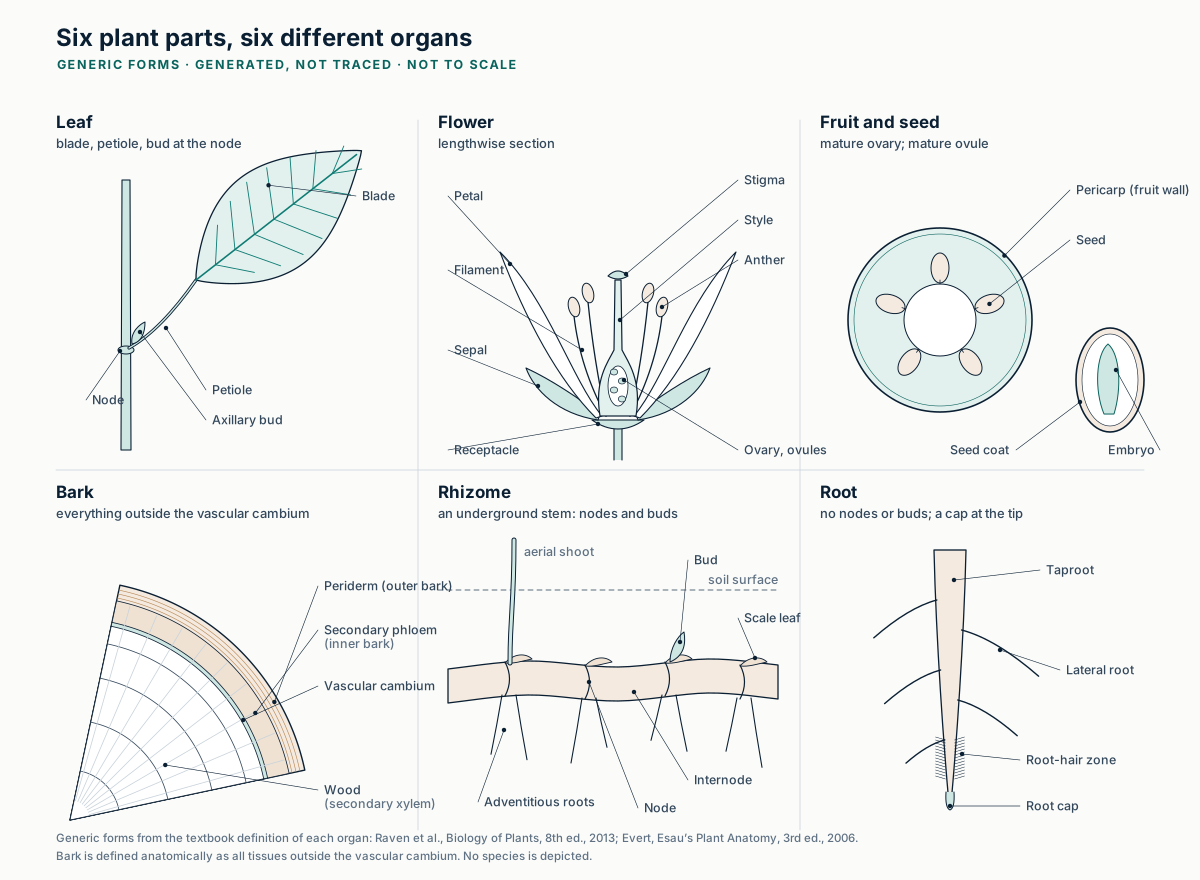
Leaf, flower, fruit, bark, rhizome and root are different organs, and their structure tells them apart before any chemistrySchematic
Six generated drawings in a grid: a leaf with blade, petiole and an axillary bud at the node; a flower cut lengthwise showing sepals, petals, stamens and the pistil with its ovary and ovules; a fruit cut across with its wall and seeds, and a seed with its coat and embryo; a wedge of a woody stem showing wood, the vascular cambium and the bark outside it; a horizontal rhizome with nodes, scale leaves, a bud and adventitious roots; and a taproot with lateral roots, root hairs and a root cap but no nodes.
Organ definitions: Raven PH et al., Biology of Plants, 8th ed., 2013; Evert RF, Esau’s Plant Anatomy, 3rd ed., Wiley 2006. Generic forms, no species depicted. Generated illustration, EUTECNIQ. Full-size SVG
Explanation, details and sources

Under 21 CFR 101.4(h), a botanical's common name follows Herbs of Commerce (1992) and is followed by the part of the plant, in English, and the Latin binomial when needed. A supplement that fails to name the part is misbranded (21 U.S.C. 343(s)(2)(C)). In Acorus, β-asarone is 50–65% of the leaf oil but 9–19% of the rhizome oil of the triploid (EMEA/HMPC/139215/2005; see Course 4).

For a specification, name the accepted species with its author, the part, and the form (whole, cut, powder or extract). The form decides which identity methods still work (section 7).

4 · Macroscopy and microscopy

Microscopy reads the plant's anatomy in a powder, and that evidence is lost at extraction
Ten features an analyst looks for in a powdered herbSchematic, not to scale
Microscopy feature plate: five calcium oxalate crystal forms, a starch grain in bright field and polarized light, four stomatal types and the glandular secretory trichome of Artemisia annua; schematic, not to scaleDrusecluster of crystalsRaphidesneedle bundle in an idioblastPrismsingle block-shaped crystalStyloid and crystal sandlong prism · many fine grainsStarch grainbright field · polarized lightAnomocyticno distinct subsidiary cellsAnisocyticthree unequal subsidiary cellsDiacytictwo cells across the pore axisParacyticcells parallel to the poreGlandular trichomeArtemisia annua, secretorycavityapical cellssubapical cellsstalk
Crystal forms: Lawrie NS, et al. AoB Plants. 2023;15:plad031; Franceschi VR, Nakata PA. Annu Rev Plant Biol. 2005;56:41–71. Stomatal types: Gray A, Liu L, Facette M. Front Plant Sci. 2020;11:881. Starch in polarized light: Hong Kong Chinese Materia Medica Standards (HKCMMS), Radix Ginseng. Trichome: Olsson ME, et al. Phytochemistry. 2009;70:1123–1128; Czechowski T, et al. PNAS. 2016;113:15150–15155.
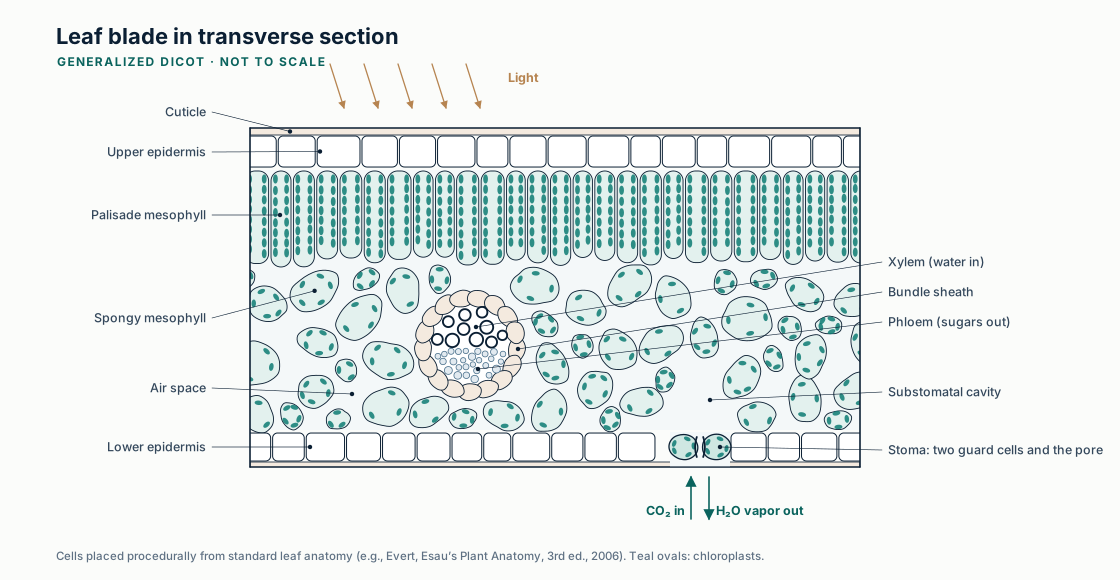
A leaf in cross-section shows the tissues that leaf-powder microscopy looks for: epidermis, stomata, palisade and veinsSchematic
Cross-section of a generalized dicot leaf from top to bottom: waxy cuticle, upper epidermis, columnar palisade cells packed with chloroplasts, loosely packed spongy mesophyll with air spaces, a vein with xylem above and phloem below inside a ring of bundle-sheath cells, and the lower epidermis with a stoma formed by two guard cells opening into a substomatal cavity.
Leaf anatomy: Evert RF, Esau’s Plant Anatomy, 3rd ed., Wiley 2006, ch. on the leaf. Cells placed procedurally; not to scale. Generated illustration, EUTECNIQ. Full-size SVG
Text version of the feature plate
  • Druse: a cluster of calcium oxalate crystals. Raphides: bundles of needles inside a specialized cell. Prism: a single block-shaped crystal. Styloid: a long prism. Crystal sand: many fine grains in one cell.
  • Starch grain: concentric lamellae around a hilum; under a polarizing microscope a black cross appears.
  • Stomata: anomocytic, no distinct subsidiary cells; anisocytic, three subsidiary cells of unequal size; diacytic, a pair of polar subsidiary cells perpendicular to the pore; paracytic, lateral subsidiary cells parallel to the pore.
  • Glandular secretory trichome of Artemisia annua: the enzymes of artemisinin synthesis are expressed only in the apical cells; the subapical cavity stores the product.
In the Hong Kong standards, the three “ginsengs” overlap in crystal and vessel size but differ in which tissues are presentGovernment standard
Diameters of diagnostic powder features in the Hong Kong standards for Panax ginseng, Panax quinquefolius and Eleutherococcus senticosus, in micrometres, log scale110100Diameter (µm), log scaleCalcium oxalate clustersPanax ginseng, calcium oxalate clusters: 19–173 µm19–173Panax quinquefolius, calcium oxalate clusters: 8–91 µm8–91Eleutherococcus senticosus, calcium oxalate clusters: 10–74 µm10–74VesselsPanax ginseng, vessels: 19–100 µm19–100P. quinquefolius: described, size not givenEleutherococcus senticosus, vessels: 18–109 µm18–109Simple starch granulesP. ginseng: described, size not givenPanax quinquefolius, simple starch granules: 2–28 µm2–28Phloem fibresEleutherococcus senticosus, phloem fibres: 9–47 µm9–47Xylem fibresEleutherococcus senticosus, xylem fibres: 8–37 µm8–37Also described in the powderCanalsStarchFibresPanax ginsengPanax ginseng, canals: describedPanax ginseng, starch: describedPanaxquinquefoliusPanax quinquefolius, canals: describedPanax quinquefolius, starch: describedEleutherococcussenticosusEleutherococcus senticosus, canals: describedEleutherococcus senticosus, fibres: describedCanals: resin canals (Panax) or secretorycanals (Eleutherococcus).The ranges overlap, so no singlemeasurement identifies a powder. Thecombination of features does.Panax ginsengPanax quinquefoliusEleutherococcus senticosus
HKCMMS, Department of Health, Hong Kong SAR: Vol. 1, Radix Ginseng; Vol. 3, Radix Panacis Quinquefolii; Vol. 6, Acanthopanacis Senticosi Radix et Rhizoma seu Caulis (the standard names the plant Acanthopanax senticosus). Powder sections, accessed October 23, 2026.
Data table: powder features in the Hong Kong standards
Diameters in micrometres as printed; "described" means the feature is listed without a size
FeaturePanax ginsengPanax quinquefoliusEleutherococcus senticosus
Calcium oxalate clusters19–1738–9110–74
Vessels19–100 (reticulate, scalariform)described (reticulate, scalariform, annular, spiral)18–109 (bordered-pitted)
Simple starch granulesdescribed (compound granules of 2–11 units)2–28 (compound granules of 2–9)not described
Fibresnot describednot describedphloem 9–47; xylem 8–37
Canalsresin canals, yellow secretionresin canals, yellow oil dropletssecretory canals
Explanation, details and sources

USP general chapter ⟨563⟩, Identification of Articles of Botanical Origin, codifies macroscopic and microscopic assessment. Calcium oxalate occurs in five forms (raphides, druses, prisms, styloids and crystal sand), and crystal shape is constant within a species. Starch grains show a hilum and, under a polarizing microscope, a black cross.

Microscopy needs a trained analyst and an authenticated reference, and it says little once material is extracted. Read the chart as a pattern: the two Panax monographs describe no fibres, so a "ginseng" powder full of fibres calls for further tests.

5 · HPTLC

An HPTLC test compares a sequence of zones with a reference run on the same plate

The standard plate carries 15 tracks of 8 mm bands, developed 70 mm in a saturated chamber and viewed three waysSchematic; zones illustrative
HPTLC plate laid out to the USP general chapter 203 parameters: 20 by 10 cm glass plate, 15 tracks of 8 mm bands applied 8 mm from the lower edge, first track at 20 mm, development to 70 mm in a saturated chamber, then three detection modes; schematic1 SST2 ReferenceTracks 3–15: samples70 mm8 mm100020 mm to track 1Plate: 20 × 10 cm glass, silica gel 60 F254Developmentfilter papersolvent33% relative humidityplate conditioned first20 min saturationchamber lined withfilter paper5 mm solvent levelbelow the 8 mmapplication lineDevelop to 70 mmfrom the lower edge,then dryDetectionUV 254 nmUV 366 nmWhite light afterderivatization
Parameters: E. Reich, "HPTLC for polyherbal formulations", USP workshop slides (usp.org), slide 2, citing USP ⟨203⟩; HPTLC Association white paper, "High-Performance Thin-Layer Chromatography in Practice" (camag.com). SST: Do TKT, et al. J Chromatogr A. 2021;1638:461830.
IUPAC definitions applied to the plateRF = ba hRF = 100·RF k = 1 − RFRF Rs = 2(z2 − z1)w1 + w2
Migration distance a
RF, zone 1
RF, zone 2
hRF, zones 1 and 2
ΔRF
k, zones 1 and 2
Resolution Rs
Zone 1 minus reference RF

The plate you set, and the scan of the sample trackCalculation
Defaults: USP ⟨203⟩ geometry (application 8 mm, front 70 mm). Zone positions and widths are illustrative. Densitogram: Gaussian zones with width = 4σ.
Method, assumptions and limits
What it calculates
RF and hRF of two zones, their difference, the retention factor k implied by each RF, the resolution of the pair and the offset of zone 1 from a reference RF.
Equations
RF = b/a and hRF = 100 RF (IUPAC, Pure Appl Chem 1993;65:819, p. 845). R = 1/(1 + k) in column chromatography, and "ideally" RF equals R, so k = (1 − RF)/RF (p. 843). Peak resolution Rs = 2(tR2 − tR1)/(wb1 + wb2) (p. 847), evaluated here with zone positions and widths read on the developed plate.
Variables and units
Positions in mm from the lower edge of the plate; widths in mm along the development direction.
Valid range
Zones must lie between the application position and the front, and the front at least 10 mm above the application.
What it does not establish
Identity. A pharmacopoeial test compares zone sequence, colour and intensity with a reference on the same plate under the stated conditions; a matching RF alone proves nothing.
Verification
Independent Python reference: tests/numerics/ref/academy_plant-identity.py; unit tests: tests/unit/acidn.test.js.
Asian and American ginseng are told apart by one pair of isomers, ginsenoside Rf and pseudoginsenoside F11Government standard
Thin-layer identity criteria in the Hong Kong standards: Panax ginseng must show ginsenoside Rf and no pseudoginsenoside F11; Panax quinquefolius must show 24(R)-pseudoginsenoside F11; Eleutherococcus is identified by isofraxidin, liriodendrin and syringin. Ginsenoside Rf and pseudoginsenoside F11 share the formula C42H72O14P. ginsengP.quinquefoliusE. senticosusGinsenoside Rb1Ginsenoside Rb1 · P. ginseng: zone requiredGinsenoside Rb1 · P. quinquefolius: zone requiredGinsenoside RcGinsenoside Rc · P. ginseng: zone requiredGinsenoside Rc · P. quinquefolius: zone requiredGinsenoside Rg1Ginsenoside Rg1 · P. ginseng: zone requiredGinsenoside Rg1 · P. quinquefolius: zone requiredGinsenoside RfGinsenoside Rf · P. ginseng: zone requiredPseudoginsenoside F11Pseudoginsenoside F11 · P. ginseng: must be absentPseudoginsenoside F11 · P. quinquefolius: zone requiredIsofraxidinIsofraxidin · E. senticosus: zone requiredLiriodendrin (eleutheroside E)Liriodendrin (eleutheroside E) · E. senticosus: zone requiredSyringin (eleutheroside B)Syringin (eleutheroside B) · E. senticosus: zone requiredzone must match the referencemust be absentnot specifiedWhy this pair decides the testGinsenoside Rf and pseudoginsenoside F11 have the same formula and mass. Amolecular mass alone cannot tell Asian from American ginseng; the position ofeach zone on the plate, against reference substances, can.Same formula, different moleculesOHOOOHOHOHOOOHOHOHOHOHOHGinsenoside Rf (PubChem CID 441922)C42​H72​O14​ · 801.02 g/molOOOOOOHOHOHOHOHOHOHOHOHPseudoginsenoside F11 (CID 21633072)C42​H72​O14​ · 801.02 g/mol
HKCMMS TLC identification sections for the three monographs (above). Structures: PubChem CID 441922 and CID 21633072 (isomeric SMILES, retrieved October 23, 2026); formula and mass computed with RDKit.
Text version of the TLC criteria

Radix Ginseng: zones corresponding to ginsenosides Rb1, Rc, Rf and Rg1, "but no spots or bands corresponding to pseudoginsenoside F11". Radix Panacis Quinquefolii: zones corresponding to ginsenosides Rb1, Rc, Rg1 and 24(R)-pseudoginsenoside F11. Eleutherococcus: zones corresponding to isofraxidin, liriodendrin (eleutheroside E) and syringin (eleutheroside B). Both isomers are C42H72O14.

Explanation, details and sources

USP general chapter ⟨203⟩ standardizes high-performance thin-layer chromatography (HPTLC) for botanical identification. A fingerprint is "a sequence of separated zones with a certain color and intensity", read against a botanical reference material and a system suitability test (SST) on track 1.

b: distance from the application position to the zone centre; a: distance to the solvent front; z: zone positions; w: zone widths, all in mm. In a four-laboratory trial, RF values of SST markers were reproducible within a confidence interval of 0.040 (Do et al. 2021).

Worked example (calculator defaults). With the application line at 8 mm and the front at 70 mm, the solvent travels a = 62 mm. A zone centred at 30 mm has RF = 22/62 = 0.355 (hRF 35.5); a neighbour at 33.5 mm has RF = 0.411. With zone widths of 3.0 and 3.2 mm, Rs = 7.0/6.2 = 1.13.

Common misreadings.

  • Comparing RF values between plates or laboratories without an SST. Even with one, RF values of SST markers varied within a confidence interval of 0.04 between four laboratories.
  • Treating one matching zone as identity. The test is the whole sequence of zones, colours and intensities against the reference.
  • Reading an absent zone as proof of absence. A zone below the detection limit of the chosen derivatization does not appear.
6 · Comparing fingerprints

Similarity coefficients compare the shape of two fingerprints, so they cannot see dilution

Densitograms are compared with the correlation coefficient r and the congruence (cosine) coefficient; values near 1 mean similar patterns. Both ignore overall scale. Try each preset.

Two similarity coefficients over the sampled densitograms x (reference) and y (sample)r = Σ(xi − x̄)(yi − ȳ)√[Σ(xi − x̄)² Σ(yi − ȳ)²] c = Σxiyi√(Σxi² Σyi²)
Correlation coefficient r
Congruence coefficient c
Total area, sample ÷ reference
Marker zone, sample ÷ reference

Reference and sample densitograms, and each zone's ratioIllustrative profiles
Eight reference zones with invented intensities, Gaussian σ = 1.6 hRF units, sampled every 0.5 hRF. Coefficients as reviewed by Goodarzi M, et al. Anal Chim Acta. 2013;804:16–28, and Noviana E, et al. Front Pharmacol. 2022;13:853023.
Method, assumptions and limits
What it calculates
The Pearson correlation and the congruence (cosine) coefficient between a reference and a sample densitogram, the ratio of their total areas and the ratio of the marker zone.
Assumptions
Zones at fixed positions with equal Gaussian shape; no baseline drift; densitograms on the same plate and scale. Every intensity is invented for teaching.
What it does not establish
A pass or fail. Acceptance limits for similarity are set per method and validated; none is applied here.
Verification
tests/numerics/ref/academy_plant-identity.py recomputes both coefficients with numpy and scipy.stats.pearsonr.

A similarity coefficient answers "same pattern?", not "same amount?". Pair it with a quantitative assay of named markers, and inspect the zone-by-zone ratios before accepting a high coefficient.

7 · DNA barcoding

DNA barcodes name the species of raw material, but not the plant part, the chemistry or most extracts

The core barcode separated 72% of species in CBOL's test; adding ITS raised discrimination in a larger surveyPeer-reviewed
Species discrimination of candidate DNA barcodes: CBOL 2009 plastid loci, the rbcL plus matK core barcode at 72%, and nuclear ITS results from China Plant BOL 2011 and Chen et al. 2010CBOL 2009, all samples (907 samples, 550 species)single plastid locirpoC1rpoC1: 38% of species discriminated38%rpoBrpoB: 40% of species discriminated40%atpF–atpHatpF–atpH: 50% of species discriminated50%matKmatK: 57% of species discriminated57%rbcLrbcL: 58% of species discriminated58%trnH–psbAtrnH–psbA: 58% of species discriminated58%psbK–psbIpsbK–psbI: 64% of species discriminated64%CBOL 2009, 397 samples with all seven locithe recommended two-locus barcoderbcLrbcL: 61%61%matKmatK: 66%66%rbcL + matK (core barcode)rbcL + matK (core barcode): 72%72%All seven lociAll seven loci: 73%73%0%25%50%75%100%Larger studies with nuclear ITSChina Plant BOL 20116,286 individuals, 1,757 speciesrbcL + matKChina Plant BOL 2011, rbcL + matK: 49.7%49.7%ITS + any plastid markerChina Plant BOL 2011, ITS + any plastid marker: 69.9–79.1%69.9–79.1%Chen et al. 20106,600+ samples, 4,800 speciesITS2 aloneChen et al. 2010, ITS2 alone: 92.7%92.7%0%50%100%Each study used its own samples andcriterion; compare within a panel, notacross.
CBOL Plant Working Group. PNAS. 2009;106(31):12794–12797 (criterion: smallest interspecific p-distance larger than the largest intraspecific distance); China Plant BOL Group. PNAS. 2011;108(49):19641–19646; Chen S, et al. PLoS ONE. 2010;5(1):e8613.
Data table: species discrimination by barcode
Percentage of species discriminated, as reported
Study and sampleLocus or combinationDiscrimination (%)
CBOL 2009, 907 samples, 550 speciesrpoC138
rpoB40
atpF–atpH50
matK57
rbcL58
trnH–psbA58
psbK–psbI64
CBOL 2009, 397 samples with all seven locirbcL61
matK66
rbcL + matK72
All seven loci73
China Plant BOL 2011, 6,286 individuals, 1,757 speciesrbcL + matK49.7
ITS + any plastid marker69.9–79.1
Chen et al. 2010, more than 6,600 samples, 4,800 speciesITS292.7
Each processing step removes a kind of evidence; only chemistry survives into most extractsQualitative summary
Which identity evidence survives processing: morphology is lost at powdering, microscopy at extraction, DNA is degraded or removed in many extracts, and the chemical fingerprint remains but can be mimicked; qualitative summaryWhole or cut herbPowderExtractMulti-ingredient productMacroscopyshape, plant part, foreign matterMacroscopy, Whole or cut herb: applicableMicroscopycells, crystals, starch, hairsMicroscopy, Whole or cut herb: applicableMicroscopy, Powder: applicableMicroscopy, Multi-ingredient product: limitedDNA barcodesequence of one or more lociDNA barcode, Whole or cut herb: applicableDNA barcode, Powder: applicableDNA barcode, Extract: limitedDNA barcode, Multi-ingredient product: partlyChemical fingerprintHPTLC, HPLC, LC-MS profileChemical fingerprint, Whole or cut herb: applicableChemical fingerprint, Powder: applicableChemical fingerprint, Extract: applicableChemical fingerprint, Multi-ingredient product: partlyapplicablepartly: processing or other ingredients interferelimitednot applicableA matching chemical fingerprint can still be imitated by spiking or by synthetic compounds; see the method matrix at the top of the course.
Parveen I, et al. Planta Med. 2016;82(14):1225–1235; Raclariu AC, et al. Phytochem Anal. 2018;29(2):123–128; Raclariu AC, et al. Phytomedicine. 2018;44:32–38; Gafner S, et al. J Nat Prod. 2023;86(2):460–472.
Text version of the processing matrix

Macroscopy needs whole or cut material. Microscopy works on powders but not extracts. DNA barcoding works on raw material; Parveen et al. do "not recommend the use of universal primers for DNA barcoding of processed plant material as a sole means of species identification". Metabarcoding detected the labelled species in 34 of 38 Echinacea products and found other species too. Chemical fingerprints apply to all forms but can be imitated.

Explanation, details and sources

The Consortium for the Barcode of Life plant working group recommended rbcL + matK as the core land-plant barcode (CBOL 2009); later studies added the nuclear ITS2 region. Every organ carries the same genome, so a barcode cannot tell root from leaf.

Limits that matter for a purchase decision.

  • A barcode is only as good as the reference sequence it matches; protocols for DNA-based identification still need standardizing before regulators accept them as routine (Raclariu et al. 2018).
  • Universal primers are not recommended as the sole identification of processed material (Parveen et al. 2016).
  • DNA says nothing about the marker content the specification controls.
8 · Adulteration

Market surveys find substitution, dilution and spiking that any single test would miss

Seven published studies flagged 11% to 43% of the products they testedPeer-reviewed
Share of products flagged in seven published authenticity studies, 10% to 43%, each with its own definition, method and sample sizeProduct or studyShare flaggedSamples and finding0%10%20%30%40%50%Grape seed extractVillani et al. 2015 · HPLC-UV-MSGrape seed extract: 42.9% (Villani et al. 2015 · HPLC-UV-MS)43%n = 21 · 9 flaggedcontained peanut skin extractSt. John's wortFrommenwiler et al. 2016 · HPTLCSt. John's wort: 37.8% (Frommenwiler et al. 2016 · HPTLC)38%n = 37 · 14 flagged8 with synthetic dyes, 6 off-fingerprintGinkgo leaf productsWohlmuth et al. 2014 · HPLCGinkgo leaf products: 37.5% (Wohlmuth et al. 2014 · HPLC)38%n = 8 · 3 flaggedadded flavonol aglycones and genisteinBlack cohosh productsJiang et al. 2006 · HPLC, LC-MSBlack cohosh products: 36.4% (Jiang et al. 2006 · HPLC, LC-MS)36%n = 11 · 4 flaggedAsian Actaea (3 alone, 1 mixed)St. John's wort productsRaclariu et al. 2017 · DNA metabarcodingSt. John's wort products: 32.0% (Raclariu et al. 2017 · DNA metabarcoding)32%n = 78H. perforatum not detected in 32%Turmeric, 48 publicationsGafner et al. 2025 · scoping reviewTurmeric, 48 publications: 20.0% (Gafner et al. 2025 · scoping review)20%n = 2,23520.0% adulterated overallEchinacea productsRaclariu et al. 2018 · metabarcodingEchinacea products: 10.5% (Raclariu et al. 2018 · metabarcoding)11%n = 38 · 4 flaggedEchinacea not detectedchemical methodsDNA metabarcoding
Villani TS, et al. Food Chem. 2015;170:271–280; Frommenwiler DA, et al. J AOAC Int. 2016;99(5):1204–1212; Wohlmuth H, et al. Phytomedicine. 2014;21(6):912–918; Jiang B, et al. J Agric Food Chem. 2006;54(9):3242–3253; Raclariu AC, et al. Sci Rep. 2017;7:1291; Gafner S, et al. Pharm Biol. 2026;64(1):87–107; Raclariu AC, et al. Phytomedicine. 2018;44:32–38. Samples are small and not random; these are not market prevalence estimates.
Data table: authenticity surveys
Products flagged, as reported in each study
ProductStudyMethodFlagged / testedShare (%)
Grape seed extractVillani 2015HPLC-UV-MS9 / 2142.9
St. John's wortFrommenwiler 2016HPTLC14 / 3737.8
Ginkgo leaf productsWohlmuth 2014HPLC3 / 837.5
Black cohosh productsJiang 2006HPLC-PDA, LC-MS4 / 1136.4
St. John's wort productsRaclariu 2017DNA metabarcodingspecies not detected in 32% of 7832
Turmeric (48 publications)Gafner 2025scoping review2,235 samples20.0
Echinacea productsRaclariu 2018DNA metabarcoding4 / 3810.5
Explanation, details and sources

The ABC–AHP–NCNPR Botanical Adulterants Prevention Program documents how ingredients are faked and how each scheme is detected; its review lists bilberry, ginkgo, grape seed, St. John's wort and turmeric among ingredients at risk (Gafner et al. 2023).

An identity file therefore combines methods by material form: anatomy plus a chemical fingerprint for raw herbs and powders, a fingerprint plus a quantitative assay for extracts, and metabarcoding when a blend may hide other plants.

Key terms

Nine terms used in identity specifications

Show the 9 key terms
Accepted name
The name a checklist such as POWO uses for a species; other names are synonyms.
Author citation
The botanist who published the name, e.g. "L." for Linnaeus.
Plant part
The organ used (root, leaf, flower); required on U.S. supplement labels.
Druse
A spherical cluster of calcium oxalate crystals.
RF
Zone travel divided by solvent-front travel, both from the application line.
SST
System suitability test: a reference mixture that shows the plate ran correctly.
Botanical reference material
Authenticated plant material run beside the sample.
DNA barcode
A short standard DNA region compared with a reference library.
Metabarcoding
Sequencing many barcode copies at once to list the species in a mixture.
Check your understanding

Five questions on choosing an identity test

A supplier's certificate says "identity: conforms". Is that enough under Part 111?

No. § 111.75(a)(1)(i) requires the manufacturer to conduct at least one appropriate identity test or examination on each dietary ingredient, unless FDA has granted a petition. Certificates can support other components under § 111.75(a)(2), not this test.

A lot of "ginseng" powder shows ginsenoside F11 on the HPTLC plate. What does the Hong Kong standard say?

Radix Ginseng (Panax ginseng) must show no zone for pseudoginsenoside F11, so the lot fails as P. ginseng. F11 is required for P. quinquefolius, which suggests American ginseng or a mixture.

Why can a DNA barcode not confirm that a product is made from root rather than leaf?

All organs of a plant carry the same genome. The part is read from anatomy (macroscopy, microscopy) or from organ-specific chemistry.

A sample's densitogram has r = 1.00 against the reference. Can it still be adulterated?

Yes. Dilution with an inert filler scales every zone equally and leaves r and the congruence coefficient unchanged. A quantitative assay is needed.

Which method would reveal a second, undeclared plant in a capsule blend?

DNA metabarcoding. Raclariu et al. found that TLC and HPLC-MS confirmed target compounds but gave no information on other plant ingredients.

Next: genomes, species and chemotypes

Why closely related plants make different compounds, and how genome size and ploidy are measured.