

Genomes explain why plants that share a name can make different compounds, so a specification must test the chemistry as well as the species
This course covers how many plant species are known, how genome size and ploidy are measured, what the chloroplast genome can and cannot tell apart, and how biosynthetic genes decide a plant's chemistry. Each topic ends at a decision a botanical specification has to make.
Medicinal-plant genome assemblies differ about 18-fold in size, from 0.56 Gb in Catharanthus roseus to 9.87 Gb in Ginkgo
Data table: assembly sizes
| Species | Group | Gb | Note |
|---|---|---|---|
| Ginkgo biloba | Gymnosperm | 9.87 | Nearly complete assembly, 27,832 genes (2021) |
| Camellia sinensis var. assamica | Flowering plants | 3.02 | 80.9% repeats |
| Panax ginseng | Flowering plants | 2.98 | Tetraploid assembly, 59,352 annotated genes |
| Papaver somniferum | Flowering plants | 2.72 | 11 chromosomes; 15-gene alkaloid cluster |
| Artemisia annua | Flowering plants | 1.5 | Per haplotype; about 50,000 genes per haplotype |
| Catharanthus roseus | Flowering plants | 0.5617 | 8 pseudochromosomes, contig N50 24.7 Mb |
You will learn
- How many vascular plant species are accepted, and how few have a measured genome size or an assembly.
- What 1C, 2C and 1Cx mean, and how flow cytometry turns a peak ratio into picograms and megabases.
- How polyploidy changes chemistry, using Acorus and β-asarone as the worked case.
- Why the four-part chloroplast genome carries the standard DNA barcodes, and where they stop resolving species.
- What a medicinal-plant genome paper reports, and how much sequencing an assembly needs.
- How the artemisinin pathway and the noscapine gene cluster tie genes to a specification.
Botanists accept 342,953 vascular plant species, and fewer than 1,000 land plants had a genome assembly in 2021
Data table: names, species, C-values and assemblies
| Quantity | Count | Date and source |
|---|---|---|
| Plant names in WCVP | 1,383,297 | April 16, 2021; Govaerts 2021 |
| Accepted vascular plant species | 342,953 | April 16, 2021; Govaerts 2021 |
| Species with a C-value (all groups) | 12,273 | Release 7.1, April 2019 |
| Angiosperms with a C-value | 10,770 | Release 7.1 |
| Land-plant species with a genome assembly | 798 | January 2021; Marks 2021 |
Explanation, details and sources
The World Checklist of Vascular Plants, which feeds Kew's Plants of the World Online, listed 342,953 accepted species among 1,383,297 names in April 2021. Genome data cover a small fraction: Marks et al. (2021) counted 798 land-plant species with assemblies, about 0.16% of roughly 350,000 land plants.
Treat any species count as dated: WCVP is "continuously updated" (Govaerts et al. 2021), so cite the version. For product work the useful number is smaller: how many candidate species have a measured genome size, a reference sequence or a published pathway. For most, none exists.
Plant genomes range from 0.061 to 160 Gbp, so every size must state whether it is 1C, 2C or 1Cx
Data table: genome sizes in the chart
| Species | Gbp | Type | Source |
|---|---|---|---|
| Genlisea tuberosa | ≈0.061 | FC | Fleischmann 2014 |
| Glycyrrhiza uralensis | ≈0.379 | AS | Mochida 2017 |
| Acorus americanus (2x) | 0.430–0.465 | FC | 2C 0.88–0.95 pg × 978/2; Sokoloff 2024 |
| Catharanthus roseus | 0.5617 | AS | Xu 2023 |
| Artemisia annua | 1.5 | AS | Liao 2022 |
| Papaver somniferum | 2.72 | AS | Guo 2018 |
| Panax ginseng | 2.98 | AS | Kim 2018 |
| Camellia sinensis | 3.02; 3.1 | AS | Xia 2017 (var. assamica); Wei 2018 (var. sinensis) |
| Ginkgo biloba | 9.87 | AS | Liu 2021 |
| Paris japonica | 148.89 | FC | Pellicer 2010, as converted by Fernández 2024 |
| Tmesipteris oblanceolata | 160.45 | FC | Fernández 2024 |
Method, assumptions and limits
- What it calculates
- The sample's 2C DNA content from the ratio of G1 peak positions, then 1C, 1Cx for the ploidy you enter, megabases, and whether 2C falls inside one of three published Acorus ranges.
- Equations
- 2Csample = (mean fluorescence of sample ÷ mean fluorescence of standard) × 2Cstandard, the formula quoted by Al-Qurainy et al. (Plants 2021;10:1362); 1 pg = 978 Mbp (Doležel et al. 2003); 1Cx = 2C/p (Greilhuber et al. 2005).
- Assumptions
- Sample and standard nuclei stained together under the same conditions; fluorescence proportional to DNA content; G1 peaks identified correctly. The warning for peaks within 5% of each other is this tool's rule for overlapping peaks, not a published criterion.
- What it does not establish
- Ploidy. The tool divides by the ploidy you enter; inferring ploidy from DNA content needs reference values for known cytotypes, which is why the Acorus ranges are shown.
- Verification
tests/numerics/ref/academy_genomes-and-species.py;tests/unit/acidn.test.js.
Explanation, details and sources
Greilhuber et al. (2005) separate the holoploid genome size (C-value, the whole chromosome complement) from the monoploid genome size (Cx, one chromosome set). In a diploid 1C equals 1Cx; in a tetraploid it does not. Flow cytometry measures the 2C content of nuclei against an internal standard, and 1 pg of DNA equals 978 Mbp (Doležel et al. 2003).
Worked examples. Paris japonica: 1C = 152.23 pg × 978 Mbp/pg ≈ 148,900 Mbp, the 148.89 Gbp quoted by Fernández et al. (2024). Acorus calamus against a tomato standard (2C = 1.96 pg): peaks at channels 260 and 400 give 2C = 0.65 × 1.96 = 1.27 pg, inside the published triploid range (calculator defaults).
Common misreading. Assembly length is not a flow-cytometry 1C value. Ginkgo's draft assembly was 10.61 Gb and the later, nearly complete one 9.87 Gb (Guan et al. 2016; Liu et al. 2021).
Why it matters for a program. Genome size sets the sequencing budget: at equal coverage, Ginkgo (9.87 Gb) needs about 6.6 times the reads of Artemisia annua (1.5 Gb per haplotype). It also tells a laboratory which flow-cytometry standard to run, and a shift in 2C can flag a different cytotype.
Polyploidy is common in plants, and in Acorus the number of chromosome sets tracks β-asarone
Data table: Acorus cytotypes
| Cytotype | 2C DNA (pg) | β-asarone, leaf oil | β-asarone, rhizome oil | β-asarone, dried rhizome |
|---|---|---|---|---|
| Diploid, A. americanus | 0.88–0.95 | not detected | not detected | — |
| Triploid, A. calamus | 1.23–1.31 | 50–65% | 9–19% | 0.3% |
| Tetraploid, A. verus | 1.47–1.61 | major component | 85–95% | 4.4–8.3% |
Explanation, details and sources
Ploidy increase accompanies about 15% of angiosperm and 31% of fern speciation events (Wood et al. 2009), and whole-genome duplications occurred in the ancestors of all seed plants and of all angiosperms (Jiao et al. 2011). Sweet flag shows what this means for a product: its three cytotypes differ in DNA content and in β-asarone, and calamus may not be added to U.S. food (21 CFR 189.110).
Polyploid lines are frequent: Wood et al. (2009) estimate a standing incidence of polyploid species within genera of 35%. Any species a supplier offers may therefore exist in several cytotypes, and chemistry can differ between them, as Acorus shows.
For a specification, the species name alone does not fix β-asarone. A flow-cytometry ploidy check or an ITS barcode identifies the cytotype (Sokoloff et al. 2024), and a quantitative β-asarone assay confirms the chemistry. Databases can disagree: NCBI files the diploid's chloroplast genome under Acorus calamus var. americanus (NC_010093), while POWO accepts Acorus americanus.
The chloroplast genome is small and conserved, which makes it easy to barcode and slow to separate close relatives
src/modules/acidn/compute/plastome_stats.py. Loci: CBOL Plant Working Group 2009.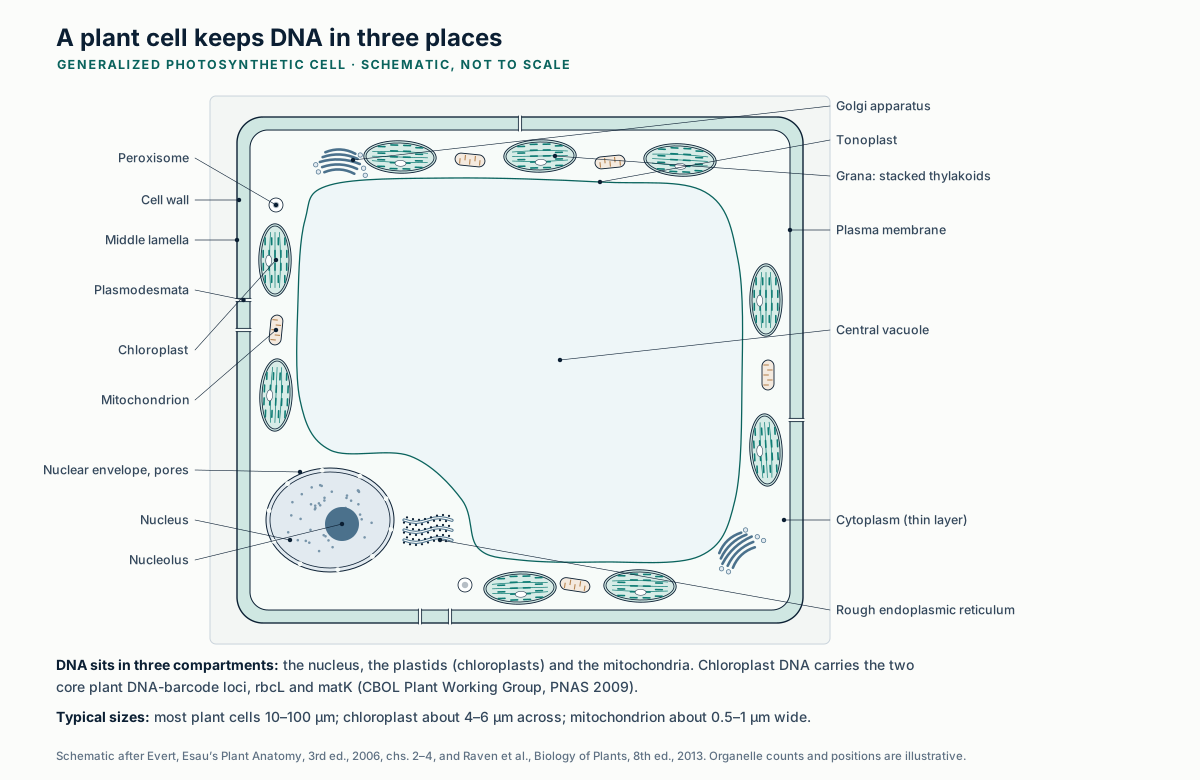
Data table: chloroplast genome partitions
| Species | RefSeq | Length | LSC | SSC | IR (each) | GC, whole | GC, IR |
|---|---|---|---|---|---|---|---|
| Ginkgo biloba | NC_016986.1 | 156,988 | 108,172 | 22,762 | 13,027 | 39.6 | 47.9 |
| Acorus calamus | NC_007407.1 | 153,821 | 83,493 | 18,278 | 26,025 | 38.6 | 42.6 |
| Curcuma longa | NC_042886.1 | 159,550 | 92,604 | 18,542 | 24,202 | 36.3 | 42.8 |
| Papaver somniferum | NC_029434.1 | 152,931 | 83,029 | 17,920 | 25,991 | 38.9 | 43.1 |
| Glycyrrhiza glabra | NC_024038.1 | 127,943 | — | — | — | 34.2 | — |
| Hypericum perforatum | NC_083133.1 | 139,725 | 95,109 | 11,084 | 16,766 | 37.4 | 43.8 |
| Arabidopsis thaliana | NC_000932.1 | 154,478 | 84,170 | 17,780 | 26,264 | 36.3 | 42.3 |
| Camellia sinensis | NC_020019.1 | 157,103 | 86,645 | 18,276 | 26,091 | 37.3 | 42.9 |
| Catharanthus roseus | NC_021423.1 | 154,950 | 85,765 | 17,997 | 25,594 | 38.1 | 43.3 |
| Withania somnifera | NC_047245.1 | 155,365 | 86,260 | 18,325 | 25,390 | 37.6 | 43.0 |
| Nicotiana tabacum | NC_001879.2 | 155,943 | 86,686 | 18,571 | 25,343 | 37.8 | 43.2 |
| Artemisia annua | NC_034683.1 | 150,952 | 82,772 | 18,268 | 24,956 | 37.5 | 43.1 |
| Panax ginseng | NC_006290.1 | 156,318 | 86,106 | 18,070 | 26,071 | 38.1 | 43.1 |
| Panax quinquefolius | NC_027456.1 | 156,088 | 86,095 | 17,993 | 26,000 | 38.1 | 43.1 |
| Panax notoginseng | NC_026447.1 | 156,387 | 86,111 | 18,554 | 25,861 | 38.1 | 43.2 |
| Panax japonicus | NC_028703.1 | 156,188 | 86,199 | 18,013 | 25,988 | 38.1 | 43.1 |
| Eleutherococcus senticosus | NC_016430.1 | 156,768 | 86,755 | 18,153 | 25,930 | 38.0 | 43.1 |
Data table: pairwise p-distances
| Gene | Pair | Aligned sites | Differences | p-distance (%) |
|---|---|---|---|---|
| rbcL | P. ginseng vs P. quinquefolius | 1,437 | 1 | 0.07 |
| rbcL | P. ginseng vs P. notoginseng | 1,437 | 7 | 0.49 |
| rbcL | P. ginseng vs P. japonicus | 1,437 | 8 | 0.56 |
| rbcL | P. ginseng vs E. senticosus | 1,428 | 19 | 1.33 |
| rbcL | P. quinquefolius vs P. notoginseng | 1,437 | 6 | 0.42 |
| rbcL | P. quinquefolius vs P. japonicus | 1,437 | 7 | 0.49 |
| rbcL | P. quinquefolius vs E. senticosus | 1,428 | 19 | 1.33 |
| rbcL | P. notoginseng vs P. japonicus | 1,437 | 5 | 0.35 |
| rbcL | P. notoginseng vs E. senticosus | 1,428 | 20 | 1.40 |
| rbcL | P. japonicus vs E. senticosus | 1,428 | 21 | 1.47 |
| matK | P. ginseng vs P. quinquefolius | 1,512 | 1 | 0.07 |
| matK | P. ginseng vs P. notoginseng | 1,512 | 5 | 0.33 |
| matK | P. ginseng vs P. japonicus | 1,512 | 8 | 0.53 |
| matK | P. ginseng vs E. senticosus | 1,512 | 19 | 1.26 |
| matK | P. quinquefolius vs P. notoginseng | 1,512 | 6 | 0.40 |
| matK | P. quinquefolius vs P. japonicus | 1,512 | 9 | 0.60 |
| matK | P. quinquefolius vs E. senticosus | 1,512 | 20 | 1.32 |
| matK | P. notoginseng vs P. japonicus | 1,512 | 9 | 0.60 |
| matK | P. notoginseng vs E. senticosus | 1,512 | 22 | 1.46 |
| matK | P. japonicus vs E. senticosus | 1,512 | 23 | 1.52 |
Explanation, details and sources
Land-plant chloroplast genomes are single circular molecules with two inverted repeats (IR) separating a large and a small single-copy region (LSC, SSC). They carry 120–130 genes and range from 107 kb to 218 kb, independent of nuclear genome size (Daniell et al. 2016). Some legumes have lost one inverted repeat.
Reading the heat map. One base in 1,437 rbcL sites and one in 1,512 matK sites separate the two ginseng records. A barcode call between them therefore rests on a single position, which is why identity standards add chemical markers such as ginsenoside Rf and pseudoginsenoside F11 (Course 3), and why nuclear ITS2 is often added for close relatives.
Medicinal-plant genomes are large and repetitive, and their numbers change between assemblies
Data table: genome assemblies
| Species | Year | Assembly (Gb) | Protein-coding genes | Note |
|---|---|---|---|---|
| Glycyrrhiza uralensis | 2017 | ≈0.379 | 34,445 | draft |
| Catharanthus roseus | 2023 | 0.5617 | — | 8 pseudochromosomes; contig N50 24.7 Mb |
| Artemisia annua | 2018 | — | 63,226 | highly heterozygous |
| Artemisia annua | 2022 | 1.5 | ≈50,000 per haplotype | two haplotype-resolved strains |
| Papaver somniferum | 2018 | 2.72 | — | 11 chromosomes; 15-gene alkaloid cluster |
| Panax ginseng | 2018 | 2.98 | 59,352 | tetraploid |
| Camellia sinensis var. assamica | 2017 | 3.02 | — | 80.9% repeats |
| Camellia sinensis var. sinensis | 2018 | 3.1 | 33,932 | at least 64% repeats |
| Ginkgo biloba | 2016 | 10.61 | 41,840 | draft |
| Ginkgo biloba | 2021 | 9.87 | 27,832 | nearly complete; scaffold N50 775 Mb |
Method, assumptions and limits
- What it calculates
- Sequence produced, coverage per haplotype, the expected uncovered fraction and bases, and the reads and gigabases needed for a target coverage.
- Assumptions
- Reads land uniformly at random and independently; each of p haplotypes receives an equal share. The genome size you enter is one haplotype (monoploid).
- What it does not establish
- An assembly. Repeats longer than the reads, heterozygosity, GC bias and duplicate reads all leave gaps the Poisson model does not predict; the tea and Ginkgo papers above describe genomes dominated by repeats.
- Verification
- The Python reference checks e−c against a simulation that places reads at random on a one-megabase genome (
tests/numerics/ref/academy_genomes-and-species.py).
Explanation, details and sources
Repeats make up at least 64% of the tea genome (Wei et al. 2018); Artemisia annua is highly heterozygous (Shen et al. 2018). Ginkgo's gene count fell from 41,840 to 27,832 when a nearly complete assembly replaced the draft (Liu et al. 2021). Cite a genome by its assembly and year, not by species alone.
What a genome paper can give a specification.
- Gene copy number linked to a marker: artemisinin content correlated with the number of amorpha-4,11-diene synthase genes, confirmed by resequencing 36 plants (Liao et al. 2022).
- Where a compound is made: ginsenosides are produced largely in shoots and moved to the roots (Kim et al. 2018).
- Reference sequences for species-specific DNA primers, which Parveen et al. (2016) recommend over universal primers for processed material.
Worked example (calculator defaults). Artemisia annua at 1.5 Gb per haplotype, two haplotypes, 400 million reads of 150 bp: 60 Gb of sequence, 20× per haplotype, and an expected uncovered fraction of e−20 ≈ 2 × 10⁻⁹. Reaching 30× per haplotype needs 600 million reads (90 Gb). The real limit is the repeats, not the arithmetic.
Biosynthetic genes decide which compounds a plant can make, and where
Text version of the artemisinin pathway
Amorpha-4,11-diene synthase (ADS) cyclizes farnesyl diphosphate. CYP71AV1 oxidizes amorpha-4,11-diene through artemisinic alcohol and aldehyde to artemisinic acid. DBR2 reduces the Δ11(13) double bond of artemisinic aldehyde; an aldehyde dehydrogenase (ALDH1) gives dihydroartemisinic acid, which converts to artemisinin without enzymes. Engineered yeast reached 25 g/L of artemisinic acid, converted chemically to artemisinin.
Text version of the noscapine cluster
Winzer et al. found ten genes encoding five enzyme classes expressed only in the high-noscapine variety HN1, tightly linked in a mapping population and confirmed as a cluster by BAC sequencing. Li and Smolke list four cytochrome P450s (CYP719A21, CYP82Y1, CYP82X1, CYP82X2), three methyltransferases (PsMT1–3), a carboxylesterase (PsCXE1), a short-chain dehydrogenase/reductase (PsSDR1) and an acetyltransferase (PsAT1).
Explanation, details and sources
Artemisinin is made in the apical cells of glandular trichomes; the last steps run without enzymes. Opium poppy's noscapine genes sit together in one cluster, expressed only in a high-noscapine variety. Both cases explain why a marker assay belongs in a specification next to the species name.
Chemotypes also arise without polyploidy. Thyme has six chemotypes that show marked spatial segregation in nature (Thompson et al. 2003); their dominant monoterpenes are drawn on the discovery and characterization page.
Because clustered genes are inherited together, a compound can belong to a variety rather than to a species. A specification that names only the species cannot guarantee the marker; a quantitative assay, and where genetics is known a cytotype or chemotype check, can.
Nine terms used in genome and chemotype work
Show the 9 key terms
- C-value (1C)
- DNA content of an unreplicated haploid chromosome complement.
- Monoploid genome size (1Cx)
- DNA content of one chromosome set.
- Ploidy
- The number of chromosome sets in a somatic nucleus.
- Internal standard
- Nuclei of known 2C stained together with the sample.
- Inverted repeat
- The duplicated region of the chloroplast genome holding the rRNA genes.
- p-distance
- Share of aligned sites that differ between two sequences.
- Coverage
- Average number of reads covering each base.
- Gene cluster
- Pathway genes lying together on a chromosome.
- Chemotype
- A chemically distinct form within one species.
Five questions on genomes and chemotypes
A flow-cytometry run gives a sample peak at 260 and a tomato standard (2C = 1.96 pg) at 400. What is the 2C value, and which Acorus range does it fall in?
2C = 260/400 × 1.96 = 1.27 pg, inside the triploid A. calamus range of 1.23–1.31 pg (Sokoloff et al. 2024).
Why can rbcL and matK fail to separate Panax ginseng from Panax quinquefolius?
The two RefSeq chloroplast genomes differ at one site in each gene. Chloroplast genomes are highly conserved, so close relatives share most sites; CBOL left 28% of species resolved only to a group of congeners.
Is "Acorus calamus rhizome" enough to specify a material low in β-asarone?
No. β-asarone ranges from not detected in the diploid to 85–95% of rhizome oil in the tetraploid. The cytotype and a β-asarone assay must be specified; in U.S. food, calamus is not permitted at all (21 CFR 189.110).
A paper reports 41,840 genes for Ginkgo; another reports 27,832. Which is right?
The later, nearly complete assembly (Liu et al. 2021) states that its 27,832 genes supersede the earlier draft annotation. Cite the assembly and year.
At 20× coverage per haplotype, what fraction of a haplotype does the Poisson model leave uncovered?
e−20 ≈ 2 × 10⁻⁹. Real assemblies have far larger gaps because repeats and biases break the model's assumptions.
Next: the soil a plant grows in
Course 5 covers how soil, climate and harvest timing change metals and marker compounds.