

Soil and harvest set a botanical's metal content and chemistry, before any laboratory sees it
A toxic element followed from soil water into a root, a dried plant, an extract and a daily dose, against USP ⟨2232⟩ limits; then how harvest timing and drying change what a botanical contains.
One in five Ayurvedic products bought online in 2005 contained detectable lead, mercury or arsenic
Data table: the flow
| Step | Products |
|---|---|
| Ordered | 230 |
| Analyzed by XRF | 193 |
| Not analyzed | 37 |
| Detectable Pb, Hg or As (20.7% of 193) | 40 |
| None detected | 153 |
You will learn
- Why soil pH, organic matter and cation exchange change how much cadmium a plant takes up.
- How to calculate a bioconcentration factor, and why it is not a constant.
- How to carry a metal from soil to a daily dose and compare it with USP ⟨2232⟩.
- How to tell uptake from soil apart from contamination added after harvest.
- How harvest stage, season and drying change constituent content, with published numbers.
- Which WHO GACP and CITES rules apply to cultivated and wild-collected material.
Roots take up the dissolved fraction of a soil metal, and soil pH sets how large that fraction is
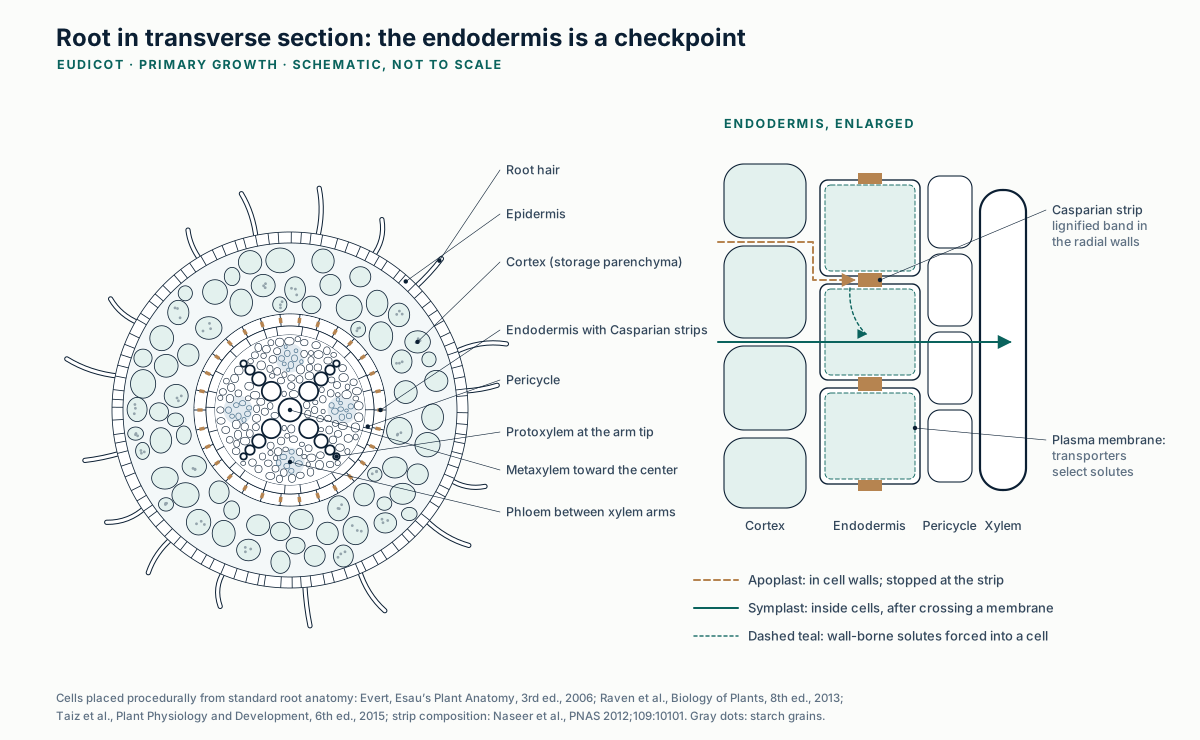
Text version of the soil and root schematic
Cadmium in soil occurs in exchangeable form on charged clay and organic surfaces, bound to carboxylate groups of organic matter, sorbed on iron and manganese oxides, and as precipitates such as cadmium carbonate, which forms near pH 7 in model systems. These pools exchange with cadmium dissolved in soil water as Cd²⁺ and organic complexes. Lower pH releases cadmium from the solid pools into solution. In the Ecuador cacao survey, bean cadmium rose with total soil cadmium and fell with soil pH, oxalate-extractable manganese and organic carbon. Calcium competes with cadmium for uptake.
At the root, ions cross the epidermis and cortex either in the cell walls or through cells. The Casparian strip of the endodermis blocks the cell-wall route, so the element must cross a membrane through a transporter. In rice, NRAMP5 carries manganese and cadmium into root cells, and the silicon transporters Lsi1 and Lsi2 carry arsenite. The xylem then carries the element to the shoot and the harvested part.
Explanation, details and sources
Soil cadmium is spread over pools held on clay, organic matter and iron or manganese oxides, in precipitates, and dissolved in soil water. Roots take it from the dissolved pool. In a synthesis of 31 cacao studies, total soil cadmium, soil pH and leaf cadmium best predicted bean cadmium; "available" cadmium from extraction tests had a negligible effect.
In 672 published cacao observations, the median bean-to-soil cadmium ratio falls from 3.4 below pH 5 to 1.2 at pH 6.5–7.0
Data table: BCF by soil-pH class
| Soil pH class | n | BCF, 25th percentile | BCF, median | BCF, 75th percentile | Median bean Cd, mg/kg | Median soil Cd, mg/kg |
|---|---|---|---|---|---|---|
| < 5.0 | 108 | 1.49 | 3.36 | 6.32 | 0.75 | 0.30 |
| 5.0–5.5 | 108 | 1.55 | 2.44 | 3.44 | 0.69 | 0.30 |
| 5.5–6.0 | 135 | 1.06 | 2.00 | 2.98 | 0.46 | 0.30 |
| 6.0–6.5 | 181 | 0.85 | 1.32 | 2.13 | 0.48 | 0.35 |
| 6.5–7.0 | 90 | 0.70 | 1.20 | 1.92 | 0.61 | 0.56 |
| ≥ 7.0 | 50 | 1.12 | 1.54 | 2.42 | 0.76 | 0.42 |
BCF = whole-bean Cd ÷ total soil Cd for each observation (the paper's definition). Percentiles by linear interpolation. 566 of the 672 observations come from Ecuador, from 7 studies in all. The paper reports, for all observations with both values, a median BCF of 1.8 and a mean of 2.5, with 77.0% above 1.
Data table: median whole-bean Cd (mg/kg) and n by soil Cd and pH class
| Soil Cd, mg/kg | pH < 5.0 | 5.0–5.5 | 5.5–6.0 | 6.0–6.5 | 6.5–7.0 | ≥ 7.0 |
|---|---|---|---|---|---|---|
| < 0.2 | 0.43 (37) | 0.23 (23) | 0.29 (36) | 0.23 (26) | 0.22 (10) | 0.21 (6) |
| 0.2–0.4 | 0.99 (34) | 0.63 (43) | 0.43 (54) | 0.33 (73) | 0.30 (20) | 0.50 (12) |
| 0.4–0.8 | 1.56 (23) | 1.52 (33) | 1.02 (36) | 0.91 (50) | 0.61 (33) | 0.89 (26) |
| ≥ 0.8 | 2.44 (14) | 3.52 (9) | 2.27 (9) | 1.59 (32) | 1.22 (27) | 1.15 (6) |
Number of observations in parentheses. Class bounds are lower-inclusive. Whole bean means nib plus shell, as the dataset records it.
101 observations from 4 studies. 63% of beans in this window exceed 0.60 mg/kg.
Method, assumptions and limits
- What it shows
- Statistics of published whole-bean cadmium measurements whose soil pH and total soil cadmium fall in the chosen window: count, median, 90th percentile, shares above 0.60 and 0.80 mg/kg, and median BCF.
- Data
- 672 observations from the dataset published with Wade et al. (2022) that report soil pH, total soil Cd and whole-bean Cd above zero. Windows: pH centre ± 0.5; soil Cd centre ÷ 1.5 to × 1.5. Statistics are precomputed (numpy, linear-interpolation percentiles); no observations are shipped to the browser. Windows with fewer than 10 observations show no statistics.
- Limits
- 566 observations are from Ecuador and some studies report means of several samples. Cultivar, plant age, sampling depth and laboratory method vary between studies. The EU limits apply to cocoa products, not to beans.
- What it does not establish
- It does not predict the cadmium in beans from any particular farm.
- Verification
- Window statistics are recomputed independently from the source CSV in tests/numerics/ref/academy_soil-and-cultivation.py.
- References
- Wade J, et al. PLoS One 2022;17(2):e0261989; Regulation (EU) 2023/915.
Explanation, details and sources
Wade and colleagues compiled soil and bean measurements from the literature and published the dataset. EUTECNIQ grouped its 672 paired observations by soil pH and soil cadmium. The authors' own model found that raising soil pH from 5 to 7, or soil organic carbon from 2% to above 3.5%, would halve the BCF.
How the numbers are measured. Total soil metal is measured after strong-acid digestion; "available" metal with salt or dilute-acid extractions, which in the cacao synthesis tracked total cadmium and explained little on their own. Most cacao studies sampled only the top 30 cm, although total cadmium rose about 200% below 25–35 cm, so surface samples may understate what deep roots reach. Plant tissue is dried, acid-digested and analyzed element by element.
Transfer factors differ between elements by orders of magnitude, and in one wolfberry survey cadmium's was about 340 times lead's
Data table: wolfberry BCF by element
| Element | Mean fruit, mg/kg | Mean soil, mg/kg | BCF (Table 2) |
|---|---|---|---|
| Cadmium | 0.100 | 0.0260 | 5.82 |
| Copper | 8.70 | 5.27 | 1.76 |
| Zinc | 19.6 | 42.5 | 0.475 |
| Chromium | 2.62 | 52.9 | 0.0560 |
| Arsenic | 0.200 | 8.36 | 0.0260 |
| Nickel | 0.880 | 41.0 | 0.0230 |
| Lead | 0.350 | 23.0 | 0.0170 |
The paper defines BCF = Cfruit ÷ Csoil (its Equation 1). Its reported BCFs differ from the ratio of the two means, which suggests they were averaged per sample; we reproduce Table 2 as published.
Because b1 < 1, the BCF falls as soil concentration rises: for cadmium it is 0.62 at 1 mg/kg and 0.22 at 10 mg/kg. U.S. EPA, Guidance for Developing Ecological Soil Screening Levels, Attachment 4-1 (revised April 2007), from Bechtel Jacobs (1998).
Explanation, details and sources
Zhou and colleagues sampled wolfberry (Lycium barbarum) fruit and root-zone soil at 37 sites in Ningxia, China. Cadmium and copper had BCFs above 1; lead had the lowest, 0.017. With a BCF that low, a high lead result in a botanical calls for a look at contamination after harvest.
Documented contamination traces back to soil, water, processing or deliberate addition, and each route needs its own control
Data table: Saper et al. (2008)
| Group | Products with metals, % | 95% CI, % |
|---|---|---|
| All products (n = 193) | 20.7 | 15.2–27.1 |
| U.S.-manufactured | 21.7 | 14.6–30.4 |
| Indian-manufactured | 19.5 | 11.3–30.1 |
| Rasa shastra | 40.6 | not given in abstract |
| Non-rasa shastra | 17.1 | not given in abstract |
US vs Indian: P = .86. Rasa shastra vs others: P = .007. Median lead 11.5 vs 7.0 µg/g (P = .03); median mercury 20,800 vs 34.5 µg/g (P = .04). Of metal-containing products, 95% were sold by U.S. websites and 75% claimed Good Manufacturing Practices; all exceeded one or more standards for acceptable daily intake of toxic metals.
Explanation, details and sources
Uptake follows soil chemistry. Contamination added on or after harvest follows people and processes, and no BCF predicts it. The route decides the control: a soil problem is managed by choosing and treating fields, an adulteration problem by testing lots and qualifying suppliers.
| Case | What was found | Route | Source |
|---|---|---|---|
| Ayurvedic medicines sold online | 20.7% of 193 products had detectable Pb, Hg or As; rasa shastra combines herbs with metals, minerals and gems | Deliberate addition in rasa shastra; not determined for the others | Saper et al., JAMA 2008 |
| Turmeric, Bangladesh | Lead chromate pigment in 7 of 9 major producing districts; turmeric powder up to 1,152 µg/g Pb; pigments 2–10% Pb by weight | Deliberate addition; mill dust | Forsyth et al., Environ Res 2019 |
| Cinnamon in applesauce pouches, U.S. | FDA identified lead in the cinnamon as the source; 566 cases (blood lead ≥ 3.5 µg/dL) in 44 states, DC and Puerto Rico, Nov 2023–Apr 2024; 55% in children under 2 | Contaminated ingredient | Troeschel et al., MMWR 2025 |
| Cacao beans, Ecuador | 560 farms; mean peeled-bean Cd 0.90 mg/kg, 45% of samples above 0.60; mean soil Cd 0.44 mg/kg, typical of young unpolluted soils | Uptake from naturally Cd-bearing soil | Argüello et al., Sci Total Environ 2019 |
| Rice and arsenic | Arsenite, the main form in paddy soil, enters rice roots through silicon transporters; FDA's action level for infant rice cereal is 100 µg/kg inorganic arsenic, met by 76% of 2018 samples | Uptake from flooded soil | Ma et al., PNAS 2008; FDA guidance, Aug 2020 |
Food limits are set per kilogram of food; a supplement ingredient answers to the daily-intake limits of USP ⟨2232⟩
Data table: limits shown in the figure
| Element | Product | Limit, mg/kg | Instrument |
|---|---|---|---|
| Cadmium | Milk chocolate, < 30% total dry cocoa solids | 0.10 | EU 2023/915, 3.2.15.1 |
| Cadmium | Rice (also quinoa, wheat bran, wheat gluten) | 0.15 | EU 2023/915, 3.2.12.3 |
| Cadmium | Chocolate < 50% total dry cocoa solids; milk chocolate ≥ 30% | 0.30 | EU 2023/915, 3.2.15.2 |
| Cadmium | Cocoa powder sold to the final consumer | 0.60 | EU 2023/915, 3.2.15.4 |
| Cadmium | Chocolate ≥ 50% total dry cocoa solids | 0.80 | EU 2023/915, 3.2.15.3 |
| Lead | Food supplements | 3.0 | EU 2023/915, 3.1.28 |
| Inorganic arsenic | Infant rice cereal (action level, 100 µg/kg) | 0.10 | FDA guidance, August 2020 |
| Cd, Pb / inorganic As, total Hg / methylmercury | Supplement component, 10 g/day basis | 0.5 / 1.5 / 0.2 | USP ⟨2232⟩ Table 2 |
Explanation, details and sources
The EU caps cadmium in chocolate at 0.10–0.80 mg/kg by cocoa-solids content and lead in food supplements at 3.0 mg/kg. USP ⟨2232⟩ caps the daily exposure from a supplement, 5 µg/day for lead or cadmium, and derives component limits by assuming 10 g/day. The USP, ICH and COA page has the full table and the Proposition 65 comparison.
Five factors link a field to a daily dose, and an extract can carry its drug-to-extract ratio times the plant's metal
Within the USP ⟨2232⟩ PDE for cadmium (5 µg/day).
Method, assumptions and limits
- What it calculates
- Plant concentration from soil concentration, the ingredient concentration after extraction, the daily exposure, its share of the USP ⟨2232⟩ PDE and, for lead, of California's Proposition 65 MADL, and the soil concentration at which exposure equals the PDE.
- Equations
- EPA mode: ln Cp = b0 + b1 ln Cs (Cd: 0.546, −0.475; Pb: 0.561, −1.328); As: Cp = 0.03752 Cs. Constant mode: Cp = BCF × Cs. Ci = Cp × DER × f. E = Ci × m. Cs,max solves E = PDE.
- Variables and units
- Cs: mg/kg dry soil, 0.05–500. Cp, Ci: µg/g (= mg/kg) dry. BCF: 0.005–10. DER: native drug-to-extract ratio, the mass of herbal substance per mass of genuine extract (EMA), 1 for powdered whole herb. f: 0–100%. m: 0.1–10 g/day. PDE (µg/day): As 15, Cd 5, Pb 5, Hg 15.
- Assumptions
- f = 100% is the conservative case: every microgram in the plant ends up in the extract. Soil adhering to roots and contamination after harvest are not modeled. Total arsenic is treated as inorganic, as ⟨2232⟩ allows for a nonspeciation result. EPA's table gives no plant model for mercury, so mercury always uses the BCF you set.
- Valid range
- The EPA regressions are generic models for above-ground plant tissue across species. Efroymson et al. (2001) fitted similar soil-to-plant regressions to published field data from contaminated soils and recommend their upper 95% prediction limits for screening. Element, species, plant part and soil pH move the real BCF over orders of magnitude (sections 2 and 3).
- What it does not establish
- It does not predict a specific lot, replace testing of the finished material, or decide Proposition 65 warnings. It does not include intake from other foods.
- Verification
- Six cases are checked against an independent Python implementation (tests/numerics/ref/academy_soil-and-cultivation.py), including the EPA benchmark Cp = e−0.475 = 0.622 µg/g at 1 mg/kg cadmium.
- References
- U.S. EPA Eco-SSL Attachment 4-1 (2007), Table 4a; Efroymson et al., Environ Toxicol Chem 2001; EMA/HMPC/CHMP/CVMP/287539/2005 Rev.1; USP ⟨2232⟩; OEHHA, Proposition 65, lead.
Six common misreadings
- A BCF≠a constant of the plant; it moves with soil pH, organic carbon, soil concentration and cultivar
- "Available" soil metal≠what the plant takes up; in cacao it added little beyond total cadmium
- Low soil metal≠a clean botanical; dust, adhering soil and adulteration bypass uptake
- The EU limit for cocoa powder≠a legal limit for cacao beans
- A USP component limit≠the PDE; it assumes 10 g/day, so it is stricter than needed below that dose and too loose above it
- Percent of an essential oil≠milligrams per gram of plant; a rising share can hide a falling total
Explanation, details and sources
Multiply soil concentration by uptake, the extract's concentration factor, the share of the element that follows the extract, and the daily intake. Run backward, the same chain gives the highest soil concentration a sourcing region can have for a given product.
Worked example. Ecuador's mean total soil cadmium, 0.44 mg/kg, times the cacao median BCF of 1.8 gives 0.79 mg/kg, close to the survey's mean of 0.90 mg/kg in peeled beans; the two studies measured different bean fractions, so the agreement is approximate. An ingredient at 0.79 µg/g taken at 10 g/day would deliver 7.9 µg/day, above the 5 µg/day cadmium PDE.
Harvest month changed essential-oil content more than threefold within one season of cultivated aromatic crops
Data table: essential-oil content, mL/100 g dry weight
| Crop | April | May | June | July | July, inflorescences |
|---|---|---|---|---|---|
| Peppermint (Mentha × piperita) | 1.01 | 1.55 | 2.32 | 3.22 | not sampled |
| Spearmint (Mentha spicata) | 1.63 | 2.45 | 3.16 | 3.68 | 5.40 |
| Rosemary (Salvia rosmarinus) | 1.76 | 2.04 | 3.52 | 2.13 | 3.09 |
| Sage (Salvia officinalis) | 1.29 | 1.16 | 1.39 | 2.65 | 1.66 |
| Oregano, field (Origanum vulgare subsp. hirtum) | 3.75 | 3.31 | 3.03 | 1.42 | 6.89 |
| Oregano, greenhouse | 3.73 | 3.27 | 2.21 | 2.60 | 5.93 |
April to July columns are leaves. Plants were set out in October at Thessaloniki, Greece, and dried in the dark at 25 °C for 10 days before distillation.
Data table: main constituents, % of oil
| Crop and constituent | April | May | June | July |
|---|---|---|---|---|
| Spearmint, carvone | 54.6 | 57.1 | 64.1 | 65.3 |
| Peppermint, linalool | 39.1 | 46.2 | 61.1 | 59.8 |
| Peppermint, linalyl acetate | 32.8 | 25.0 | 20.5 | 15.3 |
| Sage, α-thujone | 28.4 | 31.6 | 23.0 | 24.8 |
| Sage, camphor | 16.5 | 14.3 | 13.2 | 25.8 |
| Rosemary, camphor | 47.5 | 29.8 | 50.4 | 52.6 |
| Rosemary, borneol | 8.6 | 4.4 | 17.1 | 7.1 |
Text version of the timing figure
Artemisinin in one Artemisia annua clone was highest at anthesis, and 4 to 11 times higher in inflorescences than in leaves (1995). In elite Brazilian, Chinese and Swiss field germplasm it peaked in vegetative plants from late August to early September, up to 0.9% (2018). Hypericin in four wild Hypericum species on Crete was highest during blossoming and lowest during fruit ripening. In Panax ginseng roots aged 3 to 6 years from three regions, ginsenosides Rg1 and Re rose with age, and Rb1 in 6-year roots varied about twofold between regions. In Ecuador, bean cadmium was 1.4 times lower in 40-year-old than in 4-year-old cacao orchards.
Explanation, details and sources
Stefanakis and colleagues harvested five Lamiaceae species monthly from April to July in northern Greece. Peppermint oil rose from 1.01 to 3.22 mL/100 g dry weight; field oregano fell from 3.75 to 1.42. Composition moved as well: spearmint's carvone rose from 54.6% to 65.3% of the oil.
For a standardized ingredient, the month changes both how much marker a hectare yields and the ratio between constituents, so a specification built on one month's lots can fail on another's. Other constituents peak at different stages, and studies do not always agree on when. WHO's GACP guideline asks that harvest time follow "the quality and quantity of biologically active constituents rather than the total vegetative yield".
Drying shifts an essential oil toward its less volatile constituents, and at 60 °C one Ocimum species lost 48% of its oil
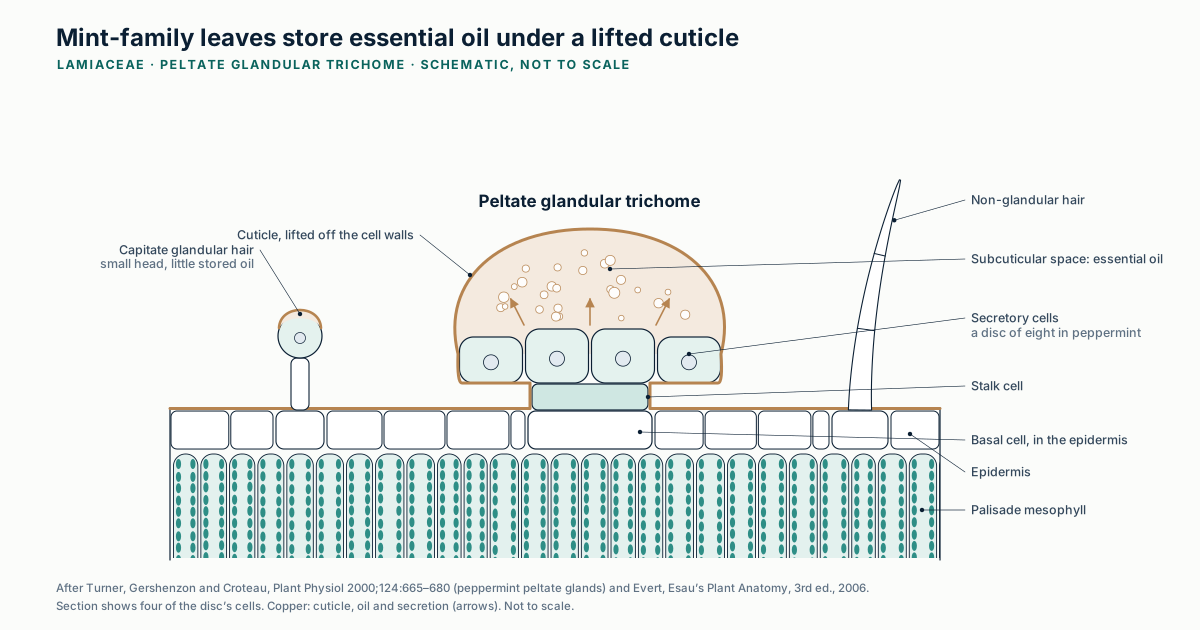
Data table: oregano oil composition by drying method, % of oil
| Constituent | Fresh | Shade, 5 days | Oven 50 °C, 24 h |
|---|---|---|---|
| p-Cymene | 17.7 | 14.1 | 10.2 |
| γ-Terpinene | 5.8 | 2.8 | 1.1 |
| α-Pinene | 2.1 | 1.4 | 0.5 |
| Carvacrol | 67.8 | 73.9 | 76.1 |
Percentages are shares of the oil, not amounts per gram of plant. The same study also tested microwave and osmotic treatments, not shown. For Ocimum gratissimum, Santana et al. found no significant difference in oil content after drying at 30, 40 and 50 °C and a 48% reduction at 60 °C, with damaged glandular trichomes.
Explanation, details and sources
In oregano, shade drying and 50 °C oven drying lowered the share of p-cymene, γ-terpinene and α-pinene and raised carvacrol's. WHO GACP recommends lower temperatures for plants rich in volatile substances, recorded drying conditions, and direct-fire heat kept below 60 °C.
WHO's 2003 GACP guideline places the controls for metals, identity and chemistry before the first laboratory test
Text version of the GACP figure
- Identity (§ 2.1–2.2). Verify and record the scientific name and, where relevant, cultivar, ecotype or chemotype. Seed suppliers should state identity, quality and breeding history.
- Site (§ 2.3.1). The same species can differ in quality between sites. Avoid contamination from soil, air or water polluted by hazardous chemicals, and evaluate past land use, previous crops and plant-protection products.
- Cultivation (§ 2.3.3–2.3.5). Day length, rainfall and temperature influence the plant's chemistry. Irrigation water should meet quality standards. Human excreta must not be used as fertilizer.
- Harvest (§ 2.4). Time the harvest by constituent quality and quantity; avoid soil contact; remove adhering soil from roots as soon as they are harvested.
- Drying (§ 4.1.3). Keep moisture low; use lower temperatures for material with volatile substances; record conditions; keep direct-fire heat below 60 °C.
- Packaging and storage (§ 4.2–4.3). Labels give the scientific name, plant part, origin, date and batch number; fresh material ideally at 2–8 °C.
- Records and audits (§ 4.5–4.6). Document all steps, including extreme weather and exposure to hazardous substances; audits by producers, buyers and authorities.
Explanation, details and sources
The guideline is international guidance, not U.S. law. In the United States, 21 CFR Part 111 binds the supplement manufacturer, which must test each dietary ingredient's identity and set limits on contaminants; GACP records are one source of evidence a manufacturer can use when it qualifies a supplier.
Wild collection adds permits and conservation rules, and American ginseng roots are CITES Appendix II whether wild or cultivated
Text version of the wild-collection questions
- Collected from the wild? Obtain collection permits from authorities and landowners and respect national red lists (WHO GACP § 3.1).
- In a CITES Appendix? Appendix II trade needs an export permit or re-export certificate.
- American ginseng? "Whole plants and roots (whole, sliced, and parts, excluding manufactured parts, products, and derivatives, such as powders, pills, extracts, tonics, teas, and confectionery)" are in Appendix II, "whether wild or artificially propagated"; cultivated ginseng that does not meet the requirements of artificially propagated is considered wild for export (50 CFR 23.68(a)).
- Genetic resources or knowledge from another country? Benefit-sharing agreements should be concluded in writing before collection or cultivation (WHO GACP § 5.1.1). The United States signed the Convention on Biological Diversity in 1993 but is not a Party.
- A threatened species obtained by cultivation? Documentation should certify that no wild-collected material is included (WHO GACP § 5.1.2).
Explanation, details and sources
CITES Appendix II lists species "not necessarily now threatened with extinction" that may become so unless trade is closely controlled; trade needs an export permit or re-export certificate. U.S. rules for American ginseng cover roots, not manufactured derivatives. The botanical atlas gives the listing status of individual species and the global ingredients page the import steps.
Ten terms used in this course
Show the 10 key terms
- Bioconcentration factor (BCF)
- Element concentration in a plant part divided by that in soil.
- Total vs available metal
- All of a soil's metal, versus the share an extraction test removes.
- Cation exchange capacity
- How many positive ions, such as Cd²⁺, soil surfaces can hold.
- Partition coefficient (Kd)
- Metal held on soil solids divided by metal dissolved in soil water.
- Casparian strip
- A sealed band in root endodermis walls that forces ions through membranes.
- Native DER
- Mass of plant material used per mass of extract obtained.
- Permitted daily exposure (PDE)
- The most of an element USP ⟨2232⟩ allows per day from a supplement.
- Chemotype
- A plant population of one species with a distinct chemical profile.
- Anthesis
- The period when a flower is open and functional.
- CITES Appendix II
- Species traded internationally only with an export permit or re-export certificate.
Five questions to test the chain from soil to dose
A soil holds 0.4 mg/kg total cadmium and the plant's BCF is 2. What does a 5:1 extract contain if all the cadmium follows it, and what does 2 g/day deliver?
The plant holds 0.4 × 2 = 0.8 µg/g, the extract 0.8 × 5 = 4.0 µg/g, and 2 g/day delivers 8 µg/day. That is above the USP ⟨2232⟩ cadmium PDE of 5 µg/day, so this soil and dose do not fit together unless less cadmium follows the extract.
Why does raising the pH of an acidic field usually lower cadmium uptake?
At higher pH more cadmium is held on clay, organic matter and oxides or precipitates, so less is dissolved at the root. In the cacao synthesis, raising pH from 5 to 7 was modeled to halve the bean-to-soil ratio.
Turmeric from one district contains hundreds of µg/g of lead. Does lead's low BCF make soil an unlikely cause?
Yes. Lead's BCF is very low (0.017 in the wolfberry survey), so a soil explanation would need tens of thousands of mg/kg of lead in the field. In Bangladesh the cause was lead chromate pigment added to turmeric, which testing and supplier control are there to catch.
A grower harvests peppermint in April to get the most oil. What does the Greek field study suggest?
Peppermint oil content was lowest in April (1.01 mL/100 g) and highest in July (3.22), and linalyl acetate fell from 32.8% to 15.3% of the oil. Both the amount and the profile depend on the month.
Does the CITES listing of American ginseng cover a powdered root extract?
No. 50 CFR 23.68(a) lists whole plants and roots, whole, sliced and parts, and excludes manufactured derivatives such as powders, pills, extracts, tonics and teas. Exporting the roots themselves needs CITES documents.
Next: what a certificate of analysis can and cannot prove
Course 6 covers COA panels, elemental impurities, residual solvents, pesticides and mycotoxins.